Alfred of Beverley

Another contemporary writer is fascinated by Galfridus’ Historia. Alfred of Beverley is a contemporary chronicler in the time the Primary Historia (the copy found at Bec in 1139) existed as a separate book from the Libellus Merlini (the first set of Merlin Prophecies in the public domain). The First Variant version of HRB was employed as partial evidence in obtaining a metropolitan for Winchester for Henry Blois and was tempered toward a Roman ecclesiastical audience, but scholars today still do not accept this fact because they deem the First Variant as a later version than the Vulgate version. Scholars today cannot conceive of the edition being tailored toward an ecclesiastical audience in Rome; simply because to this date, they still deny Henry Blois composed HRB. 

We can conclude that prophecies which predict such a future metropolitan, may well have been added to the original Libellus Merlini set of prophecies to bolster Henry Blois’ case for procuring metropolitan status for Winchester during his visit to Rome c.1144. It seems likely that the prophecies were then added to become integral with the text of HRB in the 1149 attempt for Metropolitan status.  The early prophecies were included into the version known as the First Variant HRB in 1149. The First Variant volume along with other evidences concerning Glastonbury (DA) and Winchester were presented at Rome so that Henry’s desire of procuring metropolitan status for the whole of the south west of England would be granted; because he had lost the legation and his power was reduced at this time.

In Alfred’s work the prophecies of Merlin are omitted. Merlin is presented in a more moderate light than in the HRB. Passages describing Merlin’s magic are  removed or have their details cut down simply because they have not fully been expanded as we witness in the Vulgate.  Merlin’s prophetic interventions are reduced in number.

Scholars today believe Alfred’s reduction of Merlin material that exists in the later Vulgate HRB is motivated by brevity and credulity but it is more likely the Libellus Merlini in 1147 (when Alfred’s version came to York) had not been added to the HRB as yet.  Alfred says that the prophecies are  ‘too long to be included here,’ which to me might indicate they are not in the version Alfred has and exist separately. Either way, at that time just the prophetia witnessed by Abbot Suger would have been available as the Prophecies had not yet been updated.

Wace avoided translating the prophecies for obvious reasons because Henry Blois composed the Roman de Brut and the Merlin prophecies. If he were to translate them, the complete sense might be revealed. Instead Wace holds that he did not understand them and did not wish to translate them in case what he said did not come to pass. As if!!! 

Alfred of Beverley was ‘sacrist of the church of Beverley. He speaks of himself in the preface to his book as contemporary with the removal of the Flemings from the north of England to Rhos in Dyfed around 1110-2.  Alfred also says that he compiled his chronicle ‘when the church was silent, owing to the number of persons excommunicated under the decree of the council of London.’  He says that his interest in history in general was first sparked off by reading Galfridus’ ‘Historia Britonum’.

Scholars seem to think Alfred recycled ‘Geoffrey’s’ work from a Vulgate version of HRB not what I have termed an abridged redaction which has not evolved from a First Variant’.329  Alfred’s version of the HRB text found its way north through one of Henry Blois’ nephews. Scholars today imply that Alfred relates to episodes exclusively found in the Vulgate version only. If this is a fact, I suggest to them to think again because Alfred’s edition is an evolving edition dating to 1147 before the final Vulgate edition had been published. Alfred’s edition did not evolve from the First Variant which undoubtedly existed before it but was edited to suit a specific audience at Rome.  The Vulgate edition was evolving from the Primary Historia through First Variant versions and in a version without those specific additions and subtractions between 1147-51, when Alfred relates to Geoffrey’s work. This evolved Primary Historia edition of HRB did not pander exclusively to a Roman audience in its composition like the composition of the First Variant version of HRB i.e. Alfred’s copy is a hybrid version.

Alfred admits: ‘neither the Roman nor the English historians record anything about the illustrious Arthur, although he did such remarkable deeds with such skill and valour, not only in Britain against the pagans, but also in Gaul against the Romans’.  Alfred too, questions if the Ambrosius Aurelius in Bede330 was the same as ‘Geoffrey’s’ Ambrosius. The reader will soon see that King Arthur’s fight against the Romans at Autun and Langres is of course described topographically and geographically so well in both the Roman de Brut and HRB because the scene is set in the county of Blois familiar to Henry Blois and not far from Clugny.                

Alfred of Beverley wrote his chronicle entitled Annales sive Historia de gestis regum Britanniae, which begins with Brutus. His title informs us ad annum 1129 and so incorporates the history of England up to 1129.

329Crick recognises that unlike the First Variant, the second Variant is closely related to the Vulgate text. What Crick refers to as the second Variant is an edition of the stemma evolving toward the Vulgate without the inclusions and exclusions designed specifically for the Roman audience. Until it is firmly understood that Primary Historia evolved the Second Variant  and then to the final Vulgate edition, the evolving nature is not recognised. Any theory about the evolving nature of HRB is denied by scholars on the basis that the dedications are real and therefore dictate a chronology.

330Historia Ecclesiastica, i 16

A second book or follow-on history by Alfred takes us up to the death of Henry Ist.  Some commentators think Alfred put pen to paper c.1143 based on Hardy’s analysis of Alfred’s work. Our interest in Alfred of Beverley’s work is really only to establish that it was not written in 1143 as many commentators have thought, but the edition Alfred worked with was published at the earliest after the end of 1147 and was used as a template by Alfred probably in 1150-51 as Offler and Raine have concluded.                    

Many previous commentators have concluded the earlier date because Alfred relates that he wrote in an era of enforced idleness and thus refers to the Legatine council held in 1143. The splicing of the early prophetia into the version known as First Variant was not composed before 1144.

However, the First Variant has variant editions of itself such as Hammer’s edition which is mixed with excerpts that are assumed to be from the Vulgate edition not allowing my chronology. Whether these texts in their variant forms are through the copying of different editions or ‘overwriting’ is to be determined. However, the evolving nature of the First Variant and the stemma resulting in the HRB should become clearer over time once scholars rid themselves of the false premises that have dogged any light being shone upon the Matter of Britain and who was responsible for the dissemination of its material. The idea that some scholars have determined that the First Variant follows the Vulgate because some copies of FV have updated prophecies does not hold as an absolute because of overwriting. The fact that some scholars have recognised some prophecies to have been updated or changed is progress enough in terms of the glacial advancements made by recent scholastic endeavours.

The importance of the splice into the First Variant is that the prophecies of Merlin were not in the Primary Historia as Huntingdon unintentionally reveals; yet they had been spliced into a First Variant in the Libellus Merlini form and subsequently into a Hybrid edition  before the fully evolved finalised Vulgate version of HRB was ‘now made public’. Certainly, the high church tone of the First Variant was not composed by the author for abbreviation in some cases or for expansion in others by comparison to the Vulgate edition, but by reason of its contents being read by a potential audience in Rome. The propensity for biblical phraseology and FV’s high tone with Classical borrowings is also indicative that the author of First Variant is versed in both Classical literature and is an authority in the church.

In Alfred of Beverley’s recycling of HRB he does not mention dedicatees, which, since much of his history is recycled from ‘Geoffrey’s’ work, one might think it an oversight not to have mentioned any of the illustrious patrons or dedicatees of ‘Geoffrey’s’ work. However, since we know the dedicatees in the finalised Vulgate HRB are not employed until after their deaths; Walter is not mentioned either by Alfred. We can therefore conclude Alfred is not using a finalised Vulgate HRB version. Although Alfred omits the prophecies of Merlin in recycling ‘Geoffrey’s’ work he does not mention Bishop Alexander either, but this is obviously because the copy he has must have been composed before Alexander’s death in 1148.

The Galfridus Artur edition of HRB arrived at Beverley through William Fitz Herbert or Hugh de Puiset, both Henry’s nephews. We may conclude Beverley would have obtained the version from either of these relations of Henry. We know that when the archbishop of York was deposed in favour of the Cistercian Murdac in 1147, William Fitz Herbert was staying with Henry at Winchester for some considerable time in-between 1147-53. Emma, the mother of William Fitz Herbert, half-sister of King Stephen and Henry Blois, was an illegitimate daughter of Stephen II of Blois Henry Blois’ father.

Hugh de puisset was the son of Henry Blois’ sister Agnes. Hugh held the office of treasurer of York for a number of years; during that period Hugh de Puiset had fled to Beverley in a confrontation with Murdac. It would not be logical to think the provenance of the Galfridus edition at Beverley found its way there by any other route than through Henry’s nephews since so few copies of HRB were in circulation at that time. Henry Blois had assisted Hugh’s ecclesiastical career which led him into conflict with the Cistercian Murdac.

This opinion of course runs contrary to modern scholar’s views regarding the distribution of HRB which is based upon the presumption that the Vulgate HRB was widely distributed at this time because modern scholars, un-discerningly, ‘lay aside’ the discrepancies in story-line related in EAW and its reduced Arthuriana section.

Scholars similarly account Alfred’s reasons for recycling what seems to be an un-expanded Arthuriad as a scepticism about King Arthur, rather than understanding that Henry had not fully developed his Arthuriad. Today’s modern scholars make ridiculous rationalisations for Huntingdon, the composer of EAW, having not mentioned Merlin or his prophecies in his synopsis of the Primary Historia. Modern scholar’s opinions are based on the presumption that the Bec edition of HRB and all subsequent copies were synonymous with the Vulgate excepting the First Variant and variants; but also, mistakenly assume the First Variant edition did not precede the Vulgate version.331

331One sure way of determining this (providing one can accept le roman de Brut having been authored by Henry Blois) is that Wace’s version would hardly commence following the First Variant version as a template for versifying the HRB and then Henry would finish the composition of the Brut by mirroring the Vulgate edition; especially if Vulgate had appeared first. This deduction will remain as unacceptable because the current concesus of modern scholar’s is that Wace’s Roman de Brut and Geoffrey’s HRB were composed by two different authors.

The First Variant version is the copy of HRB designed to aid Henry Blois in obtaining Metropolitan status. Speeches are more pious and a theme of divine retribution pervades the text, avoiding any stance which might annoy a Roman or Papal audience or be found to be blatantly incorrect regarding historicity found in continental or Roman annals excepting a few diversions from what is know at the time. Biblical allusions abound in speeches and narrative in the Variant version making the text more pleasing to a papal audience. Another feature of the Variant Version is the tendency to tone down or to omit altogether certain unpleasant or graphic details. The conversation between Bedwer, Arthur’s butler and the nurse of Helen, Hoel’s niece, at the latter’s grave mound on Mont St. Michel etc.

Once Henry Blois has finished with his metropolitan ‘agenda’, we can witness more anti-Roman sentiment in the Vulgate edition with additional Briton pride witnessed in rousing speeches, especially understood in the fact that the final updated prophecies in HRB appealing for sedition amongst the Celts in Briton.

Alfred has an abridged or evolved Variant in which Alfred refers to Stonehenge twice. The first is recycled from Huntingdon’s Historia Anglorum, where Henry provides an architectural description of the stones and provides the earliest use of the term ‘Stonehenge’. ‘Geoffrey’ knew the HA well and borrowed the name from HA recycling Huntingdon’s name ‘Stonehenge’. What is interesting though and concurs with EAW’s synopsis of Primary Historia account is the evolving nature of HRB.  In Alfred’s second reference to Stonehenge recycled from the evolving HRB we see the description of the burial of Constantine, next to Uther Pendragon, in the stone circle but Alfred omits entirely Geoffrey’s account of the transportation by Merlin of the giants’ ring from Ireland and their erection. This account is expanded for the Vulgate version.

Alfred mentions Merlin on numerous occasions, but he presents a substantially moderated, scaled back version compared with Vulgate HRB. His omission of the transportation of the giants’ ring is an example of this similarity to the un-evolved Primary Historia. Given that Alexander died in 1148 and we understand that Alfred’s HRB edition may have arrived in York c.1146-47 and we can see that Alexander is used as the splice in Vulgate for the Prophetia, it is possible to conclude Alfred’s references to Merlin were from HRB narrative and not because of the prophecies themselves being included in the text but this point is unfathomable.

The Libellus Merlini witnessed by Suger and the Primary Historia were two separate works put out by Henry Blois. The splicing of the two books using Alexander as the impetus to translate the prophecies could only have occurred after Alexander’s death.

Alfred of Beverley repeats what Britannicus (Geoffrey) says about Merlin, i.e. the account of the young Merlin delivering the story about the two dragons fighting. It is possible that Alfred only mentioned the prophecies because they were known to be authored by Merlin and the Libellus Merlini account which circulated in Alfred’s day, he had read, but was not going to divert from recycling Galfridus’ historia. Or, since we know the that the edition found at Beverley came directly by route of one of Henry’s Nephews and the author of both the Libellus Merlini and the HRB, they could have been together at Beverley but still un-spliced.

The First Variant is devoid of personal detail found in prefatory accounts regarding ‘Geoffrey’ simply because a Welsh Galfridus Arthurus was the author and at this stage c.1144-47,  no-one in particular was too concerned. The early PM Libellus was distributed quietly and acted as an aid and complement to HRB’s historicity but Alfred describes the prophecies as relating ‘to the future of the kingdom’, so he has definitely seen the set Abbot Suger had seen. 

However, fortuitously, once the prophecies became spliced onto the HRB; the prophecies, initially designed to corroborate the historicity of HRB were now found in the same volume. Hoel’s speech like many others had not yet been developed where he compliments Henry Blois’ alter ego (King Arthur) on his ‘Tullian dew of eloquence’.332 

Most modern scholars assume that EAW’s relatively modest treatment of Arthur and its omission of Merlin entirely influence Alfred in his History, not realising that the Primary Historia evolved into First Variant and Alfred’s copy had evolved from Primary Historia. If this is not understood, researchers still think that Alfred is openly sceptical of the ‘Arthurania’ by its reduction in his History and that Alfred moderates his portrayal of Merlin by comparison with the expanded Vulgate. The simple fact is that Vulgate had not been developed fully or published until 1155. Before this a compressed less detailed evolving Variant or Second Variant existed.

Another example of the un-expanded evolving version of Merlin is Alfred seemingly reducing Geoffrey’s entire detailed story in the Vulgate of Merlin’s powers of illusion; allowing Uther Pendragon to take on the appearance of Duke Gorlois of Cornwall and sleep with his wife Yegerna when Arthur is conceived; reduced to the briefest mention. The early edition  is un-expanded and is evolving toward Vulgate, not as scholars have deduced i.e. reduced from Vulgate. 

 Concerning the story of Leir and his daughters, Alfred provides a highly condensed abbreviation of this story in his account. His treatment is far more concise than that of Huntingdon’s précis.

Alfred’s recycling of comparative Arthuriana found in Vulgate is obviously reduced because it is not yet developed. Wright’s333 category H constitutes a huge expansion on the Variant of about 50 additional chapters of narrative and speech. This is positive development in Vulgate and cannot be accounted as reductive in a proposed late Variant.

‘Geoffrey’ in these chapters spices up Vulgate with harangues and Battle scenes and generally throws caution to the wind where historicity is concerned while having held much closer in the Variant version to accounts known in continental, British, and Roman annals. Henry Blois actually shoots himself in the foot by adhering in the Variant to Bede too closely by repeating that the British population first migrated from Armorica which contradicts his Trojan foundation; but he then corrects this discrepancy later as Wace intoning that Amorica was the last location of continental adventures before arriving at Totnes.

332Henry Blois on the Mosan plates compares his stature in terms of legacy as an author to that of Cicero.

333Neil Wright. The First Variant Version; a critical edition. D.S. Brewer

Again, this proposition of a late Variant would never be considered if the differences in EAW had been taken into account and early researchers had not subconsciously assumed that a Vulgate version was that which was found by Torigni and passed to Huntingdon in 1139.

Alfred in his preface says that others around him had already read Geoffrey’s Historia and their mouths were full of his narrations. Alfred was by his own admission accounted an ignoramus (notam rusticitatis incurrebat) for being a stranger to Geoffrey’s work c.1149-50 by the other monks.  We can gauge that the book arrived c.1147 through either of the author’s nephews and Alfred recycled c.1150-51.

Alfred witnessed charters in favour of the town of Beverley, the nearby religious houses at Bridlington, Warter, and Watton, and Rufford, between 1135 and 1154, but probably died about 1157, when a certain Robert attests as sacrist of Beverley.

The point is that, when Alfred says:‘when the church was silent, owing to the number of persons excommunicated under the decree of the council of London’….  he is not referring to the time of the council in London but what was agreed ‘at’ the council regarding ex-communication. The time that Alfred says he was composing his book must be after 1147 and within the time-frame up until Henry Murdac died in 1153. The reason for concluding this time span for Alfred’s publication is again linked to affairs concerning Henry Blois and his brother Stephen.

The poor state of the church at Beverley, which Alfred refers to, was a direct result of events which took place at York. William Fitz Herbert, as we covered earlier, was the son of Henry Blois’ sister and was Archbishop of York (twice); before and after the appointment of Henry Murdac. William of Newburgh records that William Fitz Herbert is ‘received with honour’ (put up) by Henry Blois at Winchester until re-established at York after Murdac’s death.334 King Stephen and Henry Blois helped secure Fitz Herbert’s election to York after a number of candidates had failed to secure papal confirmation.

Fitz Herbert faced opposition from the Cistercians who, after the election of the Cistercian Pope Eugene III, managed to have the archbishop deposed. Henry Murdac was a personal friend of the pope himself who was at Tiers at the time and thus consecrated Murdac as the new archbishop of York, on 7 December 1147…. effectively replacing Fitz Herbert.

However, York’s cathedral chapter and King Stephen refused to acknowledge Murdac’s appointment and Stephen imposed a fine on the town of Beverley for harbouring Murdac. In retaliation, Murdac excommunicated Hugh de Puiset (who later became Bishop of Durham), another (appointed) Nephew of Henry and Stephen who was at the time Treasurer of York when Murdac laid the city under interdict. Hugh de Puiset, in return, excommunicated the Archbishop Murdac and ordered church services to be conducted as usual.  In this he was supported by Eustace, son of King Stephen.

John of Hexam relates that Hugh de Puiset fled to Beverley where even when Prince Eustace requested Hugh’s return to his see, he refused…. and probably also went to his uncle at Winchester.  This era of church politics, (testing Rome’s power to appoint bishops), is the era in which Alfred refers to ‘when the church was silent’ i.e. when normal services were interrupted because numerous clergy were excommunicated.

From this we may surmise that Alfred had an evolved Variant (because there are still no dedicatees) branching off from certain differences noted in First Variant but not following its purposefully ecclesiastical design i.e. a seperate branch evolving toward Vulgate.

We will return to Alfred’s work when we compare it to the First Variant in a later Chapter. We can assume that there was not the amount of copies of HRB floating about the monastic system at that time…. which scholars seem to assume, based upon their dating assumptions derived by the dedicatees’ lifespans. The copy at Beverly was rare and it arrived there through a Nephew of Henry Blois.

334William of Newburgh, Cap XVIII.1

Aelred, Abbot of Rievaulx in North Yorkshire, author of Speculum charitatis (The Mirror of Charity), reportedly written at the request of Bernard of Clairvaux, Henry Blois’ nemesis,335 contains a dialogue between the author and his novice. The novice confesses in this exchange to being less moved to tears by pious readings than by fictitious tales of ‘somebody named Arcturus’. Later Aelred brands these tales as fabulae et mendacia, but the novice nor Aelred mention Merlin.

One would think that these could only be ‘Geoffrey’s’ fabulous tales and not something anecdotal which can be accountable as having been found in manuscripts of ‘saints lives’ or Nennius or Lambert of St Omer336 concerning Arthur. The reason I mention this is because Powicke’s study of Aelred reveals he composed Speculum charitatis in 1141-2 while novice master at Rievaulx and we should not forget Henry’s nephew William was installed in York in January 1141 (although not consecrated until September 1143).

What this shows is that in the middle of the Anarchy, an abbot in Yorkshire only three years (or so) after the Bec copy was found, may have been reading Geoffrey’s Primary Historia (ex-prophetia). In terms of propagation we must look to Henry Blois who has passed a copy to his Nephew, as the Primary Historia was not in wide circulation at this early date.

335The contention between Bernard and Henry Blois started over the Oxford Charter of Liberties in 1136 where Henry Blois managed to reassert the sovereignty of the Celtic church in England. Bernard’s reforms were nullified for a time. The Oxford charter retained power for monastic Abbots over Bishops; thus, limiting Vatican appointed Bishops to presiding exclusively over Vatican business in England. The charter effectively guaranteed autonomy for the Abbots. The Cluniac’s were not anti-papal but recognised that the papacy was starting to interfere with their institutions and Henry Blois, his mother and brother, all held Cluniac values. Ultimately, the Beaumont twins, siding with Clairvaux’s aims persuaded King Stephen to abandon Henry’s advice against the Papacy.  Henry was essentially displaced in 1138 as archbishop of Canterbury on the advice that the Beaumont’s said he was becoming too powerful. To all intents and purposes, it was a papal plot to undermine Henry Blois so Roman power would not be reduced and Bishops would retain their power. This of course led to the mistrust between the Bishop of Salisbury which we covered earlier. 

336Lambert in his Liber Floridus recycles from Nennius: There is a pile of stones in Britain in the province of Buelth where one stone at the top has footprints of a dog called Cabal, belonging to Arthur the warrior imprinted on the stone, from where he was hunting Trointh the boar in Carmy Cabal. Under that stone Arthur made the pile of stones. It is understood that when men of that domain remove a stone from the pile and secrete it for two days, on the third day it is found back on top of the pile. There is a sepulchre in Britain in the domain of Ercing near the spring of Lycatanir which pertains to Arthur’s son the warrior called Anyr, where Arthur buried him. Men try to measure the tomb, sometimes it measures 5 feet long, sometimes 8, sometimes 9, sometimes 15, but never the same measurement at any time. Arthur the warrior has a castle in the land of the Picts in Britain, built with amazing artistry in which are engraved all his escapades in battle. One can see the 12 battles against the Saxons who once occupied Britain. The first battle was at the mouth of the river called Gleuy. The second, third, fourth and fifth were on the river Dubglas. The seventh in the forest of Celidon and the eighth in the Castle Guinon, where Arthur carried an image of St. Mary on his shoulders in battle where the pagans fled. On that day there was a massacre of the pagans through the virtue of the Lord Jesus Christ and his saintly Virgin Mother. The ninth battle was in the City of the Legion. The tenth was at the edge of the river Tribuith. The eleventh was on mount Agned. The twelfth was on mount Badon, where 960 men fell in a single attack by Arthur with by the virtue of the Lord Jesus Christ.

In other words; what Aelred’s novice has read cannot be a First Variant version which we know was only compiled after William of Malmesbury had died in 1143 and for the express purpose to bolster evidence toward the case Henry Blois put forward in Rome in 1144 to obtain metropolitan status for southern England. 

Tatlock is drawing the wrong conclusion in assuming the finalised Vulgate HRB was in full circulation when he understands that it was Walter Espec who had passed this copy on to Aelred. Tatlock’s theory is largely based upon the supposed evidences provided by Gaimar’s epilogue and the fact that Rievaulx was near to Walter’s estate of Helmesley and also the fact that Aelred gives a good description of Walter at the Battle of Standard.

The fact that Walter Espec was buried at Rievlaux aids Tatlock’s deduction. Tatlock reckons that Aelred’s is the first reference to HRB before 1147 (apart from Huntingdon) and the ‘earliest proof of divulgation of the Historia in England,’ (which obviously is assumed as the date when Alfred obtained his copy). But Tatlock’s date is based upon Walter Espec having received a copy of Geoffrey’s HRB from Robert of Gloucester who died in 1147.

  The name of Robert of Gloucester as dedicatee was not employed until after his death and it is highly unlikely, Robert ever saw any version of HRB as Henry Blois was essentially at war with him until his death.  So, Tatlock’s proposition should be ignored. There is nothing in the novice’s tears to indicate they could not come from the same version recounted in EAW i.e. the Primary Historia. Certainly, the story of King Lear, Helena’s rape by a giant, even the nostalgia of a once chivalric Briton would be enough to bring the soft-hearted novice to tears.

Tatlock has been duped by the misinformation inserted in Gaimar’s epilogue in L’estoire des Engles.  Gaimar’s epilogue is vital in misleading posterity into believing Henry’s assertions that the ‘good book’ provided by Archdeacon Walter really existed, as posited in the Vulgate HRB.

The four written sources Gaimar refers to are Walter Espec’s book, the ‘Good book of Oxford’, the Winchester history, and an English book from Washingborough; all mentioned for a specific reason polemically.

It is one of my suppositions that Walter Espec’s name is included in the epilogue because in 1132 when Henry Blois had met Walter Espec, he had handed him a copy of his pseudo-history ( The very first draft destined originally for his uncle and Matilda) and he subsequently was trying to confuse us and contemporaneity by inventing Gaimar’s epilogue…. and the provenance of Walter’s book (by the invention of L’estoire des Bretons which no-one has ever seen). I can see no other reason for the inclusion of the name Walter Espec except to confuse by muddling all the versions if indeed Walter Espec had ever had a version.

Henry Blois had met Walter Espec when he signed a charter with King Henry Ist granting permission to build Rievaulx abbey.337 We will return to Gaimar in a later chapter but more importantly, to Alfred of Beverley’s use of an evolved First Variant version because contrary to scholarships belief, First Variant most emphatically preceded Vulgate and Alfred mentions no dedicatees or Walter. If Henry Blois had come up with the invention to introduce Archdeacon Walter to provide a provenance for Geoffrey’s source book at the time Alfred was recycling ‘Geoffrey’s’ HRB…. Alfred would surely have included this information. The need for this only really came after seditious priophecies were added to the Vulgate version and in case he was found out Henry could deny authorship.

337With the mention of Walter Espec in Gaimar’s epilogue it is likely that he had a copy of the original Psuedo-History which was later to become the material for the Primary Historia.

Apart from Huntingdon’s EAW there is only Abbot Suger’s recycling of the Libellus Merlini and Alfred of Beverley’s work from which we can deduce ‘Geoffrey’s evolution’ of HRB before 1155 (with Aielred’s anecdote).  If, as scholars propose the First Variant followed the Vulgate HRB I can think of no good reason why Geoffrey would have crafted the ecclesiastical edition except for presentation to papal authorities in an attempt at gaining MetropolItan status for Winchester

Orderic’s interpolation we can dismiss because this contains the ‘Sixth in Ireland prophecy’ and is a late interpolation. Suger does not mention the ‘Sixth in Ireland’, so has an early edition of the prophecies. There would appear no reason to think that Alfred knew the prophecies from any other source than from the Libellus Merlini  but where Merlin had been introduced into the body of the text of an evolving HRB which had expanded Merlin’s importance since the Primary Historia.

The omission of the prophecies (and Alfred’s mention of them) occurs at the point in the text where they appear in the First Variant and Vulgate so this is an evidence for their introduction into the text but no mention of Alexander so how was the splice made?

Alfred clearly knew of the prophecies, before stating that they were too long to go into. These prophecies were in some cases squewed in the later updated Vulgate edition, but seemingly (appeared to all) to have remained consistent with the Libellus edition. Maybe we can speculate that in the interim period since the advent of Primary Historia the First Variant had a set of the Libellus Merlini prophecies added which have since been substituted to the updated version from Vulgate.

It is my deduction this was carried out in the 1149 version of the evolved First Variant where the Merlin prophecies were added to the text after Alexander had died so Alfred’s text would not be the latest edition, since his arrived in the north c1147 and was a branch evolving toward the final Vulgate version.

So, the thorny question arises, if scholars can accept that the First Variant preceded the Vulgate and it was indeed employed as evidence for Henry’s request for Metropolitan status in 1144; the question is, when were the prophecies attached to the first Variant? The answer in my mind would be that the initial attempt at Metropolitan by Henry Blois at Rome in 1144 did not have the prophecies included in the text. But in the 1149 attempt when the First Variant was presented again in evidential support of his claim, the Libellus Merlini may have been spliced  Obviously, the second attempt to gain Metropolitan status for Winchester in 1149 (after Alexander was dead 1148) would have been the catalyst for inserting the Merlin prophecies in the First Variant.

But firstly, scholars have to accept HRB was written by Henry Blois, secondly the Vulgate follows the First Variant edition chronologically and thirdly the prophecies of Merlin were written by Henry Blois.

This small mountain to climb as a conversion to a new view is virtually impossible to gain traction and that is even before we get to the broader aspects of the Matter of Britain. But this ties back into my view that Alfred of Beverley did not have a Vulgate version from which he recycled ‘Geoffrey’s’ work but had what I have termed an ‘evolved variant’ because Alfred’s edition is dated to c.1147 and therefore there is no dedication to Alexander. But what we do know is that Variant editions do have the dedication to Alexander and the near contextual content of First Variant and so are specifically designed to be acceptable to a papal audience. This I believe is the 1149 edition.

As far as I can figure out from when Huntingdon wrote his letter to Warin c.1140 until Alfred’s report c.1150-51…. there is still the omission of the account of the transportation of the giant’s ring. We will never know what the prophecies contained as Alfred said they were too long to include in his comment of Britannicus’ work. Alfred refers to Geoffrey as the Briton never as hailing from Monmouthshire and is skeptical of the Briton’s accuracy saying: ‘It is worth the effort to correlate what Bede has taken from Orosius and included in his History with this account so that the basic truth of these things which are read about Caesar, according to the Briton, can be agreed

Alfred recycling ‘Geoffrey’s’ HRB wondered why King Arthur and his war against the Romans at Autun was unrecorded by the Roman annals and the Frankish chroniclers saying about his recycling of Geoffrey’s history: without daring to detract from its historical accuracy, I have done my best to briefly extract from the British history all those things which seem true whilst leaving out those things which might appear to certain people unbelievable.

‘Geoffrey’ refers to Avalon twice in the Vulgate HRB. The first is to describe Arthur’s sword. Alfred, in his reworking of the passage concerning Caliburnus, where it is forged in the island of Avalon in Vulgate HRB of 1155 omits mention of the island. This is an important point and a reflection of Henry having evolved the importance of Avalon in HRB to become commensurate with Insula Pomorum in 1155 in VM.

Henry Blois composing the the First Variant had not fully developed his coalescing of material around establishing Avalon at Glastonbury.  When Alfred describes the passage found in HRB where the mortally wounded Arthur is being taken to the island of Avalon to have his wounds tended, Alfred recycles this passage and here mentions Avalon, but significantly, omits the ambiguous word letaliter ‘mortally wounded’ which indicates that, like Huntingdon’s account in EAW, it is left open to accommodate the ‘hope of the Britons’ at this stage. It could just however be a case of Alfred reducing the recycling of the story but I would suggest that Arthur only becomes certainly dead when Henry Blois has manufactured a grave site for him within the Glastonbury graveyard. The word letaliter may indicate that Henry Blois has not yet decided to plant the body of Arthur at Glastonbury, but it definitely shows he has come up with the ’Mythical Island’…. but his muses have not fully developed the potential of Avalon. Alfred instead has Arthur only as ‘vulneratus est.’ and the word ‘letaliter’ found in Vulgate is a future development. Arthur is only wounded in battle and then abdicates

Afterall, it was this very Zeitgeist of ‘hope’ for the conquered Britons that fused with Henry’s muses to aggrandise an oft spoken but insignificant Briton warlord from the Saxon era into a fully fledged ‘Chivalric’ hero who had all the same morals and thought patterns of the Norman readership. 

Alfred also refers to Stonehenge twice in his history. The first is recycled from Henry of Huntingdon’s Historia Anglorum – where Huntingdon338 provides an architectural description of the stones and provides the earliest use of the term ‘Stonehenge’ that survives. It must have seemed strange to Huntingdon discovering the Primary Historia at Bec because Henry Blois posing as Galfridus used the HA as a source for Primary Historia and almost certainly borrowed the name from that source.

‘Geoffrey’s’ Vulgate story of Merlin’s transportation of the stones from Ireland recycles Huntingdon’s name for the circle as ‘Stonehenge’.  The evidence showing that the character and actions of Merlin is developed over time is that Alfred’s second reference to Stonehenge is recycled from the evolving First Variant which had developed the story.  He uses the description of the burial of Constantine, successor of King Arthur, ‘next to’ Uther Pendragon. Since Alfred is not using (a finalised) Vulgate, he is not aware of Geoffrey’s further developed account of the transportation by Merlin of the giants’ ring from Ireland.

338Antonia Grandsen an understated scholar says: the way Geoffrey treats his known sources corroborates the view that he was capable of intellectual dishonesty. And again, a great observation: Geoffrey was a romance writer masquerading as a historian.

Alfred mentions Merlin on numerous occasions in book five of his History, but he presents a substantially understated and underdeveloped version compared to Vulgate HRB; quite obviously because he has a copy of a developing Variant. We must assume that the prophecies that Alfred saw (whether spliced or not) were from the Libellus Merlini and not the updated set now attached to the extant First Variant copies.

Alfred’s references to the name ‘Geoffrey’ are nil. He never uses the options of naming Geoffrey as Gaufridus Artur, or Gaufridus Monemutensis; although the latter would be impossible because Henry Blois had not come up with the Monmouth appellation until after he had signed the Charters at Oxford and thought he too would be from Monmouth like Ralf who also genuinely had signed his name on some of them. 

Alfred always uses the term ‘Britannicus’. Some commentators may take Alfred’s Brittannicus reference to mean Celt or even Welshman assuming Alfred’s reference is based upon the author having situated Arthur in Wales. Alfred’s dismissal of the author’s personal name may indicate a scepticism by Alfred of Geoffrey’s existence in reality. Alfred does in fact come across as sceptical of ’Geoffrey’s’ work, but still very interested in its contents. Alfred, assuming that the Author has the same name as the protagonist, probably thinks the author is going a bit too far and does not want to proliferate further an assumed name.

Alfred makes the point that he is sifting the fact from the dross of Geoffrey’s account and if at this stage there had existed the assertion that the book had been translated, Alfred would hardly not mention that the book had never been heard of let alone presume to start correcting ancient Brittanic recorded history.Alfred knew Geoffrey’s history was inaccurate with such ridiculous inclusions such as Gormund invading. 

One poignant fact never really discussed about Alfred’s work is why would he go to all the effort of abridging Brittanicus’ work if so many editions of that work existed in 1147-50. I can see it might be argued he is just trying to sift fact from fiction against Gildas Bede where they differ from HRB and other histories but all those at Beverley were reading the same edition delivered by Henry’s nephew. There were just not the swathe of manuscripts circulating all the monasteries and courts that is believed by modern scholars as Tatlock points out.

 Alfred’s work refers to the HRB as the Historia Brittonum and its author is always named as Britannicus.  Scholars need to realise that the Historia Brittonum was the title of the Primary Historia discovered at Bec.  Subsequent versions were sometimes titled De gestis Britonum  until such time Glafridus Artur became Geoffrey of Monmouth and the HRB was titled  Historia Regum Britanniae in the final Vulgate version or De gestis Britonum.

Collation of the Alfred’s work with the textual differences between the Vulgate and FV versions of the HRB, compiled by Wright does not as is thought by scholars prove evidentially that Alfred’s work is derived from the Vulgate text. Alfred’s manuscript is a branch which is evolving toward the final Vulgate text but incorporates some recent developments in FV but does not incorporate the ecclesiastical bent of the FV but is nearly as modern. Scholars that believe FV was composed after Vulgate have not understood because they don’t know who the author of HRB is or why FV has the ecclesiastical template.

In 1147-8, when William Fitz Herbert had been suspended and the monks at Beverley had ‘all’ read the Historia before Alfred, Henry Blois had not come up with the name Geoffrey of Monmouth.339 Britannicus as an appellation by Alfred at this stage may not be based upon pudibundus Brito…. a reference to Geoffrey himself as ‘an unabashed Briton’ in a Variant version. This was probably only introduced in a revision of the prologue to the prophetia in the Vulgate version. However, pudibundus Brito seems to only be in manuscripts of the historia in Britain, which shows Henry Blois is under pressure and indicating to those hunting Geoffrey that they are looking for a Brit not a Norman.

Logically, (as long as we accept the back dating of Vulgate occurred) the prologue to the prophecies could not have been written until after Alexander died in 1148. The pudibundus Brito reference logically disqualifies Henry Blois as author (as a purposeful misdirection) especially if that edition of HRB derives from  either of his Nephews. That specific Beverley edition was directly traceable back to him. By 1155 when Vulgate was published ‘Geoffrey is dead’. Anyone trying to trace Geoffrey would not be looking for someone of Norman heritage….. as intended!! This is plain from the new updated prophecies where the Neustrians are going to be defeated.

339The name, Geoffrey of Monmouth, Henry Blois only introduces after 1153, when he has signed the charters as Galfridus Arthur at Oxford and seen and imitated Ralph’s provenance. No twelfth-century chronicler more frequently refers in a historical text to ‘Geoffrey’ than Alfred does, but he does so by referring to him as Britannicus. Alfred does not refer to Geoffrey by name, only by ethnicity. If Alfred dismissed the Gaufridus Arthur appellation as an improbable pseudonym…. then why would he not once mention Geoffrey of Monmouth…. if his name existed with the text? The simple answer is…. the name of Geoffrey did not exist in 1151 at the completion of Alfred’s work. Obviously, Huntingdon in  EAW calls him Galfridus Arturus but Robert of Torigni refers to him in his chronicle under the year 1152 as ‘Gaufridus Artur, qui transtulerat historiam de regibus Britonum de Britannico in Latinum fit episcopus Sancti Asaph in Norgualis’. Yet as discussed Robert did not compose consecutively so the ‘Translation’ reference is feasible for my chronology of when the ex brittanicus book appeared as a feature in the Vulgate version c.1155.

As an indication that the history was talked about (at least at Beverley) Alfred remarks: anyone not acquainted with the History of the Kings of Britain puts himself down as uncultivated. 

Huntingdon’s omission in EAW of the three archflamens when mentioning Eleutherius’ missionaries only gets introduced into the storyline of First Variant when Henry Blois was in pursuit of metropolitan in 1144 just after Malmesbury’s death.

This however, leads to another deduction in that, Alfred had a copy of an ‘evolving Variant’ because Alfred notes by name Faganus and Dunianus sent by Pope Eleutherius where they were distinctly not mentioned in EAW.  The preachers were not mentioned either by Malmesbury in any of his works, except those interpolated by Henry. The whole fabrication of Faganus and Dunianus sent by Pope Eleutherius was introduced into the Fist Variant as part of the evidential support of an apostolic foundation for Glastonbury when Henry was pursuing his claim for Metropolitan for the whole of Southern England.

These two very important figures Faganus and Dunianus were not included in Primary Historia.

As I shall cover later in the chapter on DA, the St Patrick charter was included in DA for the 1149 request for metropolitan status where the HRB edition was also presented as evidential supporting evidence and had the contents of First Variant i.e. the scriptural toned down contents; but most probably the 1149 version of FV also had the new improved dedication to Alexander that allows the insert of the Merlin prophecies to become part of the text.

Therefore, Alfred and the monks at Beverley c.1148 had the most recent recension of Henry Blois’s evolving HRB in the’ branch’ toward the finalised Vulgate which most likely Henry had originally passed to his Nephew before going north.  This is the time when Henry was steadily evolving the Variant of HRB toward the final Vulgate in 1155-7 which incorporated the Colophon concerning the three historians and the updated prophecies and the ex-Brittanica ruse . 
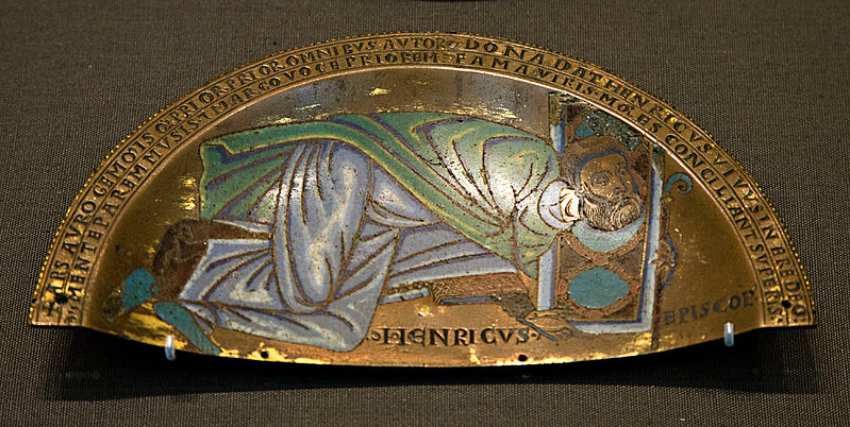
Henry Blois and the Meusan Plates or Mosan Plaques

There are two enamel plaques in the British Museum which were made in the Meuse valley in modern day Belgium, with a very high degree of skill, from copper alloy and enamel. These are semi-circular dished plaques usually referred to as the Mosan plaques.   On one of these plaques, Henry of Blois is depicted prostrating himself, offering what looks to be a very large book and underneath described by a Latin inscription as HENRICVS EPISCOP (‘Henry the bishop’).

On the other, there are two angels depicted protruding from the clouds, both swinging fragrance censors indicating the benevolence from heaven upon mankind. One of the angels is holding a golden chalice. Both have further inscriptions in Latin running along the borders of the plaques. They describe a gift to God and a donor on whom England depends for stability and a statement implying that there is nothing greater than an ‘Author’.

When the plaques came to the British Museum in 1852, the plaques were joined together, and had been previously sold as an alms dish. However, it was clear that this was not their original state or intended purpose. Henry Blois’ name is chronicled in connection with four episodes in which crosses play a large part. It is my belief that these plaques may have been attached to a cross on or above an altar. The reason for thinking this is that, as seen in the photo above, they are indented in a convex form with fixing holes to mount top and bottom of an object. It would seem, the most likely place they would fit is top and bottom on the sculpted ends of a wooden vertical upright of a cross. There may well have been similar plates made for the horizontal ends of the crossbeam, but the wording, if in the same design would have been difficult to read as the present ones have the script upright, as long as one plate is placed at the top and the other at the bottom.

Some commentators have posited that the plates comprise Henry’s own text for celebrating his time as Legate. What is written does not to me seem a personal statement regarding his time as ‘papal legate’. The sense of the words do not correlate to a middle aged Henry as the expiration of Henry’s Legatine commission was in September 1143. Nor would it be apparent at this stage that the peace of England was within his power. This would seem to me to be an ornament to be affixed to a cross to remind future generations of Henry, like a perpetually viewed epitaph.

One might suppose that Henry is depicted holding the Winchester Bible, presented in supplication…. the largest illustrated Bible ever produced. This Bible is a huge folio edition standing nearly three feet in height commissioned by Henry himself and is still on display at Winchester, although it was never fully finished because of Henry’s death. His production of the Winchester Psalter, also known as the Blois Psalter is another art work sponsored by Henry and given the workmanship of the sumptuous decorated initials of the Bible, it was made at great expense. Henry was an appreciator of art in all forms and it seems that Henry, as he passed through Flanders, commissioned these plates on the way to Rome and may well have picked them up on one of his many journeys through there.

The Meusan plates were a copper alloy different from bronze. The plates are of a specific artful skill practiced at Meuse and would not be of Insular origin. An artful object, so skilfully made, which refers to Henry in such laudatory terms can only have been commissioned by himself to perpetuate a lasting memory of him, given that the wording on the plates only he himself would fully understand the sense.  What is written panders to his innate narcissistic vanity which sees his place in the world as pivotal. Also, as we have seen by the composition the GS apologia, Henry Blois wishes his memorial of himself to be recorded reverentially in perpetuity as a good man…. and his contribution to the world as of high worth.

Henry may well have made at least 7-10 trips to Rome, but a particular trip is documented by letter where Henry seeks clear passage through Flanders.340 If one disembarked in Flanders rather than Normandy on the way to Rome from England, one would pass by Meuse on the way to Rome. These particular craftsmen were in Meuse and   were adept in enamelling.

Abbot Suger, (the same as had an early copy of the prophecies of Merlin) to whom the letter referred to above is written, died in 1151. If Henry Blois’ passage through Meuse was at this date, it might seem a little premature to be thinking of one’s own epitaph to future generations. The Meusan plates could have been commissioned on any of the several trips to Rome.

On the first plate, where Henry is prostrate and where HENRICUS EPISCOP is inscribed within the scene, the border inscription reads:

+ ARS AVRO GEMMISQ (UE) PRIOR, PRIOR OMNIBVS AVTOR. DONA DAT HENRICVS VIVVS IN ERE DEO, MENTE PAREM MVSIS (ET) MARCO VOCE PRIOREM. FAME VIRIS, MORES CONCILIANT SUPERIS.

The usual translation goes: Art comes before gold and gems, the author before everything. Henry, alive in bronze, gives gifts to god. Henry, whose fame commends him to men, whose character commends him to the heavens, a man equal in mind to the muses and in eloquence higher than Marcus. (Marcus Tullius Cicero.)341

340See Note 4

341Stratford  in Zarnecki, 1984, 261

Art is above gold and gems, but an ‘author’ before everything.  The word author in no way substitutes in meaning for a fabricator of Art but specifically relates to the composer of a book by the singular reference to Cicero. We can see the object which he presents is a book.  Some have translated this as: Art ranks above gold and gems; the maker ranks above the work. If this were the intended meaning, a host of other words would apply such as fabricator, artificer, maker etc. 

If the word AVTOR had the meaning of ‘maker’, why would the purport of the rest of the epitaph refer to the greatest and most renowned Roman author?  The eloquence referred to is a comparison with the way Cicero wrote and spoke with eloquence. The reference to ‘muses’ confirms the reference is not to worked art by an artificer but a composed piece of work by an author by his ‘muses’.

Henry Blois is plain in what he says of the enduring word because he has read books of events a thousand years old from which he has on occasion used as a source for the construction of HRB and it is this point that he makes. The author is more enduring than transitory art and acquired wealth because his words endure through generations.

Marcus Tullius Cicero wrote on a wide range of subjects, but the substance of his thoughts on politics, law, philosophy etc. have been responsible for the attitudes of others which lived subsequently.  Henry Blois has certainly read Cicero’s vast output, but his own vanity states that his work i.e.that of the HRB and other authored work compares with Cicero’s. Cicero is arguably the most famous thinker of the ancient world. The statement on the plate is an odd autobiographical statement when no written work is evident except Henry Blois’s Libellus concerning his work at Glastonbury.

Yet, Henry Blois’ work is not so much voluminous in what is ascribed to him.  Scholars will never accept that Henry Blois has written many manuscripts assigned to others because they have completely swallowed the propaganda that Geoffrey of Monmouth really existed. Scholars just miss the point of Henry Blois laying bare how he is most emphatically (in his own eyes) by his output, comparable with Cicero. In Henry’s great speech by Hoel as witnessed in the HRB, the Sibylline prophecies are referred to inaccurately (by ‘Geoffrey’) to supposedly highlight King Arthur’s fated move against Rome. In fact  the Sibylline prophecies do not even mention three British Kings.

In the Meusan plate Henry Blois refers to himself as comparable with Cicero. Are we really supposed to believe a Welsh cleric called ‘Geoffrey’ would be knowledgeable of Cicero’s works or his opinions on the prophecy of Cybil.

In reality the real reason we find this mentioned by Geoffrey is because Henry Blois is a fan of Cicero.  Cicero in his De Divinatione discusses that luck or fortune rather than any law of nature accounts for the apparent fulfilment of many prophecies saying  ‘it was clever of the author to take care that whatever happened should appear foretold because all reference to persons or time had been omitted. The author also employed a maze of obscurity so that the same verses might be adapted to different situations at different times’. 

 As I have tried to make plain to the reader in showing that the prophecies of Merlin have been ‘squewed’ at a later date in the Vulgate HRB and in the updated set in the VM from the original set found in the earlier published Libellus Merlini; is it not apparent that Henry Blois uses the same method in mixing up the icons of the Merlin prophecies by changing their inter-dependence on certain other icons mentioned in a different context in an earlier version to establish a change of time and meaning,  just as Cicero accuses Cibyl???

The very methodology is described by Cicero that Henry Blois accomplishes. Logically, and this is a very important point; if the prophecies had been written by a real Geoffrey rather than Henry Blois….. there would be no reason to run amok changing Icons in the Vulgate version of the prophecies and in the set found in VM, rather than those icons which correlated with each other when initially put out in the Anarchy in the original Libellus Merlini.

The real reasoning behind such a mixing up of the meaning of the Merlin prophecies was because Henry Blois had included the ‘seditious prophecies’ and the ‘sixth in Ireland’ prophecy in the updated set and the original icons were jumbled to make it harder to read the sense. This jumbled set then appeared to be using the same icons but now made less obvious sense and now included the seditious prophecies.  Later when Henry became under pressure from people including Henry II looking for the author of the prophecies…. Henry Blois had found it necessary to employ this ploy of Cicero’s to distant any suspicion from himself.

Anyway, a Welsh cleric hardly seems a likely proponent of the works of Cicero, but more so Virgil.  Henry’s mention of Cicero on the Mosan plate known to have been commissioned by him, ostensibly shows Henry Blois’ vanity. In essence he slips-off the mask and helps us identify Henry Blois’ regard for Cicero; just as Henry Blois’ association is laid bare by the same facet as we saw when he authored GS and again when he refers to Cicero in the VM.

Henry Blois did author manuscripts and interpolate texts to build an authorial edifice which is the basis for the Matter of Britain, but unfortunately our current scholars today refuse to recognise Henry Blois is at the heart of all things Arthurian. 

The tales Henry Blois left behind on the European tapestry of Medieval literature were Grail lore, Arthuriana and Glastonburyana and that is what makes him (in his own eyes) comparable with Cicero.   Henry has had a greater impact on the European stage than anything Cicero ever wrote. Henry Blois was a scholar and left behind an array of material in one form or another. As we proceed through the evidence it will become plain what may be ascribed to his output. William of Malmesbury in the unadulterated section of DA writes: This man, of illustrious birth, is also distinguished in his knowledge of letters…

Henry was very eloquent as several chroniclers attest in different instances. Henry thought he had a mind equal to the classical muses and eloquence greater than Cicero. If Muses are accounted as the inspiration of man’s thoughts, we need only look at HRB to see Henry’s mind is equal to them or at least inspired by them. Stratford concludes of the Meusan plaques: All that can be said with certainty is that the inscriptions are not posthumous and that the plaques therefore date from the period when Henry was bishop of Winchester. So Why does Henry think he ranks equatable with Cicero if he has left no written work behind? Why rank authorship above all material things.

Why would no scholar up to this moment ask that question? I will tell you why: if they admit that it is a possibility that Geoffrey is the author of HRB, then a flood of evidences start appearing as rocks in front of the ship that has sailed aimlessly for over a hundred years. Basically, they would have to re-evaluate every position and when the ship starts to sink what is left to ‘learn’ except that which I have posited.

Why would Henry Blois accredit so much that is desirable to the person of an author? In plain speak, one can see it is the expression of an accolade or personal self-acclaim – an aspiration of worth like musical notes from a great composer.  If great composers like Mozart had existed before Henry Blois’ era, of course he would have included their works alongside that of great literature.  More importantly, if Henry realised that the written word left to posterity is far more desirable or greater than riches or of higher worth than the manufacture of any kind of art form, architectural work or Jewels; what evidence is there that he, likening himself to Cicero, has also left any such works to posterity?

What works could be accountable in his own mind that ranks him comparable with Cicero?  The HRB was the world’s first ‘best seller’ and anyone who was anyone had read it. Grail literature has given pleasure to all generations and classes and languages.

Homer begins the Odyssey and the lliad with an invocation of the Muses as does ‘Geoffrey’.  The Muses were the Greek poets’ divined conceptions of the faculties which blessed poets in reciting or composing their work. Henry Blois was steeped in the classics and is not referring to the maker of an ‘artifact’ but the author of books and poetry. But, unless we uncover his authorial edifice left to posterity, no-one will understand to what he himself is referring. 

The Meusan plates were surely commissioned by Henry Blois himself and transported back to Winchester after a continental journey to Rome. There is no evidence that anyone else ever suspected Henry’s authorship of several works yet he bears testimony of this truth.

Therefore, the very words found on the Meusan plates would be redundant or senseless in the context of another person having designed the epitaph in memoriam of Henry.  Even if his image is that of a ‘venerable statesman’ at best, as Knowles describes him; where is there any connection whatsoever to things literary for a comparison with Cicero as an author? 

Henry Blois eloquence is recorded in GS at the Legatine council and thereafter at the court in Winchester where his sophistry is picked up by William of Malmesbury, but his greatest speech in HRB is his retort to Lucius Hiberius’ presumption of tribute to Rome. Henry formulates a great speech of defiance from the mouth of King Arthur in front of his barons. It is this which inspires Hoel to say: For so exactly hath thy provident forethought anticipated our desire, and with such Tullian dew of eloquence hast thou besprinkled it withal.342(Marcus Tullius Cicero)

342HRB IX xvii

Carol Martin in her comparison of the two speeches of Hoel found in’ Wace’s’ Roman de Brut and HRB, completely skips over the real reasons for the Tullian reference in her ignorance of the author of both manuscripts. She misses the point completely that King Stephen on account of the ‘leonine’ numbering system to 4 in the Libellus Merlini originally only went that far. Also, she is oblivious to the fact that Henry Blois is Geoffrey and so proposes arguments for the difference in the two versions of Heol’s speech which can be wholly attributed to Henry Blois’ timing of the composition of the speech i.e. when it was composed and then modified.  Geoffrey’s Hoel in light of the Anarchy and Wace’s once it had finished. Henry Blois, now given a second chance to re-evaluate previous contradictions or tautologies related in Hoel’s speech by Geoffrey now corrects them as Wace.

 However, let there be no question that Henry Blois’ epitaph was written by himself; the Meusan plates were manufactured by his design. It is the bold statement that the ‘author is before everything’ which is baffling if Henry Blois left nothing authored by him.

If he authored nothing, why would he compare himself with Cicero? More importantly, why if he held this view that a great literary work has more value than the more commonly accepted material artefacts which are lusted after by mankind generally…. why would he hold such a view, if it has no basis in reality? a great author writes a great book and they are timeless and appreciated by many across generations just as Henry Blois appreciated the work of Cicero who wrote the thoughts of a great man over one thousand years before henry Blois lived.

Michael R Davis, Henry Blois’ biographer confirms that these self commissioned plaques do provide a view of Henry Blois but Davis, like all other commentators is unacquainted with the secretive authorship of Henry Blois. Whatever their origins, the Henry Blois plaques provide us with a magnificent example of the art commissioned by Henry Blois as well as providing an understanding into his view of himself.  

It is this logical sequence of questions and suppositions which point to the authorship of a great work paralleled or surpassing that of any of the works of Cicero in the mind of the ‘author’ who commissioned the epitaph. Certainly, HRB is a work which aspires to such greatness and to the ignorant has the stamp of authority…. without pretension or condescension, which is the mark of a great work.

No other person could be responsible for the wording on the Meusan plates. No-one else but  Henry himself has any idea of Henry Blois’ authorship of a hugely successful work or who was the primordial promulgator of Grail Literature in the guise of Master Blehis; and no-one else would know of his aspirations. This is the idea behind his propaganda in persuading others that works can be ascribed to anyone but himself.

Henry has two founts for his self-image and vanity; one which is witnessed here, stems from his immense learning, the other from his high birth.  Not only is he seeking his place in history, but he actually attempts to establish his own version of it. What must be understood about Henry Blois is how he wishes to be perceived by posterity and his understanding of how history is transferred into posterity; but did he really think his fame and character would ‘commend him to the heavens’?

Henry has vainly composed his own ‘living’ epitaph.  Much like the GS acts as an apologia for Henry Blois actions as much as his brother’s deeds; the GS is couched as a memorial to his brother, but Henry Blois is already adorning the memory of himself to posterity. The GS’s ulterior motive is to paint a glossed image of himself for posterity. The HRB however, changes the way posterity sees or understands itself. The composition of HRB is a vain action, although unpretentious in its high Latin style it pretends to pass itself off as credible history.  Henry through his learning has understood how a place in history is attained by great men and is passed down by chroniclers.

History usually only records the deeds of Kings; and therefore, Henry uses Stephen’s acts (GS) to implant a record of his own deeds. This is so that History may account him as a great and influential man and his own name is recorded in the dust of history. The substance of man is conveyed into posterity through forms such as buildings or artworks and it is Henry’s preoccupation with making his mark in history (which is dictated by his own vanity) which ultimately led him to construct the Vulgate HRB.

I cannot think of any literary work which has had such an enduring effect on any nation (disregarding the religions), other than the ‘History of the Kings of Britain’; its Arthuriana and the subsequent Grail legends; the germs of which all derived from Henry Blois. This man has studied the classical philosophers and orators which is evident from the sources used in the construction of HRB. His rousing speeches put in the mouths of others, polished in style, rhetorical with their balance and oratorical questions are highly sophisticated; reworking the speeches of great men from antiquity and grafting them into the mouths of the heroes of the HRB. When Arthur has given his reply to the Romans regarding the non-payment of tribute, Hoel commends Arthur’s speech with the words ‘your speech, adorned as it was with Ciceronian eloquence, has anticipated exactly what we all think”. 

If the reader now understands that the GS was written as an apologia for Henry’s actions and understands Henry’s vanity; portraying himself as a pious and venerable man who did great deeds for England…. one should understand that a poem written about Henry Blois was written by himself for posterity, (See Note 5). In this same poem we can understand from a small extract how he perceives himself: He was the Cicero of our time, son of the generous stock of Kings, gem of parents and he was a glory of the world, the summit of religion. The guide of the Kingdom, the defence and hope of the powerful; staff of the weak and lover of covenants of peace. Rome, head of the world, rich in foreign treasures has been made wealthier by his gift.

Rome was certainly rich in treasure and Henry Blois itemises some of these in his book written under the pseudonym of Master Gregorius which I shall cover shortly, but how Rome has been made richer by him is debatable except through ecclesiastical change i.e, Cluniac reforms.

Anyway, there is little doubt that no other person would have written such flattering words about Henry and we can assume about the poem, like the epitaph on the Meusan plates, the words are his own.

In Greek mythology, poetry and literature, ‘Muses’ were thought to be the goddesses of the inspiration of that literature. A mountain in the region in Boeotia, celebrated in Greek mythology, where two springs sacred to the Muses were located are reminiscent of the Vita Merlini’s land of Boeotia where it is said to have two fountains; the one makes the drinker forgetful, the other makes them remember. However, in the Vita Merlini we have an example of where both Cicero and the Muses, (or at least the land of Boeotia) betray Henry’s mental associations as both muses and Cicero are mentioned on the plaque by Henry Blois together in the same sentence. Henry’s underlying considerations and ponderings likewise are derived from insight and inspiration which is a necessary precursor to eloquence in oratorical form or the written word, which he himself was blessed with, as was Cicero.

Henry betrays himself as the author of the VM through this previous thought pattern i.e. through his association of muses and Boeotia, with Cicero. In the dedication of the Vita Merlini, Geoffrey calls upon the Muses and compares himself (in false self-deprecation) to Orpheus and a group of Augustan epic poets: Thus I should wish to embrace you with a worthy song, but I am not able to, even if Orpheus and Camerinus and Macer and Marius and Rabirius of the great voice altogether would sing with my mouth while the Muses accompanied me.

The reference to the poets Camerinus and Rabirius could be derived from a passage in Ovid’s ‘Letters from Pontus’, (mostly unknown) but for Ovid’s mention of them. Most scholars today misunderstand ‘Geoffrey’ and think he only had a passing knowledge of most of his references and they think that ‘Geoffrey’ was showing off by referring to famous Greek or Latin poets. This is totally a misrepresentation of the delight Henry Blois had for poetry and the classics.

Henry, as we will discover in a discussion of the HRB itself, must have a photographic memory, as many of the classical tracts which he quotes from, or from which he draws inspiration, would have been found on the continent while he was at Clugny,343 but certainly not at Glastonbury, where Henry’s initial pseudo-history destined for Matilda and his uncle initially began its composition. Henry’s mind needed classical manuscripts to feed it; along with chronicles to provide the epic ‘literature of British history’ that we have in the Vulgate HRB today.

343We do not know where Henry stayed in Normandy in 1137-8 but it is likely he resided at times in a monastic house and possibly even Le Bec.

Griscom makes a certain point which involves ‘Geoffrey’s’ photographic memory and concerns information found at Glastonbury where Griscom could not understand its provenance: Geoffrey could not have invented such a mass of material. Nor have ‘expanded’ the meagre entries of Nennius, the AC, or Gildas and Bede into stories, incidents of which are found nowhere else, but which are substantiated by archealogical research.

Griscom then gives the example of ‘Pascentius’ son of Vortigern who invited the Saxons into England as allies against the Picts and the Scots and how ‘Geoffrey’ relates that he went to Ireland to obtain assistance where he was well received. Griscom is fascinated that six miles north of Cork at Ballybank there is a stone inscribed in ogham characters, which is deciphered to read ‘Ailella maqi Vorrtigurn’, while another at ‘Knockaboy’, county Waterford bears the single ogham name Vortigurn.

Then Griscom says ‘No other record of this King having any connection with Ireland outside of Geoffrey’s account is known’. Griscom then says ‘Geoffrey’ must have had some native account behind it. What Griscom does not realise is that the muniments of Glastonbury that William of Malmesbury and obviously Henry Blois perused were extensive c.1126-33. This fact which ‘Geoffrey’ expands upon with his muses would obviously have derived from Irish pilgrims as witnessed in author ‘B’s Life of Dunstan: ‘that Irish pilgrims as well as other crowds of the faithful had a great veneration for Glastonbury’. It should also never be forgotten that in this period at Glastonbury in Henry’s youth while constructing the pseudo-historia, Henry was very personable (as William confirms) with all the monks and they would have been Irish and Welsh and Breton amongst others.

It is examples like this and the fact that Welsh bardic material is also known by ‘Geoffrey’ which leads scholars to add credence to a source book, especially after Henry Blois’ interpolation known as Gaimar’s Epilogue. Essentially all researchers have underestimated Henry Blois’ genius of propaganda and the fact he had a photographic memory.

One last comment on this first plaque from Meuse is about the inscription: Henry, alive in bronze, gives gifts to god.

It is my belief, (which is purely conjecture), Henry had planned some brass effigy of himself so that posterity would be reminded of him. I would even hazard that it was along the lines of Cadwallo’s bronze. This image, (unlike most episodes or icons of the HRB which can be traced to a previous source), came directly from Henry’s mind…. as there is no reference to any such embalming within brass elsewhere in classical literature: The Britons embalmed his body with balsams and sweet-scented condiments, and set it with marvellous art within a brazen image cast to the measure of his stature. This image, moreover, in armour of wondrous beauty and craftsmanship, they set upon a brazen horse above the West Gate of London in token of the victory I have spoken of, and as a terror unto the Saxons.344

This bronze statue will become more relevant to the reader when we cover Gregorius’ study of the bronze horseman Marcus Aurelius in Rome. It is my belief also that on Henry’s first trip to Rome to pick up his pallium, he was so struck by the Horseman (supposedly Marcus Aurelius) outside the Vatican that it was the inspiration for Cadwallo’s embalmed bronze.

344HRB XI, xiii

With the Anarchy followed by his self-imposed exile, I expect Henry envisaged many projects that never came to fruition. Maybe Henry was going to produce one of the pair of Dragons (banners345) which Arthur used and it was going to appear at Winchester just as David’s sapphire appeared at Glastonbury. We might suggest that as an heirloom Harold’s dragon banner became the fictional other half of the Arthur banners.346

On the second Meusan plaque, where two censing angels are emerging from the clouds, the border has inscribed on it:

+ MVNERA GRATA DEO PREMISSVS VERNA FIGVRAT. ANGELVS AD CELVM RAPIAT POST DONA DATOREM; NE TAMEN ACCELERET NE SVSCITET ANGLIA LVCTVS, CVI PXA VEL BELLVM MOTVSVE QVIESVE PER ILLUM.

In Translation: The aforementioned slave shapes gifts pleasing to God. May the angel take the giver to Heaven after his gifts, but not just yet, lest England groan for it, since on him it depends for peace or war, agitation or rest.

The aforementioned is ‘Henricus episcop’ on the first Meusan plate as seen above. ‘May the Angels take him to Heaven after he has given his gifts’, indicates that Henry firmly believes he is part of the divine plan, and his part is important. The angels sprinkling their heavenly aroma upon men, is how Henry Blois sees the world; all of mankind in a giant drama coordinated in a heavenly script. Henry hopes his actions on earth are in accordance with those in heaven and asks a little more time to sort things out.

I hope now the reader sees how complex Henry Blois is; vain enough to think it is through him that England’s war or peace depends. The contradiction is that he is a resolute believer and yet a manipulative liar i.e. a split personality.347  In the Merlin prophecies in the VM concerning Cadwalladr and Conan rebelling against Henry II,  we can see why at this later stage in life he still thinks the state of war and peace in England are dependent upon his actions; because it is he who attempts through the prophecy concerning the Celts to bring about an uprising of the Cornish, Breton, Welsh and Scottish tribes. Anyone doubtful of this fact just needs to read John of Cornwall’s rendition of the Merlin prophecies.

Henry hopes in the inscription (which is indicative it was composed by him while alive) for a longer sojourn on earth and hopes his lifespan is extended before death arrives; but not too quickly, not before England is roused up from its struggle, since on him it depends for peace or war, agitation or rest.

In the wording on the Meusan plaques, there is a correlation to authorship. These plates are commissioned so that in memoriam his ‘persona’ does not slip into obscurity. The Meusan plates must have been made after Stephen’s death to even consider an epitaph. But at this stage the interpretation of certain prophecies that incite rebellion ring true in the plaque’s prophetic overtones in that war and peace in England are dependent upon Henry Blois.

345The Legendary history of Britain J. S. P. Tatlock p. 38 seems to think that Harold’s Dragon may be at Winchester and this is what ‘Geoffrey’ is constructing his storyline upon i.e. about the two dragons fabricari by Arthur. It is not beyond reasonable conjecture that William the Conqueror, Henry Blois’ Grandfather, put the captured dragon portrayed in the Bayeaux tapestry at Winchester. Tatlock posits that ‘Geoffrey’ might have seen it there.  It seems relatively certain that Henry Blois would not incorporate it in the story-line of First Variant if it did not exist in his day. However, in one later text of HRB we can see an addition evolving from First Variant where Henry is explaining the influence of Uther Pendragon upon military culture as an expansion to chime with this physical proof: up until this day it has been the custom for the kings of this land to carry a dragon before them as a standard in military expeditions

346In the seventeenth century Henry Blois’ unadorned slab of Purbeck marble was removed to expose his bones buried before the high altar in Winchester Cathedral. It is reported that a chalice was discovered along with some fragments of textiles including fine silks and braids with brocading of a very high quality. It would not surprise me, if indeed this was the cup which was promulgated as the Grail cup and the textile was the remains of a disintegrated banner, considering that Henry was well accustomed to disinterring the dead and could foresee the opening of graves by posterity!!!

347Dom David Knowles, The Monastic Order in England: Henry of Blois, though not precisely a complex character…. for throughout all his activities there is the same stamp of energy and directness of purpose… was certainly a man of many-sided qualities. Without knowledge of Henry’s authorship of HRB, few scholars have any real idea of Henry Blois’ true character. Voss’s montage of his character of course omits his authorial prowess and split personality.

Henry Blois, King Arthur, Archivolt Modena

The sculpture on the Duomo di Modena Cathedral in Modena in northern Italy has puzzled Arthurian scholars for years.  An entrance to the Cathedral known by Arthurian aficionado’s as the ‘Modena Archivolt’ is the earliest representation of an Arthurian theme in monumental sculpture. The abduction of Guinevere is a very popular element of the Arthurian legend, first appearing in written form in Caradoc of Llancarfan’s Life of Gildas. As I maintain and will show in progression, the Life of Gildas was authored by Henry Blois.

There are three reasons initially to account for Henry Blois’ impersonation of Caradoc of Llancarfan which lead to Henry’s composition of the Life of Gildas under Caradoc of Llancarfan’s name. The first reason is to settle a contention regarding the antiquity of Glastonbury in a spat between Canterbury and Glastonbury. In the text of William of Malmesbury’s GR and DA there are two references which locate Gildas at Glastonbury. Gildas is supposed to have written his De Excido there.348 These references are both interpolations (which I shall show later on in progression), but by employing the name of Gildas, it helped Glastonbury abbey to establish its position in antiquity in the ecclesiastical hierarchy by association to Gildas.

348There is no mendacious design behind Gildas’ work of history De Excidio et Conquestu Britanniae and it would seem to be written by someone in the sixth century (who flourished in the year of our Lord 546) under that name. Gildas leaves no clue to where he wrote the book or where he came from. His connection with Glastonbury is entirely concocted by Henry Blois’ interpolations into DA, GR3 by William of Malmesbury and the invention of Life of Gildas by Henry Blois under the name of Caradoc.

The second reason for concocting the Life of Gildas may have to do with land claims made by Henry Blois. In the fictional account of Life of Gildas, authored by Henry Blois, undisclosed land is given to Glastonbury.  After Gildas acts as peacemaker between Arthur and King Melvas due to the kidnap of Guinevere, Gildas obtains promises of reverence and obedience and assurances against future violation of the abbey or its lands.

Much of Caradoc’s Life of Gildas is based upon and formatted from the genuine Life of St Cadoc. St Cadoc’s story first appears in a Vita Cadoci written shortly before 1086 by Lifris of Llancarfan. The Cadoc legend, written long before Henry Blois depicts King Arthur in HRB as a chivalric hero, is a depiction of a saint’s life where Arthur (the warlord) is portrayed as wilful and inflamed with love for a certain Gwladys. He is also depicted with his friends Kai and Bedwir.  There are many commonalities to the Cadoc legend and the concocted Life of Gildas story where Arthur helps kidnap Gwladys; and there is a King Maelgon who reigned over all Britain along with other similarities.

The inspiration for the story line for the kidnap of Guinevere depicted on the Modena Archivolt may well have derived from two sources to form the composite story as found in the Life of Gildas authored by Henry Blois. Firstly, a steward of Cadocus’ convent had his daughter carried off by King Maelgwn’s tax gatherers: a certain King, of the name of Maelgon, reigned over all Britain, who sent some of his young men to the region of Gwynllwg, that they might there receive tribute; who, coming to the house of the steward of Cadoc, seized his very beautiful daughter, and took her away with them.

Secondly, it may well be based upon on an escapade concerning a woman called Nest by whom Henry Blois’ uncle King Henry Ist bore an illegitimate son in the person of Henry Fitz Henry.  Nest ferch Rhys or Helen of Wales was the only legitimate daughter of Rhys ap Tewdwr, King of south Wales. It is not clear if the illegitimate child was born in or out of wedlock, but Nest was known to be highly sexed and had many lovers and the King eventually married Nest to Gerald Fitz Walter of Windsor. A certain Tarquin of Wales however, was informed of her at a feast in 1109 and entered her castle and carried her off. Anyway, we may speculate that these are the composite germs of the Guinevere abduction episode. 

Scholars have been ingenious in their reasoning as to how the engravings appeared on the Modena archivolt. Tatlock is bemused by the archivolt for its undisputed early date:  While most of the names of course are due to the Arthur tradition, there is nothing highly individual about a man and woman in a castle…the names may even have been added later to an imaginary scene, perhaps when the portal was reconstructed by someone who had heard or read some romance.

The proposition and suggestion is contrived by Tatlock. The relationship between ‘Geoffrey’ and Caradoc’s life of Gildas are excluded in Tatlock’s rationalisation. It would be an astounding coincidence given King Arthur’s British garb in the engraving, if the carving was matched to Artus de Bretania and the names added later as Tatlock suggests.  When the composer of both the Arthuriad and the Life of Gildas are found to be one and the same, we can easily deduce the Modena Archivolt was commissioned by Henry sometime after 1138.

The most probable time the engraving was commissioned on the Modena Arcivolt is in 1139 when Henry became Legate; around the time of discovery of his Primary Historia at Bec by Huntingdon. The suggestion is that Henry passed through Modena commissioned the engraving having just composed the Life of Gildas and that Henry arrived in Rome soon after.

On the north portal, known commonly as the Porta della Pescheria, the archivolt and lintel are carved in high relief with secular scenes with an Arthurian episode that appears in Caradoc of Llancarfan’s, Life of St. Gildas authored by Henry Blois. The Kidnap of Guinevere also is mentioned in Chrétien de Troyes’ The Knight of the Cart and much later by Ulrich von Zatzikhoven’s Lanzelet.

The fact that the Kidnap episode mentioned is in a work by Chrétien de Troyes becomes highly relevant to our further investigation much later, when we discover that the court of Champagne is propagating Grail stories told by a ‘Master Blihis’.

  It is not by coincidence that Henry Blois is closely related to Marie of France,349 Chrétien’s patron. The point right now is the ‘kidnap of Guinevere’ episode is closely connected with Glastonbury, long before the famed discovery of Arthur’s remains in the manufactured grave at Glastonbury in 1189-91. So, Scott’s assumptions regarding DA (which is about Glastonbury) is incorrect once Henry Blois is understood to have authored HRB and much of the first 34 chapters of DA:

 Finally we can be sure that all references to King Arthur must have been written after the purported discovery of his remains buried between the two pyramids in 1190-1, as must those chapters that seek to identify Avalon with Glastonbury because such an identification only became necessary and meaningful, after, and as further evidence for, the claim that Arthur had been buried at Glastonbury.

Logically, If we know the ‘Chivalric’ King Arthur and Guinevere is a construct of ‘Geoffrey’ and so is Avalon, Watkin even recognises through Insulam Pomorum that Glastonbury is connected to Avalon through the Chivalric King Arthur at the advent of VM C.1155-7 negating Scott’s red line. But, since King Arthur is not connected to Avalon in the Primary Historia  (EAW) composed in 1138 and the engraving on Modena turns up in 1139-40 (which is a replica of the story in Life of Gildas) composed by Henry Blois, one can see the ‘Chivalric’ Arthur i.e the one married to Guinevere, surfaces at Glastonbury (in the engraving and in the literary tract of Life of Gildas) between 1138 and 1140.

This is 40 years prior to Scott’s red line which has been forced on him by previous scholars erroneous deductions. Is it by complete coincidence that Henry Blois just happens to pass Modena on his way to Rome to pick up the pallium in this two year window 1138-40 because one other thing we know is that at the advent of the First Variant in 1144, the island of Avalon has appeared for the first time in that script because we know for certain it would have been mentioned in EAW by Huntigdon had Henry Blois conceived of that name when he composed the Primary Historia in 1138. 

This fact dislocates most scholars’ theories that Arthur’s connection to Glastonbury (and thus Avalon) was established by the unveiling of his grave at that location. Scholars will only realise this if they ignore Tatlock’s rationalisation, which in effect ignores the early date of a Chivalric Arthur other than ‘Geoffrey’s’ work and accept that the life of Gildas was also authored c.1139 by Henry Blois.

The only reason Tatlock offers such a weak case for the existence of the engraving in Modena is because of the Cathedral’s completion date of 1140 and this date confutes every other wrongly deduced theory about Arthur’s connection to Glastonbury (Avalon) being after his fictional disinterment. As Watkin pointed out, the current conclusions of modern scholars is illogical because Insulam Pomorum was posited as synonymous with Insula Avallonis c.1155 at the advent of VM. Most surely King Arthur’s connection to Glastonbury was earlier than 1189.

What has puzzled commentators is that the construction of the cathedral in Modena began in 1099, but the sculpture depicting the Arthurian scene can be dated between 1130 and 1140.  Loomis350 is simply wrong, dating the construction to 1099-1120, based on the fact that the edifice was consecrated in 1106. The Modena cathedral was not finished until 1140!

349See chapter on the Lais of Marie of France who is also Marie of Champagne.

350Arthurian literature in the middle ages R.S Loomis p.60

Commentators have envisaged a ‘real-life’ Geoffrey of Monmouth who was geographically remote from Modena as the originator of the ‘Chivalric’ Arthurian legend. So, the Modena archivolt engraving has presented a conundrum as to how this scene depicted, which transpires at Glastonbury in the Life of Gildas now appears in Modena, one year after the discovery at Bec of the Primary Historia. The  Kidnap of Guinevere portrayed in the engraving was supposedly related by Caradoc in his Life of Gildas and centres around an imaginary dispute between King Arthur and King Melvas; but scholars need to recognise that Henry Blois is the author of the Arthuriad and the Life of Gildas; but this vital information is still ignored by experts such as Crick and Carley.

Many theories to explain the relationship of the engraving to the story found in the Life of Gildas have been posited such as the pre-existing tradition of Arthur in Brittany (which there was) which has somehow spread to Modena (which it had not) or through the troubadour tradition of Arthurian stories which I shall show in progression originated through Henry Blois. No scholar in the last 200 years has contemplated that the author of HRB and the life of Gildas were the same person; which is a fairly obvious deduction from the conclusions in this investigation.

The simple answer is that, Henry Blois, a wealthy Bishop traveller, on his way to Rome c.1139-40, commissioned the Arthurian depiction engraved on the archivolt to concur with an account Henry Blois himself had fraudulently composed in the Life of Gildas which he had fraudulently composed impersonating Caradoc’s name, (Caradoc died 1129) which puts King Arthur at Glastonbury. Henry Blois at the time of composition is the Abbot of Glastonbury where the event depicted in the engraving took place and also is the fount of all ‘Chivalric’ Arthur content. The story line of the Life of Gildas adds credence to the ‘Chivalric’ Arthur legend which Henry Blois had concocted in the HRB in 1138; but Henry made a point of not mentioning Glastonbury in HRB, so there would be no connection to him.

Henry Blois had a contretemps with the ecclesiastical authority of Canterbury and the writing of certain of its monks over the antiquity of Glastonbury; mainly brought about by Osbern’s accusation.351 This is the main reason for commissioning William of Malmesbury’s DA and has much to do with the contents of Eadmer’s letter which I shall cover in depth later.  To counteract Osbern’s accusation, Henry Blois assumed the name of Caradoc and composed the Life of Gildas; in which proof was provided for the abbey’s antiquity by Gildas’s supposed association with the abbey at Glastonbury. (Gildas was of known date-able antiquity).

For good measure also, King Arthur was in the spotlight in this episode for rescuing his wife from Melvas at Glastonbury, and the scene also confirmed for the reader that the ‘Chivalric’ King Arthur, the hero of Henry Blois recently published HRB, also had a wife called Guinevere; thus substantiating the persona of the ‘Chivalric’ King Athur, corroborated by another author other than ‘Geoffrey’.

351Osbern had stated in his composition of the life of St Dunstan that St Dunstan was the first abbot of Glastonbury. This annoyed the monks at Glastonbury that a claim of older provenance in the church pecking order (based on antiquity) was made by a monk at Canterbury. Henry Blois had seen the 601 charter which dated Glastonbury’s antiquity at least 300 years prior to St Dunstan. We can see through the interpolations in DA that Henry Blois was not satisfied with the year 601 but then goes back through time inventing Phagan and Deruvian all the way to Joseph of Arimathea for Glastonbury’s pedigree of Antiquity.

A pertinent point here is that we know for certain Caradoc is dead already when the Life of Gildas was composed because if not, Henry would not be impersonating him as the author. I elucidate later on in the section on Caradoc that Caradoc plainly is seen to die c.1129; so, it makes a clear mockery out of the colophon found in certain copies of Vulgate HRB which suggest Caradoc was ‘Geoffrey’s’ contemporary.

Nothing should surprise the reader about the salad of mis-leading, yet corroborative detail left behind by Henry Blois. It is simply ridiculous to hold onto the dating conventions of the HRB as defined over the last 200 years by modern scholars. Every pre-conception about ‘Geoffrey’ learnt from the deductions about dating and authorship of the several editions of HRB needs to be re-evaluated once it is understood that Henry Blois is the author of the HRB and the Roman de Brut; Glastonburyalia from the DA; and the Life of Gildas and Arthurian legend from his propagated Perlesvaus and Grail legend; and the work of Robert de Boron.  

What is confusing to most commentators is that the abduction of Guinevere episode first appears in the Life of Gildas but does not feature in HRB. There is of course no reference to Merlin on the archivolt either, as the sculpture on Modena was finished before Henry Blois had invented Merlin as a character of HRB i.e. just after the Primary Historia was composed in 1138 and before FV in 1144.

Merlin never had contact with Arthur in the story-line of HRB. This fact is not by specific design of the author,  but by the circumstance of the chronology of composition of primary Historia evolving toward the FV in 1144 (and the other stemma which evolves to Alfred’s copy) and the use of prophecy to sure up the throne for Stephen and to predict a Metropolitan for Henry. 

Merlin did not even get mentioned in Huntingdon’s précis of the Primary Historia, simply because the character of Merlin was an expansionary idea and addition to HRB after the Primary Historia had been composed and deposited at Bec in 1138. Also, between 1139-44 Henry had come up with the idea of employing prophecy for political gain and therefore the original Libellus Merlini would have gone out in the public domain to the privileged few such as Abbot Suger.

In the VM and HRB and in the insertion of the Merlin passage into Orderic already discussed, it is Henry Blois who is witnessed to promote the belief that Gildas is accounted as the author of the work ascribed to Nennius.  It is Henry Blois who promotes with purposeful intention Nennius’ work as having been authored by Gildas; because Gildas is connected to Glastonbury by having been the adjudicator between Arthur and Melvas in the completely fictional episode of the Kidnap of Guinevere authored by Henry Blois witnessed in the Life of Gildas and on the Modena Archivolt commissioned by Henry Blois

The rationale behind the polemic is that if it were Gildas who had at one time spoken to King Arthur, (and now put forward as author of Nennius’ work) rather than the obscure mention of Arthur by Nennius; then it would lend more credibility to Henry’s depiction of the ‘Chivalric’ Arthur in HRB.

Scholars have suggested Gildas (as the composer of Nennius work) is a common medieval misrepresentation. This purposeful misrepresentation was purposefully highlighted in HRB by the supposed ‘Geoffrey of Monmouth’ and was by design of Henry Blois and he even had copies of manuscripts made titled with Gildas as author to confirm his propaganda seen in HRB. Thus, the Vatican manuscript of Nennius’ work has the name of Gildas as its author. One guess at how that manuscript arrived in Rome!! What is obvious in HRB, is that Henry tries to link the ‘Chivalric’ Arthur of HRB to the Ambrosius Aurelianus of Gildas. 

What I do want to stress to the reader is the purposeful confusion which Henry Blois injects, by including Caradoc’s name in the inscriptions on the Modena archivolt. This same Caradoc features in Henry Blois own romance called the life of Caradoc, included in the first continuation of Chrétien de Troyes’s Perceval, le Conte du Graal c.1165 by Wauchier.352

352Richard I, before he became King was le compte de Poitier/pitou c.1165-75 listening to Wauchier who is ‘continuating’ one of ‘Bleheris’s’ histories which had been told first to Chrétien de Troyes. Of Course Belheris or Blihos- Bleheris is the same as Master Blehis or H. Blois. 

Caradoc of Llancarfan is supposedly the author of the manuscript in which the ‘abduction of Guinevere’ is found and the intention might possibly be that the person who commissioned the engraving i.e. Henry Blois, wanted posterity to conflate ‘Carrado’ with Caradoc Duke of Cornwall from the HRB and with the supposed authors name from which the tale comes.     

Conflation, confusion and the anachronisms of characters lost in antiquity is Henry Blois’ ‘Modus operandi’ for contructing the Matter of Britain. What may have transpired is that Caradoc of Llancarfan was known to have written a life of Gildas and left the only manuscript at Glastonbury where Henry Blois added to it. This would then ostensibly appear that even a tract written before 1129 (the year Caradoc died) bore witness to Gildas and Arthur, the two having been recorded in the sixth century together in the episode supposed to have taken place at Glastonbury. 

A more likely theory in reality, since William of Malmesbury did not mention the life of Gildas manuscript or refer to its contents in the unadulterated part of DA; the probable conclusion is that Henry Blois composed the whole tract using the Life of Cadoc as a template. One thing is for certain though, Gildas never met the ‘Chivalric’ King Arthur at Glastonbury nor was Guinevere kidnapped there, so I will leave it up to the scholars to determine how an episode from a book composed by Henry Blois got to be engraved on an Archivolt in Modena in  the same year Henry Blois went to Rome where he would most certainly have gone through Modena on the Bologna highway to Florence to get to Rome.

The action scene depicted on the Modena archivolt centres on a moated stone castle with a blank shield hung on the wall. The depicted castle is stone with wooden external fortifications; a woman named Winlogee looking very sad with a down-turned mouth is in a tower with a man named Mardoc.  A man with a pick axe defends the tower and appears to some commentators to be named Burmaltus. The name more probably applies to the last of the three horsemen on the left and Burmaltus is confederate with Arthur and most likely intended to be synonymous with Bedwir a charachter who features in the Vita Cadoci.

On the other side of the tower, a horseman exits named Carrado to repel the attackers. All the men on horses are in Norman garb except for King Arthur who is in a kilt. The tower is besieged by Artus de Bretania and Isdernus, while the other knight, identified as Carrado, is confederate with Mardoc. Mardoc is supposed to be synonymous with Melvas in Caradoc’s Life of Gildas (also synonymous with Maelgon of Lifris’ account). Mardoc is battling three knights whose inscriptions are Galvaginus, Galvariun, and Che. Obviously, Artus is King Arthur, and Winlogee is Guenevere; Che is Kay; Galvaginus might be Gawain,353 and Carrado is Caradoc or Caradoc the Duke of Cornwall.

Isdernus who is not immediately identifiable, may just be Isidore, from whom, we know, Henry Blois derived much of his nature material from the Etymologiae (supposedly expounded by Merlin and Taliesin) in the VM as I covered earlier.  We could speculate that by including the personage of Isidore in the inscription, in Henry Blois mind it dates the scene back to the early six-hundreds by the inclusion of a datable and historical figure of Isidore.354  The rationale behind Henry’s devise is that if Isidore and Gildas are seen to be connected to Arthur, then this automatically would substantiate Arthur in antiquity.

353Tatlock equates Gawain with Walwen. William of Malmesbury says that in the reign of William II the enormous grave of Walwen, worthy nephew of Arthur on the sister’s side, was discovered in Ros in Wales. He had reigned in the part of Britain still called Walweitha and had been driven out by Hengistus’ kin; but Arthur’s grave has never been found whence old foolish lies return again. p.206

354Saint Isidore of Seville. d. 636 AD.

Galvariun might be Galahad; although scholars would naturally assume he is of the later Lancelot–Grail cycle and unknown at this date, but it should not be forgotten Henry was the composer of the original Perlesvaus manuscript.  Until one understands that it is Henry Blois who first proliferates and propagates Grail material on the continent, most commentators are unable to grasp there is only one person responsible for the origins of original sources of Grail Legend.

Certainly, most modern scholars’ accusation against my solution to the Matter of Britain laid out in this work accuse me of apportioning more compositions to Henry Blois than they can even consider. Henry Blois compares himself with Cicero, so consider why he would do so if he authored nothing for posterity!!! If they choose to accept Henry Blois’ misdirectional propaganda, all of which points away from Henry Blois, more fool them. But one of them one day will find the one match hidden in the haystack and when the spark of truth (i.e Henry Blois) is recognised, the whole barn will burn down and the erroneous edifice constructed by them filled with straw will be revealed as the acrid smoke of the learnèd such as Crick and Carley

Mardoc may be Mordred or Melwas. Caradoc’s Life of Gildas is central to connecting Gildas to Arthur which not only provides authority for the abduction episode but also places the episode in historical terms by relation to Gildas which is Henry Blois’ aim;  also witnessed in his interpolations into William of Malmesbury’s DA about Gildas at Glastonbury. The life of Gildas not only links Gildas to Glastonbury but also Arthur.  This engraved scene or episode in stone on the Modena archivolt links the Grail heroes through Caradoc’s Life of Gildas to Glastonbury as this is the location where the action supposedly takes place in Caradoc’s account. 

We might suggest Burmaltus is the precursor to Barinthus, who, after the battle of Camlann, navigated a wounded Arthur to Insula Pomorum, recorded in the VM. As we are able to date the Modena inscription to c.1140, we can see that there is already a link to Glastonbury as the kidnap episode supposedly transpires there. This link is Henry Blois and until our modern set of scholars recognise this as fact the previous 200 years of garbled contradictory deductions about Glastonburyana and Arthuriana and the Grail’s existence at Glastonbury will persist.

The sculpting of the archivolt scene would have been commissioned just after Henry wrote the life of Gildas. As we have covered, Henry terminates his HRB where Caradoc’s Brut y Tywysogion picks up. We also know that Henry Blois makes overtures in the Vulgate HRB colophon to make it seem as if the Brut y Tywysogion follows on from HRB, when in reality, Caradoc is not a contemporary of ‘Geoffrey’ but died in 1129 (if ‘Geoffrey’ had ever lived in the first place).

Caradoc was already dead when the Primary Historia was composed and long before the appearance of the Vulgate HRB and its colophon as I show clearly later when we investigate Caradoc. Henry Blois as author of HRB ends his account where Caradoc’s already composed account starts, hence the ridiculous colophon advocating that Caradoc should be the ‘continuator’ of ‘Geoffrey’s’ work. Henry Blois has duped both scholars and contemporaries looking for ‘Geoffrey’ by proffering this sequence of events, simply by naming dedicatees which appear to have lived in the era when Vulgate HRB was supposedly composed and by avering that the ‘continuator’ of HRB is still alive before ‘Geoffrey’ dies; in effect implying the Gwentian chronicle of Caradoc of Llancarvan is a work still to be completed.

At the time the Modena archivolt was sculpted, there certainly was no thought of writing a Vita Merlini. However, Isidore’s name (if I am correct in assuming Isdernus is purposefully to be conflated with Isidore) was inscribed on the archivolt long before the VM was written which as we know versify’s much of Isidore of Seville’s Etymologiae. Now, here is the point to be made which is vital to understanding the emergence of the Island of Avalon in 1144 in FV five years after the Primary Historia was discovered.

We know Henry Blois composed VM and we know all the island conflation therein is pulled from Isidore of Seville’s etymologiae;  but by the reference to the name Isidore here in 1140 on the archivolt as Idernus and the evolution from no evidence of Avalon in EAW and the emergence of the island of Avalon in 1144 in FV…. can we not now assume as edidential that even between 1138 and 1144 we can see the physical evidence of the germ of Henry Blois’ intention to locate Avalon at Glastonbury. This purposeful conversion is made perfectly clear in VM through Insula Pomorum by employing Isidore’s Islands. In other words, we can see Avalon’s conversion as explained in the section on the VM by Henry conflating Isidores islands in 1155; but is it not pertinent that we can now see Isidore connected to Arthur not only through Insula Pomorum but by being named on the Modena archivolt c.1140.

So what I draw from this is that Henry Blois c. 1140 had the thought that he wanted Glastonbury to be the Mystical island and he was going to make sure it happened through the sophistry which is evident in the VM’s use of Isidore’s islands.

But what the reader has to understand is that if the original Melkin document which actually stated the name Ineswitrin on it (the Melkin document being the template for Henry Blois’ Island of Avalon) actually existed….. why did Henry not just produce the Melkin document and not go through the process of changing the title island from Ineswitrin to Avalon.

The answer is that Ineswitrin was used as a name to be commensurate with Glastonbury in the evidencial support given to the papal authorities in the 601 charter when Henry tried to get a Metropolitan. If he had not come up with the name Avalon instead of Ineswitrin for the mythical Island where Arthur was taken then all and sundry would then understand by the connection of Ineswitrin to Glastonbury who the author of HRB was. 

Henry Blois has an innate capacity to conflate and confuse historical events to seem plausible history. He writes under the name Caradog of Llancarfan in his version of the Vita Gildae:

‘He [Gildas] arrived at Glastonbury during the time that King Melwas reigned in the summer country …it was besieged by the tyrant, Arthur, with an innumerable host on account that his wife, Gwenhwyfar, whom the aforesaid wicked King [Melwas] had violated and carried off, bringing her there for protection, owing to the invulnerable position’s protection due to the thicketed fortifications of reeds, rivers and marshes. The rebellious King had searched for his queen throughout the course of one year and at last heard that she resided there. Whereupon he roused the armies of the whole of Cornwall and Devon and war was prepared between the enemies. When he heard this, the abbot of Glastonbury, attended by the clergy and Gildas the Wise, stepped in between the contending armies and peacefully advised his King, Melwas, to restore the ravished lady. And so, she who was to be restored was restored in peace and good will. When these things had been done, the two Kings gave to the abbot the gift of many domains.’

The summer country is obviously to be deduced by the reader as Somerset in its proximity to Cornwall.  Some commentators may now conclude (now that they are appraised of Henry Blois’ authorship of the Life of Gildas), that since Life of Gildas was composed in response to Osbern’s accusation (in effect to establish the antiquity of Glastonbury), the manuscript may have been written prior to Primary Historia; and therefore is the explanation of Henry’s omission of any mention of Glastonbury in HRB.

This may well be the case…. as the last paragraph of the Life of Gildas is probably an addition to the work to coincide with a later agenda of Henry Blois post 1143 (after William of Malmesbury’s death). The last paragraph of the life of Gildas establishes the 601 charter concerning the donation of Ineswitrin to appear to pertain to the island of Glastonbury being synonymous with Ineswitrin…. so confirming for the gullible, Ineswitrin is now commensurate Glastonbury.

As the reader shall understand in progression, the Life of Gildas along with the Ineswitrin charter of 601AD mentioned by William of Mamesbury plays an important part in this investigation because in reality Iniswitrin is Burgh Island in Devon. This certain fact staring the likes of Prof Carley in the face by the de-cryption of the message in the Melkin document of which the self professed expert has declared the prophecy a fake through his own ignorance and an unwillingness to be exposed as the fraudulent expert on a document about which he has pontificated absolute drivel. 

 The etymological explanation of Ineswitrin being the old name for Glastonbury is in an additional paragraph made later in 1144 by Henry to his already composed the Life of Gildas. The reasoning behind Henry Blois at that time purposefully misrepresenting the ancient charter concerning the donation of Iniswirin to Glastonbury Church was because he was presenting the 601 charter to papal authorities as a genuine proof of antiquity of an ‘old church’ at Glastonbury. I shall cover this important bit of sophistry later in progression but Ineswitrin needed to be understood as Glastonbury for the 601 charter to have any bearing on Glastonbury’s antiquity rather than an Island called Ineswitrin which is obviously in Devon because the King of Devon is donating it to Glastonbury.

In the ‘Dialogue of Arthur and Gwenhwyfar’ discussed by Evan Jones,355 Melwas is stated to be from Ines Witrin also Gwenhwyfar says: “I have seen a man of moderate size at Arthur’s long table in Devon dealing out wine to his friends.” For the moment it is pertinent to declare to the reader that Henry Blois knows Ineswitrin is in Devon because the 601 charter found at Glastonbury by William of Malmesbury declares the island was donated to Glastonbury by the King of Devon.

Now here is the crux for Prof Carley to understand; If the decrpyted geometrical message in the prophecy of Melkin actually locates an island in Devon and we know the Island of Avalon (now presently the name affixed to the document showing Melkin’s geometry) is a fictitious island invented by Henry Blois, then does it not seen apparent that King Arthur who is connected in the ‘Dialogue’ being from Ineswitrin is a proof solid…. that the Melkin prophecy as a document existed at Glastonbury along with the 601 charter which also names the same island. All that has transpired is that Henry Blois has swapped out the Island of Ineswitrin and replaced its name on the document with his own fictional Island of Avalon which can now be seen in JG’s rendition of the Prophecy of Melkin.  

355See note 8

I hope the reader now sees what a mountain of empirical learning of the scholars need to deconstruct to start at the beginning, by the understanding that Geoffrey of Monmouth is Henry Blois. If this can be relearned by the learnèd i.e. accepted, then at least we start with a true foundation. But, what I have witnessed is that even if you establish for Crick that the Vulgate HRB could not be the template for EAW and therefore could not be the first Historia, there is no way that she will relearn that the Vulgate edition of HRB followed FV; and this is just a simple foundation block necessary to the new edifice that needs to be constructed to understand the Matter of Britain. So for her, the Vulgate appeared in 1139 and that’s that!!! regardless of all the inconsistencies in her erroneous construct but all Such conclusions are provisional, of course.”

In the sections on the DA and GR we will discover just how important the island of Ineswitrin is and its relevance to Glastonbury, because of the existence of the 601 charter. What I can say definitively is that the above poem of the ‘Dialogue’ post-dates Henry Blois.  With Henry’s fraud involved and his ability to impersonate and backdate, it has been impossible to find the reason behind such a plethora of material which correlates with an obviously bogus history as presented in the HRB and the interpolated part of DA. It is only when one understands Henry Blois’ input, that the whole enigma can be deconstructed.

The tale of ‘Carrado of the Dolorous Tower’ for instance is an example of the myriad of crossover material. So the story seems to mirror the engraving. Winlogee (Guinevere) while out in the forest riding with Isdernus is abducted by Carrado and taken to the Dolorous tower. The answer would be that ‘Carrado of the Dolorous Tower’ is derived from Henry Blois’ Life of Gildas version of the abduction of Guinevere but the story must be viewed as a descendant conflation of the engraving on the Modena Archivolt as Carrado is not mentioned in Life of Gildas but Carradoc is…… and Henry Blois impersonates Carradoc of Llancarfan as the composer of the Life of Gildas. 

Henry Blois impersonates Caradoc after he died and while travelling to Rome passes through Modena and witnesses the architecture of the new cathedral in construction. He speaks to whoever is overseeing the project and offers to pay for some of the decorative material that is to adorn the external parts of the cathedral. Why would anyone deny a bishop and someone from such a high noble family from procuring his folly; especially if he is contributing to the beautification of the structure and paying for it?  Henry decides to include the name of the person he has impersonated as the author of Life of Gildas and leaves other instructions concerning names and features to be included in the engraving during a sojourn en route to or from Rome.

In the interpolations in DA, Henry reaffirms the story of Melvas which he initially had composed in the Life of Gildas and commissioned that story as an engraving on the Modena Archivolt.  In the Life of Gildas, we are told Gildas wrote his history while at Glastonbury. Gildas is corroborated as being at Glastonbury and even buried there…. according to Henry’s interpolations into William of Malmesbury’s DA in the first 34 chapters. The real problem which arises from this is….in reality Gildas did not have anything to do with Glastonbury. He is only connected by the concocted works of Henry. William of Malmesbury of course does not even mention the work of Caradoc of Llancarfan.

 A commission was given to Malmesbury to compose the DA. As is evident from the prologue of DA,  William of Malmesbury had not gone far enough in establishing (embellishing) the abbey’s antiquity in DA.  Malmesbury in DA also had only shown a proof of antiquity to the year 601 by the charter which gave Ineswitrin to the ‘Old Church’. Henry Blois wanted  to establish a more archaic provenance for the Glastonbury church.

At the extreme right of the archivolt, we see two figures labelled Galvariun and Che. The odd thing about them is that they do not seem to be ready for a fight carrying their lances over their shoulders.

This is probably just a strange coincidence, but Henry Blois’ father who was Count of Blois, Count of Chartres and Count of Troyes, has on his seal a very similar image of a Norman knight with his lance over his shoulder which nearly replicates the Modena depiction.

King Arthur is depicted in what would have been thought in that era c.1140 to be the old British warrior dress, based upon what the Scottish or Welsh might have worn at the time i.e. a kilt. King Arthur is depicted as having a beard. Coincidentally, Henry Blois was castigated at times for wearing his beard too long. This strange quirk that Arthur is represented as hirsute may tie into one of the strangest episodes in the HRB: For this Ritho had fashioned him a furred cloak of the beards of the Kings he had slain, and he had bidden Arthur heedfully to flay off his beard…  Whoever, commissioned the Archivolt was cognisant that Arthur had a beard.

I will show that the Life of Gildas has many parallels with the Vita Cadoci i.e. the Vita Cadoci supplies some of the inconsequential ‘filler’ material which comprises padding for the Life of Gildas and it pads out Henry Blois’ main thrust in writing the book which is strictly propagandist toward establishing Glastonbury church’s antiquity and in corroborating the person of Gildas and his association with Arthur in antiquity.

Finally, the lintel carvings on the Modena archivolt include a cross, birds, animals, and a man riding a hippocamp. According to Eratosthenes (and noted by Strabo) the temple at Helike in the coastal plain of Achaea was submerged by the sea, but it was dedicated to Poseidon Helikonios, (the Poseidon of Helicon) and the sacred spring of Boeotian Helikon we came across earlier.  When an earthquake suddenly submerged the city, the temple’s bronze Poseidon accompanied by figures of hippocamps continued to snag fishermen’s nets.

Hippocamps are rare in sculpture and even rarer in medieval carving. Yet, whoever commissioned this sculpture on the archivolt wanted one depicted and had obviosly read the classics to have knowledge of a hippocamp. It would seem likely that Henry Blois had read Eratosthenes. It was Eratosthenes who endeavoured to fix the dates of the chief literary and political events from the conquest of Troy. Of course, nearly the same feat is carried out by ‘Geoffrey’ in the construction of the HRB. Also, on the lintel are the birds from Isidore’s Etymologiae. We can deduce that through the content in the VM extracted from Isidore and the archivolt’s ‘Isdurnus’ inscription, that Henry had also read Isidore’s work.

It is safe to conclude the archivolt was commissioned by Henry Blois yet no-one suspected a Bishop as an inveterate fabricator of tales. It will become clear to the reader the motives behind presenting Gildas at Glastonbury and the reasoning behind the etymological addition concerning Ineswitrin into the last paragraph of the Life of Gildas when we cover this material further on.

The 601 A.D. charter regarding Ineswitrin and Glastonbury Abbey

Few commentators have broached the subject of Ineswitrin and the provenance of its name in Glastonbury lore. There is a general acceptance by scholars researching Glastonbury legend that it is the old name for the island of Glastonbury as it used to exist when the flood plains of the somerset levels were swamped. Few scholars understand that this assumption of synonymy between the name of Glastonbury (isle of Avalon) and Ineswitrin is incorrect.  They have not understood Ineswitrin’s connection and importance to the propaganda which Henry Blois had interpolated into William of Malmesbury’s GR and DA.

The name of Ineswitrin is found in the GR, DA, and the life of Gildas. There is no prior instance of the name of Ineswitrin in connection with Glastonbury in any previous manuscripts prior to the twelfth century. In the GR and DA, both (in their unadulterated forms) composed by William of Malmesbury, the name Ineswitrin appears in connection with a charter concerning an island which informs us of the grant of an ‘estate’ with the name of Ineswitrin to the ‘old church’ at Glastonbury.

In the text of DA which is known not to have been interpolated, the original manuscript commenced with chapter 35 in its present form of the text (with tiny interpolations after Henry’s death).   Henry Blois added his interpolations which comprise the most part of the first 34 chapters of DA. Therefore, the opening chapter which William would have started evidencing the ‘Antiquities of Glastonbury’ would have begun with a copy of the 601 charter.

This charter dated to 601 AD was the earliest evidence William of Malmesbury could find which still existed at the Abbey when William himself, commissioned by Henry Blois, searched their records.  Thus it is with the 601 charter, William began his original manuscript thereby supplying a date in antiquity previous to Dunstan. Soon after William of Malmesbury’s death, interpolations were included by Henry Blois which comprise the first 34 chapters of DA.

In the Life of Gildas, it unequivocally states that Glastonia was of old called Ynisgutrin. The statement has no validity as the reader will come to understand and therefore indicates that whoever wrote Life of Gildas has the same agenda as the person wishing to pass off the 601 charter as applicable to an ‘estate’ called Ineswitrin….. as if the said island was located at Glastonbury. The person wishing to perpetuate this obfuscation is Henry Blois because he wishes to establish an earlier antiquity for Glastonbury church by misrepresenting the Island of Glastonbury as commensurate with the island (Ynes) of Witrin. Thus through the date specified on the charter, by conflation…….. dates the old Church at Glastonbury to have existed prior to 601 AD. The ‘Old’ Church certainly did exist prior to 601 AD as the charter evidences.

The reason that this statement is vital as corroborative evidence, is that it accords with the name in the charter of the ‘estate’ of Ineswitrin donated by a Devonian King to the Old church at Glastonbury.

Martin Grimmer356 comments on the point that British monasteries and other ecclesiastical sites are thought to have provided a foundation for West Saxon establishments, with the British Celtic communities in some fashion metamorphosing into West Saxon Roman houses.  It is this relationship which brings the 601 charter into existence in that the King of Devon is donating the most religious site in Britain to Glastonbury. The King of Devon is Melkin and it is he who in composing what is now termed Melkin’s prophecy shows us in nearly indecipherable Latin why he has donated an Island in Devon to the old church at Glastonbury. The sole reasoning behind his construction of a cipher is for posterity to understand that the papal religion at Rome is an invented religion and the proof of this is found in deciphering the cryptogram found in the Melkin prophecy.               

 For the moment, it is Ineswitrin, the island of Avalon and Avalon’s supposed synonymy with Glastonbury that bring us to the subject of this 601 charter and its relevance to why Henry Blois composed the short tract of the Life of Gildas in the first place and then subsequently added the last paragraph.

356Martin Grimmer. The Early History of Glastonbury Abbey: A Hypothesis Regarding the ‘British Charter”.

In William of Malmesbury’s unadulterated De antiquitate Glastonie ecclesie, the 601 charter begins the whole DA account with grants to Glastonbury.  This logically would be the first place to start i.e. with the oldest surviving record. William’s commission and reason for producing the De antiquitate Glastonie was to counter a claim made by Osbern of Canterbury that Glastonbury’s foundation only occurred in the mid-tenth century and St Dunstan was the first abbot of Glastonbury.

This conflict had arisen because Glastonbury monks had claimed that St Dunstan was buried in the Church at Glastonbury and in reality, Canterbury monks knew Dunstan’s relics were buried at Canterbury. Therefore, Henry Blois employed William of Malmesbury to produce a tract which, in essence, validated Glastonbury’s antiquity and contradicted the false assertion that Dustan was the first Abbot. .

Part of this proof of antiquity was based upon the 601 charter and the circumstantial evidence it provides. Another relevant point which was indicated by the date of the charter was that a religious house at Glastonbury existed before Augustine’s arrival and negates the commonly held assumption that Augustine (who became the first Archbishop of Canterbury in the year 597) was the “Apostle to the English” and a founder of the English Church specifically since its metamorphosis from an ancient Briton ecclesiastical foundation attested to by Gildas.

Coincidentally, ‘Geoffrey’ expresses the same commonly held belief in his bogus Prophecies of Merlin Afterward Rome shall bring God back through the medium of a monk.  The obvious intonation is that Christianity existed in Britain before it fell away (as Gildas makes plain) and therefore Augustine could not be founder of the Church of Briton….and therefore primacy for Glastonbury at this time (Henry’s main concern) should not be awarded to Canterbury through a heritage from St Augustine, as it was in Henry Blois day; but rather, Glastonbury Church should be considered much older as it was termed already ‘old’ in the text of 601 charter.

The 601 A.D. charter in effect was a proof which indicated that even at that date, the church at Glastonbury was termed ‘old’ and therefore evidenced a pre-existence of the British (Celtic) church before Augustine’s arrival. This is entirely obvious through the works of Gildas; but the dispute was specifically about the antiquity of Glastonbury. The DA, as I have posited already, was interpolated by Henry Blois himself and this practice evidently continued after his death in the same book.

So, I will cover the analysis of the exclusively Glastonbury record of DA in a later section. The DA, which in effect was an instantaneous cartulary (and treated like one thereafter), is thought by modern scholars to have been originally written c.1129-34.  However, it was interpolated ‘for the first time’ immediately after William of Malmesbury’s death in 1143 by Henry Blois.

Since the name of Ineswitrin357 is only corroborated in the Life of Gildas which was in fact composed by Henry Blois and we know the DA is grossly interpolated by him also; I will state for the record now, that the unadulterated version of DA was written prior to 1134.358 The Henry Blois interpolations into the DA were started post 1143.

  357John Scott DA I, pp. 44-45; 5, pp. 52-53; 9, pp. 56-57;88- 89, pp. 140-41.

358The DA refers to Henry as brother of Theobald, not the more likely named by importance, King Stephen,so must have been composed prior to 1135 when Stephen was crowned.

The main body of the Life of Gildas may well have been composed after the 1134 date of the presentation of DA to Henry Blois, but the last additional paragraph of Life of Gildas  dates to after 1143 because it ties in with Henry’s ‘agenda’ to gain Metropolitan status for Winchester; where it is also employed as corroborative evidence to uphold Henry’s position in presenting Yniswitrin as an estate ‘on’ Glastonbury island. This mis-representation of an island in Devon being accounted as an ‘estate’ on Glastonbury island was easily done because no-one at that time knew where the Island of Witrin was located. In fact before the Melkin document and the 601 charter were discovered by William of Malmesbury and shown to Henry Blois, no-one had ever heard the name. So it was Henry Blois who purposefully conflated the two island locations.i.e. ineswitrin and Glastonbury as an Island.

To construct an initial edifice, an architect is necessary. Once the structure stands and the architect is dead, additions to the edifice can still be added by subsequent generations. Henry Blois has built his literary edifice in secret on the back of appearing that sources derive from various authors; one of which was through the interpolarions in William of Malmesbury work i.e the GR3 and the DA. The Arthurian legacy and the Grail legends are built upon the foundations of Henry’s own HRB through a fictitious ‘Geoffrey’ at first and then through then through the Glastonbury lore presented in GR3 and DA followed by a certain ‘Master Blehis’.

Why it was necessary for Ineswitrin to be established as the earlier appellation of Glastonbury island is the puzzle I hope to clarify. Certainly, the most ingenious etymology has been employed to establish this as a fact which most modern scholars accept at face value, as it is portrayed by Henry Blois’ sophistry and accepted by them as a truth.

In reality Ineswitrin was an Island in Devon which was donated to the Glastonbury Church in 601 AD.  It was never a part of the Island on which the Glastonbury church stood or even an ‘estate’ near to the Glastonbury church. It is entirely misleading and inaccurate to assume the location of Ineswitrin and the donation of the Island estate by a Devonian King applies to an estate or parcel of land existing as part of the Glastonbury Island itself.

It is only Henry Blois’ statement in the Life of Gildas which is reiterated in DA which transforms through misinformation, the island of Ineswitrin into an ‘estate’ near to Glastonbury.  We are led to believe it is the old name for Glastonbury.  In reality the name applies to an island in Devon and the reason for this purposeful translocation lies squarely with Henry Blois.  The answer lies in the fact that the Ynis or the ‘Ines’ part of the name denotes an Island. We know from the vivid description in the ‘Dunstan author B’ manuscript that Glastonbury was an Island c.1000AD.

The 601 charter represents a genuine donation of an island estate to the Church at Glastonbury on a genuinely extant charter at the time Malmesbury searched Glastonbury’s records. The 601 charter, drawn up by a Bishop Mauuron, records a grant to the ‘old church’ made by a King of Dumnonia of five ‘cassates’ at Ineswitrin at the request of Abbot Worgret.

William of Malmesbury records the donation as follows: On the estate of Ynswitrin, given to Glastonbury at the time the English were converted to the faith. In 60I AD the King of Dumnonia granted five cassates on the estate called lneswitrin to the old church on the petition of Abbot Worgret.  I, Bishop Mauuron wrote this charter. I, Worgret, abbot of that place, have subscribed. The age of the document prevents us knowing who the King was, yet it can be presumed that he was British because he referred to Glastonbury in his own tongue as Yneswitrin which, as we know, was the British name. But Abbot Worgret, whose name smacks of British barbarism, was succeeded by Lademund and he by Bregored. The dates of their rule are obscure but their names and ranks can clearly be seen in a painting to be found near the altar in the greater church. Berthwald succeeded Bregored.

Martin Grimmer’s suspicions are that the date of the charter is wrong based upon the term anno Dominae.  Grimmer dates the charter for other reasons to the 670’s in line with the establishment of Wessex rather than 601 which was obviously the date expressed on the extant charter from which Malmesbury makes a copy.  The logic of Grimmer’s assessment does not follow as the 601 date ties in perfectly with the second Saxon incursion into the south west c.590-660 and provides the reason for the donation.

Grimmer’s other point of objection to the date of 601 being genuine is also contestable because contrary to his argument the paschal tables used by priests to find the date for Easter by their nature began at the incarnation. Dionysius Exiguus had already implemented this as a dating system c.500 A.D.

The 601 charter is the one piece of evidence upon which Glastonbury stakes its foundation, in a proof that it was founded prior to Canterbury (that is before all the other early foundation legend was added to DA subsequently). Therefore, the charter itself would have been under scrutiny as to whether it was genuine or not. Although the charter appears only in the later B & C stemma versions of William of Malmesbury’s GR, it does not follow that the charter was not genuine by omission in GR1, because GR1 was composed before William spent time searching the records at Glastonbury.

Many of the other Glastonbury additions to version C & B of GR will be elucidated in a later chapter specifically covering material related to our investigation found in the GR.

There is no reason to doubt the charter and its date is genuine. William of Malmesbury was accustomed to seeing old charters. Why would someone perpetrating a fraud have a charter with Dumnonian King as donor if the charter in reality did not apply to a real location in Devon? Why choose a place called Ineswitrin which no-one has heard of as the object of the grant, if the 601 charter was a 12th century fraud? If the charter was really archaic and it was a genuine charter from the 670’s as Grimmer posits; why perpetrate the fraud by applying a date of 601AD which is after Augustine’s arrival in any case and no other reasoning can be found for implying that date.

There can be no reason why a Saxon house which used to be a ‘Briton/Celtic’ church would change a date of donation from a Devonian King. There was no charter evidence relating to the years between 601 and 670 at Glastonbury, but a picture that William of Malmesbury had seen by the altar led him to record three names of Abbots in the intervening 70-year period and relate that they were British abbots.  If there were these abbots, why is Grimmer so insistent that the 601 charter is of later date?  If his suspicion of fraud is purely based on the Anno Dominae term, there is not much previous charter evidence for comparison upon which to base such a dismissal of the date on his seemingly flimsy premise.

So, let us leave the date at 601, remembering that this is the very charter to be scrutinised by detractors at Canterbury or whoever at Rome later. Those accusers such as Osbern, who presume a case of Roman primacy in an Augustinian foundation at Canterbury would have viewed the original most probably.  The reader will understand as we progress that the charter was also to be produced as supporting evidence at Rome in to aide Henry’s case for Metropolitan.

The supposition that the charter was manufactured to lend weight to the claim for Glastonbury’s antiquity might be tenable if the Island did not exist in Devon in reality and did not coincide with the precise position to which Melkin’s encrypted geometrical prophecy locates it one the cryptogram is deciphered. Again,  if the reader can understand and accept for the moment that Henry Blois has substituted the name of an island called ‘Ineswitrin’ in the original version of Melkin’s prophecy for his own invented name of Insula Avallonis also posited in HRB as an Island to which a wounded Arthur was taken, all will become clear by the end of this exposé.

The naming of the Island of Avalon (Insulam Avallonis) on the Melkin prophecy is an interpolation by Henry Blois. The rest of the text which makes up the content of the prophecy of Melkin is not fictitious. Modern scholars have made a huge error of judgement by dismissing Melkin’s prophecy as a fake.  Researchers like Carley who hold this view could never understand fully the elements of Glastonbury legend or Grail legend which relate to the Island of Ineswitrin in Devon without accepting that the Melkin prophecy is a bone fide cryptogram obviated by its deconstruction and what it unveils when de-crypted.

The Island of Avallon is Henry Blois’ invention in HRB; so re-named upon the name of a town in the region of Blois. It would be a remarkable co-incidence that Melkin’s  geometric instructions couched in no uncertain terms in the prophecy of Melkin, mark precisely the spot which locates an island in Devon i.e. Ineswitrin.

Especially, when it just so happened also, that a supposedly faked charter is witness to an Island being donated to Glastonbury by a Devonian King. and can be identified through logic that the island of Iniswitrin in Devon is the same Island to which the content of the prophecy of Melkin refers to.  Henry Blois who had a copy of this document i.e. the prophecy of Melkin swapped the name of the island as the subject of the prophecy  to refer to his invented name of Avallon. This will become blatantly clear as the reader progresses through the information here under investigation.

The interpretation of the 601 charter is not straightforward because of Henry Blois’ bogus and misleading etymology in the life of Gildas. William of Malmesbury at the time of composing DA (in his own words) in no way intonates that Ineswitrin is synonymous with the island of Glastonbury. Everything which points to the supposition that Ineswitrin (as a location) is an ‘estate’ at or near Glastonbury or the old church is an interpolation into DA or false information supplied by Henry Blois in Life of Gildas or interpolated into GR3.

What has added more confusion to the salad which researchers have to deal with is Henry Blois’ etymological explanation in the Life of Gildas, because this etymology is recycled  by Gerald of Wales.359  It is little wonder then that for 200 years of scholarship Ineswitin is believed to be commensurate with Glastonbury.

The reader will understand in a later chapter once we get to that point…. that Gerald has seen and read DA (for the most part in its current form) prior to King Arthur’s disinterment.

 Heather Edwards360 assesses the 601 charter as probably genuine and also sees no motive for forgery. William of Malmesbury obviously believed the charter itself to be representative of Glastonbury’s antiquity by mention of the ‘Old church’ and the date of the charter. William of Malmesbury in no way infers in any work (of his pen) that Ineswitrin is an estate on the Island of Glastonbury.361  In his account in the GR, he makes the observation that Glastonbury must be an ancient foundation as ‘even then (it) was called Old Church’.

William portrays that the poor condition of the document caused the King’s name to be illegible. William says: The age of the document prevents us knowing who the King was. However, where it is stated that the writer of the charter is British because he referred to Glastonbury in his own tongue as Yneswitrin which, as we know, was the British name… this is a certain interpolation by Henry Blois which concurs with what he had written in Life of Gildas.

359De principis instructione 1.20 (c.1I93-95), and Speculum Ecclesiae 11.8-10 (c.1216).

360Heather Edwards, The Charters of the Early West Saxon Kingdom (Oxford: British Archaeological Reports 198, 988) p. 65.

361William of Malmesbury’s VD ii (written after the body of DA) does not mention Ineswitrin.

William knew Ineswitrin was a British name for an island somewhere, but it is Henry Blois’ interpolation which infers the name is synonymous with Glastonbury. In no other document is it found that Ineswitrin was the old name for Glastonbury prior to Henry Blois’ interpolations. How could it be when the name actually applies to an Island in Devon?

William’s statement that the Island of Ineswitrin was given to Glastonbury at the time the English were converted to the faith is based upon the commonly held belief that the real faith i.e. Roman, only arrived at the time of Augustine. This incidentally adds credence to the fact that the 601 date is firmly believed by William. The apparently mistaken date of A.D. 610, which also references the conversion of the English which is found in the GR C version must be a dyslexic misprint because it states: ‘that is, in the fifth year of the coming of the blessed Augustine’. William is implying that a church existed at Glastonbury. At the time of the donation, it was already old.

In reference to the contention of antiquity between Canterbury and Glastonbury monks, it is being spelled out to Osbern that, ‘Glastonbury already had an old church before the founder of yours (Canterbury) arrived on English shores’. This is the main reason for the erroneous etymology ostensibly making the island in the 601 charter appear to be the synonymous with  the island upon which the ‘old church’ existed.

William of Malmesbury while living at Glastonbury, would have become very sympathetic to the views of Glastonbury monks because it is evident to him that Dunstan was not the first abbot and so took on the commission of composing DA to counteract the rivalry against Canterbury.  William’s disgust (as a prodigy of Roman religion) for anything prior to Augustine’s time is evident in his reference to Abbot Worgret.

Martin Grimmer’s exposé on this 601 charter is revealing, but he does not understand Henry Blois’ role or reasoning behind the motive in having the audience of Life of Gildas believe Ineswitrin was a previous appellation for Glastonbury. Grimmer states that:

Ineswitrin looks like a British name, it cannot securely be contended that it was the pre-Saxon name for Glastonbury. The possibility exists, rather, that Ineswitrin was the name of an estate, as it is in fact called in the charter, that was later erroneously taken to be the early name for Glastonbury, perhaps because the actual origin, identification, and location of the grant was forgotten.

This is in part true.

The knowledge of Ineswitrin had faded into obscurity, since the charter was deposited in the scriptorium or chest of old documents which William of Malmesbury was going through in the abbey at Glastonbury. The charter would have fallen into obscurity or redundancy as a consequence of the change from a Briton to a West Saxon house. However, it was not by accident Ineswitrin was posited as the old name for Glastonbury.

The relevance to this donation is intricately linked to the prophecy of Melkin.  We should discount any notion that Melkin’s prophecy was a late invention as attested by James Carley who’s theoretical errors abound; his ability to make rational deductions on Melkin and a score of other matters being tainted by a priori positions taken by his mentor Lagorio.

Scholars are simply quite wrong and have no evidence to back up the false accusation that Melkin’s prophecy is a fake, especially after Carley having stated he does not understand the prophecy’s meaning. Without any evidence that the Melkin prophecy is a fake, it is simply a position taken by modern scholars on the assumption or fallacious deduction that Insula Avallonis was a name of the Island about which Melkin’s prophecy referred to.  This was where ‘Geoffrey’ had placed King Arthur having been wounded and therefore any mention of Avalon is tied up with the fraud that scholars have wrongly determined was carried out by Henry de Sully. i.e. thinking the cross which explained that where King Arthur was unearthed was only from that moment on… now know as Avalon. One wrong turn in this quagmire of confusion hightens the inadequacy of subsequent conclusions. This is where Lagario and Carley have misled everyone and are just too obdurate or dimwitted to realise their error. 

The logical consequence of that is that if ‘Geoffrey’ dreamed up the story-line of the chivalric King Arthur being taken to Avalon, then Avalon itself must be a figment of ‘Geoffrey’s’ imagination; especially since it is entirely obvious to all modern scholars that the disinterment of Arthur on Avalon was staged.

They simply have no way of thinking otherwise until it is understood that Henry Blois manufactured the grave-site including a cross which in effect declared Avalon as Glastonbury when it was found with Arthur’s remains. The huge erroneous judgement on the part of Carley is that the author of the story in HRB and the manufacturer of the gravesite are one and the same as the interpolator into DA which points out the position of where to find King Arthur’s manufactured grave. Carley in his arrogance and stupidity is still misleading students today. Not being aware of his error leads to a whole heap of ignorance by rationalising Henry de Sully manufactured the grave and at a later date a monk interpolated DA recording the site of the disinterment in DA and yet not recording one fact about the exhumation; defeating the idea of why Carley posits the exhumation took place, to promote alms to the abbey.  Carley needs instruction instead of blowing smoke on those who wish to learn what happened and the sequence of events which is known as the Matter of Britain.

The name on the Melkin Prophecy originally was Ineswitrin as will be shown in progression.

Henry Blois certainly had no idea of where the island of Ineswitrin was located, but I will also cover later how and where his search for its location was carried out (in two places). Henry Blois was appraised of the Island of Witrin’s genuine existence because he knew the charter was genuine and the island existed in Devon. It was Henry Blois who eventually substituted the name of Ineswitrin for Avalon in the extant Melkin’s prophecy (recycled by JG) to fit with Henry Blois’ later (post 1158) agenda in which he composed the ‘De Regis Arthurii mensa rotunda’ from which JG obtained and recycled the excerpt which constitutes the Prophecy of Melkin as it is witnessed today.

This point becomes self-evident as we progress through the following chapters. However, Grimmer, attempting to enlighten us on the Ineswitrin conundrum follows on with an exceptionally lucid point:

Nor for that matter does Ineswitrin even have to be an estate which is located within Somerset. This opens up the possibility of Ineswitrin being situated further west in territory in Devon or Cornwall still under the control of a British King.

Thank you for opening up this possibility Grimmer because the King of Dumnonia i.e. Devon and Cornwall does have an Island that used to be called Ineswitrin. The only problem is, to find this island one has to decrypt Melkin’s document and understand that Henry Blois and not ‘Geoffrey’ has changed the name of the island (which is the ‘subject Island’) which is indicated by the Melkin prophecy in its geometry.  Understand the raison d’être of the Melkin document!!!!! It points out the island’s location in Devon.  This is the only reason the so called prophecy was encrypted!!!

If Grimmer or any other of the experts understood the HRB had been composed by Henry Blois, they would understand why ‘Geoffrey’s’ Insulam Avallonis had been inserted instead as the subject of the Melkin prophecy. The fact is it points clearly to an Island in Devon once called Ictis in the Greek era.

The King of Dumnonia would only be able to grant land within his own territory, which locates Inis Witrin somewhere in Devon or Cornwall, the old Dumnonia. There seems to be no obvious reason why the name Dumnonia would have been interpolated into the charter, especially if the charter was a fraud and the intent was to provide proof of antiquity for Glastonbury.  Instead it adds credence to the unequivocal position that Ynis Witrin really was an island location in Dumnonia and someone is trying (through interpolation) to make us think otherwise.

Grimmer also states that William’s: assertion that the donor was the ‘King of Dumnonia’ (‘rex Domnonie’), which he presumably made because that was what he found on the document from which he was working. This is a fairly explicit statement of the charter’s origin.

Finally, Grimmer concludes: As has been shown, there is no contemporaneous evidence suggesting that Ineswitrin was the name for Glastonbury, rather than the name of an estate granted to Glastonbury.

Well done Grimmer for making this statement!!!! It is true; but to get solid proof of this fact one has to follow the rest of the evidences put forward in the rest of this research.

Henry Blois’ etymological addition to the last paragraph of the Life of Gildas is added later to a script ( which he had already written) so that none could accuse Glastonbury of having a grant or document (which proved proof of its antiquity) pertaining to an unidentifiable location.

The inconsistency of logic of this charter referring to Glastonbury is: if Glastonbury was an Island as described in Dunstan ‘B’, the ‘old church’ and any monastic house attached to it would be considered as ‘Glastonbury’; so why is Glastonbury, if it is an island, receiving by donation a part of itself i.e. the ‘island of Witrin’….  on which the ‘old church’ is located.

Logically, Ineswitrin being defined as an island by the British word ynes and the island entity of Glastonbury and its ‘old church’, cannot be one and the same but must be separate Islands. It was the synchronicity of both Ineswitrin being an island and the fact that the ‘old church’ existed on an island in the Dunstan text by author B which made the illusion (by which Henry Blois attempts to mislead his audience) all the more plausible.

The purposeful etymological transformation concocted in the Life of Gildas concerning Ineswitrin was added in 1144 by Henry Blois to a manuscript already wholly composed by himself countering Osbern’s accusation. Thereafter, all and sundry accepted Ineswitrin as the old name for Glastonbury. 

At the end of the Life of Gildas, between an ‘amen’ and a verse colophon proclaiming the authorship of Caradoc, there is the postscript, stating that: “Glastonbury was of old called Ynysgutrin and is still called so by native Britons.”  It is this ‘postscript’ and the cleverly inserted ‘g’ gutrin (made of glass) in the etymology which misleads us all to ‘Glass Island’ in further bogus etymology which then extenuates further into the fog as the Isle de Voirre. I shall get to this point later.

To think Henry Blois is not ‘Geoffrey’, or to think that Henry Blois is not impersonating Caradoc as the writer of the Life of Gildas would be the same as denying that Henry Blois is not Master Blihis or Bliho-Bleheris; believing what is stated in HRB that Caradoc is a contemporary of ‘Geoffrey’. The facts which connect Henry Blois to Caradoc are on the Modena archivolt.

Gildas’ entirely fictitious connection to Glastonbury found in the Life of Gildas is the common denominator:

he (Gildas) could not remain there any longer: he left the island, embarked on board a small ship, and, in great grief, put in at Glastonia, at the time when King Melvas was reigning in the summer country. He was received with much welcome by the abbot of Glastonia, and taught the brethren and the scattered people, sowing the precious seed of heavenly doctrine. It was there that he wrote the history of the Kings of Britain.362 Glastonia, that is, the glassy city, which took its name from glass, is a city that had its name originally in the British tongue. It was besieged by the tyrant Arthur with a countless multitude on account of his wife Gwenhwyfar, whom the aforesaid wicked King had violated and carried off, and brought there for protection, owing to the asylum afforded by the invulnerable position due to the fortifications of thickets of reed, river, and marsh.

William of Malmesbury’s ‘British tongue’ epithet in reference to the charter just alludes to the fact that Inis Witrin is old English, but in no way establishes the etymological truth between the supposed connection of ‘vitrea’ and the ‘Glass’ in Glastonbury. This subtle connection which is similar to some later etymological interpolations, are part of a persuasive polemic designed by Henry Blois to synchronise what initially were contradictory and conflicting evidences.

The name Glastonbury, from the Anglo-Saxon period exists in charters from the reigns of the West Saxon King Ine (c.704) where it was termed ‘Glastingaea’ and from Cuthred (c.744) as ‘Glastingei’. There are other early variations, ‘Glaestingabyrig’ and ‘Glaestingeberig’.

Glastonbury was never at any stage in history ‘well known’ as Inis Witrin, but had always been Glastonia, Glaesting, Glaesinbyrig, Glasteigbyrig and never Ynes gutrin, Insula Vitrea, Isle of Glass, Isle of Apples or the Fortunate Isle, before Henry Blois came to England. Most emphatically, no one had previously thought to establish Glastonbury as Avallon, Avalonia, or Insula Avallonis as this appellation is derived from the name of a town north of Clugny near to Arthur’s battle scene by Henry Blois the composer of HRB. 

362It is not by coincidence that the composer of the Life of Gildas would have us believe, just like ‘Geoffrey’ (and Orderic in the interpolated passage about Merlin’s prophecies), that Nennius’ Historia Brittonum was written by Gildas.

However, this brings us to the interesting question of ‘cassates’ mentioned in the 601 charter: peticionem Worgret abbatis in quinque cassatis (superscript: id est hidis) i.e. hides.

Even though William of Malmesbury summarises this grant as follows: ‘The King of Dumnonia gave five hides of land known as ‘Yneswitrin’ (‘rex Domnonie dedit terram apellatam Yneswitherim v hidas’), the original word ascribed from the charter is ‘cassatis’.

If we consider first, the original nature of the hide; the word ‘hida’ occurs in the laws of King Ine, c. 690.  If the reader can excuse the somewhat tiresome explanation that follows; some commentators have posited that the word is derived from ‘hydan’ -English “hut” to a certain measurement of land ‘a hide’, but there is nothing in the sources of Anglo-Saxon history to support this opinion nor is it probable that the word “hut” was used as a complimentary part of a whole ‘estate’. Coincidentally, Henry posing as ‘Geoffrey’…. who had obviously come across this problem while dealing with this 601 charter (and knowing that Henry Blois is the same person who loves to please in etymological explanations in HRB)…. ‘Geoffrey’ writes in HRB:

Hengist took a bull’s hide, and wrought the same into a single thong throughout. He then compassed round with his thong a stony place that he had thought cunningly chosen, and within the space thus meted out did begin to build the castle that was afterwards called in British, Kaercorrei, but in Saxon, Thongceaster…363 

There is absolutely no truth in this statement, but it just indicates that Henry can fabricate on any subject plausibly.

Bede, in his history, always uses the word ‘familia’ where in Anglo-Saxon we should expect to find the word ‘hide’; and in King Alfred’s paraphrase of Bede the word ‘familia’ is commonly rendered hida, or by one of its allied forms, hiwisc or hiwscipe.

For example— Singulae possesiones decern erant familiarum — waes thaes landes hundtwelftig hida; comparata possessione decern familiarum — gebohte tyn hida landes.

Another example— Habens terram familiarum septem millium — is thaes landes seofen thusendo hida; donavit terram octoginta septem familiarum — sealde seofon & hundeahtig hida landes.

So, when Bede estimates the extent of Islands, his unit of measurement is still the family. Thus, about the Island of Thanet he says:

Tanatos insula non modica, id est magnitudinis juxta consuetudinem aestimationis familiarum sexcentarum — six hund hida, and of the Isle of Wight he gives, — Est antem mensura ejusdem insulae (juxta aestimationem Anglorum) mille ducentarum familiarum — twelf hund hida.

From these examples, we may gather that in the time of Bede, who died on Ascension Day 735 AD, the value and extent of land was measured, not by its acreage nor by its material worth, but by the number of families it could maintain.  Later, in England, it became a unit used in assessing land for liability to “geld”, or land tax and the ‘hide’ lost its original meaning and became the basis of a tax system of assessment; but this was long after the Dumnonian charter which mentiones five ‘cassates’.

Knowing William of Malmesbury’s resistance to the invention of material, we should assume that his inability to read the flourit of the Devonian King364 substantiates William was looking at the charter he was duly copying. If the charter were a fraud, doubtless the name of a King would have been provided on the charter which was evidenced as his first chapter in DA before Henry Blois interpolated the manuscript. The evidence that William is actually eyeballing the charter is witnessed also by the personal form of the two ‘attesters’ using the word ‘I’:‘I, Mauron the bishop, wrote this charter. I, Worgret, abbot of the same place, have subscribed it.’

363HRB VI, xi

364See Note 6

It would seem it is William’s own interpretation that ‘Hides’ translates from the ‘Cassates’ term used on the 601 charter. Cassatis, derived from cottages i.e. cassa was interchanged with the word hides…. as the understood measurement in William’s day. Given the fact that both ‘cassates’ and ‘hides’ seem to be measurements of land, maybe the Island of Ineswitrin had five cottages located on it. This may be clearly seen in Image 3.

I would suggest that the ‘five’ refers to dwellings on the island. This then throws light upon the King knowing exactly what he is donating on the island of Ineswitrin to Glastonbury before Henry Blois contaminates the meaning by sophistry. The King of Dumnonia is giving an Island (Inis) with the name ‘Witrin’ with five cottages on it to Glastonbury old Church. This is the purport of the 601 charter.

In the next chapter we discuss the actual location of Ineswitrin as Burgh Island based upon two indisputable facts along with the rationale we have just covered. Ineswitrin without doubt becomes Melkin’s Island mentioned in the prophecy where Joseph of Arimathea is buried. This fact may seem difficult to accept at the moment, but all will become apparent shortly. Burgh Island in Devon is Ineswitrin and was Pytheas’ Island of Ictis. Strangely enough, five cottages on the Island would be about the right amount for a small fishing community based there in 601AD.

However, the reason that Glastonbury held a grant from a Dumnonian King and then lost interest in any monetary value that the island may have provided, would indicate the five families or cottages were just those of a small community on the island.365 The reason the Dumnonian King donated the Island to Glastonbury is not stated in the charter but the importance of what the island contained was hidden in the numerical and topographical puzzle which became known as ‘The Prophecy of Melkin’.

This mystical sounding prophecy or document just happens to appear at Glastonbury also. What scholars have to understand is that the 601 charter donated an Island to Glastonbury. Nobody at Glastonbury knew where the island was located. Guess what…. alongside that document was another which also had the name Ineswitrin as its subject title (not Insula Avallonis). If one could crack the code or encryption on the document which became known as Melkin’s prophecy you would be able to locate Ineswitrin.  I will show for the reader evidence in the following pages that the prophecy of Melkin was extant in the time of Henry Blois. Ignore prof. Carley, the pontificating Cretin who, with no basis in fact,has told all his students that the Melkin prophecy is a fake. He is the fake!!!!

Over time, and after the Saxon incursion, the connection was lost between the Island of Ineswitrin and the ‘old church’ at Glastonbury until such time as William of Malmesbury found the charter in an old chest and Henry Blois produced the charter to provide evidence of antiquity for the abbey at Glastonbury.  From this proof of antiquity i.e. what was written on the charter…. an opportunistic advantage was realised. ‘Ynis’ was indisputably understood as the Dumnonian, Celtic, Briton word for ‘Island’.

Unquestionably author B refers to Glastonbury as an Island c.1000 AD…. So, to confuse Glastonbury with Ineswitrin is not a huge contortion for someone wishing to propagate such a misconception…. and is easily done with bogus etymology. Even Grimmer got that point!!

Henry Blois’ problem was if the 601 charter was to act as a proof to the sceptical for the early existence of a church at Glastonbury, surely someone questioning the charter’s genuineness would be asking: ‘where exactly is the place being donated’. Hence the need for the contrived etymology in the Life of Gildas, as no-one at Glastonbury, five hundred years after the 601 charter was signed, had any idea of the island’s location which was being donated. Henry Blois could not understand or fathom one jot pertaining to the document which shows any inquirer exactly where the island is located.  Carley is just to dim to understand this  and what the great scholar Carley has pronounced upon will not be retracted. The reader can read all the flatulence that Carley has excreted in the section on the Prophecy of Melkin.

365See Image 2


There is no mistaking where the king is from. William of Malmesbury’s recognition of Dumnonia as Devon is seen in GR ‘in Dumnonia, now called Devonshire (Deuenescire)’, and again where William says ‘Crediton is a small villa of Dumnonia, which is commonly called Devonshire’.

In Gildas’ ‘De excidio Britanniae’, Dumnonia is included as one of the British Kingdoms and therefore William of Malmesbury and Henry Blois and any who contended the validity of the charter would have no problem accepting the reality of a King from Dumnonia. The problem was that they would think if the charter was genuine…. to what location in Devon does it apply?

This is specifically why it was necessary to concoct corroborative evidence so that though charter appeared genuine (which it was)…. Ineswitrin had to be construed as part of Glastonbury to give location to an island which was lost in the mists of time. Therefore, the last paragraph was inserted in Life of Gildas (and later backed up by another corroborative interpolation found in the St Patrick charter in DA).

William of Malmesbury’s reference to Worgret’s abbacy ‘of that place’ (‘eiusdem loci abbas’), indicates that, Worgret previously had been an abbot of Glastonbury. It must have been prior to the abbacy of Haerngils, for whom at least two charters survive from the 680’s.  Haerngils appears at the head of what appears as an ‘abbatial list’ for Glastonbury, contained in an eleventh-century manuscript.  This would further suggest Worgret’s abbacy must have been prior to the 680’s and thus adds weight to the date of 601 that William has ascribed to the charter contrary to Grimmer’s proposed later date. The charter was only recently discovered in the chest of old papers from which William was gathering evidence to compose his DA. Of course a sensible chronicler like William of Malmesbury would no include a document in DA which made no sense to anyone.

William in the employ of the monks at Glastonbury was commissioned to write ‘De antiquitate Glastonie’ to provide a document which validated Glastonbury’s antiquity. This acted to counter the claim made by Osbern of Canterbury that Glastonbury’s foundation only occurred more recently. The main discrepancy followed propaganda put out by Glastonbury that St. Dunstan’s relics resided at Glastonbury as opposed to Canterbury.

The DA was in part written to counteract Osbern’s denial of Glastonbury’s claim.  Osbern a monk at Glastonbury in his Life of Dunstan had claimed that Dunstan was the first Abbot of Glastonbury, but the Monks at Glastonbury thought this to be untrue as evidence existed at the abbey in the 601 charter which proved the Glastonbury church and monastery history went further back.

So when Henry Blois was abbot there he thought he would take on Osbern at his own game and so put out his own false claim. Henry retorted with the clain that Dunstan was buried at Glastonbury not Caterbury. This sent the monks at Canterbury into a spin of anger which resulted in Eadmer’s Letter.

St Dunstan 909–988AD was an Abbot of Glastonbury, a Bishop of Worcester, a Bishop of London, and an Archbishop of Canterbury who was later canonised as a saint. So, Dunstan’s remains were a valuable relic to possess in terms of alms and prestige at a monastic institution. So, to think Henry Blois had put out false propaganda claiming his relics were at Glastonbury resulted in an argument between the two monastic houses linked to the ecclesiastical institutions.

Osbern, when he was a little boy at Canterbury remembered that the Archbishop had removed the coffins of Dunstan and Elfege, in preparation for building the church. 50 years afterwards he testified to the reality of that translation of the corpses in order to confute the untrue assertions made by the monks of Glastonbury.

The monks of Glastonbury claimed that during the sack of Canterbury by the Danes in 1012, Dunstan’s body had been carried for safety to their abbey at Glastonbury. Until Henry Blois interpolated William of Malmesbury’s DA there was no famous church father of note associated with Glastonbury.

By the time Henry Blois died there was a plethora of Church Fathers who were supposedly buried there.  This story of St Dunstan’s translation was disproved by Archbishop William Warham, who opened the tomb at Canterbury in 1508.  Supposedly they found Dunstan’s relics still to be there so the reader must take note of Henry Blois dishonesty at an early age in feeling that he had the right ‘to just make up stuff’. But we shall see later on in progression that this erroneous rumour put out by Glastonbury which required a response in the form of Eadmer’s letter was perpetrated by Henry Blois.

The hubris of my statements throughout this work is because for 200 years the people professing to be experts on Glastonburyalia, ‘Geoffrey’s HRB and Grail literature have less clue of what transpired in the era of Henry Blois than the uneducated!! The task I have in uncovering their errors is made worse by the volume of information that needs correlating to bring the reader along as we progress; so that unlike the method of scholars, the evidence that joins the three genres may be seen to correlate as we progress as evidences are uncovered and context is understood.

In William’s DA, he references two passages by author ‘B’s Life of Dunstan’ and in a passage following the statement that Dunstan’s father took him as a boy to visit Glastonbury, then goes on to describe the place itself:

’There was within the realm of King Athelstan a certain Royal Island known locally from ancient times as Glastonbury. It spread wide with numerous inlets, surrounded by lakes full of fish and by rivers suitable for human use and, what is more important, endowed by God with sacred gift. In that place at God’s command, the first neophytes of Catholic law discovered an ancient church, built by no human skill as though prepared by heaven for the salvation of mankind. This church was consecrated to Christ and the holy Mary is mother, as God himself the architect of heaven, demonstrated by many miracles and wonderful mysteries. To this church they added another, an oratory built of stone which they dedicated to Christ and to St Peter. Henceforth crowds of the faithful came from all around to worship and humbly dwelt in that precious place on the island’.

The other relevant passage that William quotes from author ‘B’s Life of Dunstan’ is:

 ‘that Irish pilgrims as well as other crowds of the faithful had a great veneration for Glastonbury particularly on account of the blessed Patrick the younger, who was said most happily to rest in the Lord there.

However, all this evidence apart, we can still know that the Island to which Melkin refers upon which Joseph of Arimathea is said to be buried in the prophecy of Melkin, was once known as ‘White Tin Island’ or Ines witrin (as I shall uncover in the next section). This is Joseph’s connection to the Island that Diodorus describes from Pytheas’ account which traded tin with the Phoenicians. Diodorus’ account by its description of Ictis fits Burgh Island and it is the geometry in the decrypted Melkin’s prophecy which also situates the substituted the island of Avalon in that prophecy precisely where Burgh Island is located.

The Arthurian Annals

Any student interested in Arthuriana has to start with the work of ‘Geoffrey of Monmouth’. If you understand who ‘Geoffrey’ is then you have a huge head start in understanding how ‘Geoffrey’ composed his HRB and VM and his reasons for doing so. 

The evidence from the British annals of Gildas and Bede concerns Ambrosius Aurelianus as a British warlord against the Saxons. ‘Geoffrey’ attempts to conflate this person with Arthur. In ‘Geoffrey’s’ HRB, the name Ambrosius Aurelianus is purposefully conflated with either Merlin or Arthur, purely on the basis that this person in Bede and Gildas is carrying out a campaign against the Saxons which parallels ‘Geoffrey’s’ fictional account of Arthur. Gildas says of Ambrosius Aurelianus: certainly his parents, who had worn the purple, were slain in it. His descendants in our day have become greatly inferior to their grandfather’s excellence. Bede follows Gildas and recounts Ambrosius Aurelius, a modest man of Roman origin and that “under his leadership the Britons took up arms, challenged their conquerors to battle…

It is completely obvious through Tatlock’s work that Henry Blois has constructed most of his history from an array of material continental and insular such as Annales Cambriae, Nennius, Bede, Gildas, Welsh sources, and such continental sources as Sigebert’s Chronicle, Landolfus Sagax, the chanson de geste  and many others, which help to substantiate his case as he also follows the Roman annals such as Tacitus to a point. 

The only problem with trying to align with known history in the story-line of the Psuedo Historia,(that version composed for Henry Blois’ Uncle); Primary Historia, (that version found at Bec in 1139); the First Variant and the Vulgate versions…. is that it throws up some contradictions which are inevitable when trying to invent new history.  Henry, when composing his Psuedo Historia for his Uncle in the period before he had been to Wales and was able to flesh out his Arthurian account, probably adhered to Historical chronology.

But when ‘Geoffrey’ invents a ‘Chivalric’ Arthur and inserts him into history, the strictures of truth and chronology have to be eased.  Henry no longer becomes a slave to corroboration, liberalising the story-line from historical sources. He  has his protagonist Arthur waging battle scenes in an area known to Henry Blois and certainly not to a Welsh ‘Geoffrey’.

‘Geoffrey’ found a gap in history into which he inserts his Chivalric Arthur from his own imagination giving him his own Norman Values where he inflates, elaborates, mixes chronology, and uses his own family circumstances to invent characters such as King Lear based on his own Father. Henry Blois edges from Roman annals to continental chronicles to inventing his own anachronisms chiming and glancing off genuine history, even using information from contemporary historians such as Malmesbury and Huntingdon as sources, then astounding them with his inventions previously unknown, such as the appearance of Stonehenge etc.

Funnily enough Henry Blois competes in his quest to impress his insular historians and to amaze his Norman contemporaries to show the superiority of ‘Geoffrey’ over every other historian (except maybe Cicero).

 Daphne Oosterhout in her Classical sources of the Vita Merlini says: Reminiscences have been used purposefully by Geoffrey to echo works by famous authors that he familiarized himself with during his education. However, it ought to be noted that reminiscences serve to echo another author’s language rather than the content of his work. Consequently, these echoes or copies may be regarded on the one hand as a tribute, and on the other hand as a means for Geoffrey to show off his own knowledge and the breadth of his education. 

In truth Henry Blois did want his work to impress. Much of this effort to begin with carried out in the research for the Psuedo Historia destined for his uncle, but also to outdo the plodding Huntingdon and Malmesbury as seen in the HRB.  

Oosterhout also goes on to say: As with his other works, the Vita Merlini was used by Geoffrey of Monmouth to try and gain profit from his patron(s). Therefore, it was of the utmost importance to him that he could impress those patrons with both his knowledge, education and literary prowess.

Until scholars can understand that Henry Blois is the author, they will never understand that the author of VM was the wealthiest man in Britain and never set out to impress any patron but composed HRB and the VM because he loved art; but, above everything… the work of a brilliant author was of the greatest worth. See the inscription on the Mosan Plaques.

 Obviously Henry Blois has had to stick to historical guidelines to a point but where Arthur is concerned (and a third of his history involves this era), it is questioned by scholars why ‘Geoffrey’ licences himself to divert from following the broad strokes of History in the first two thirds of his book. The reason is because the Dark ages allowed this sort of liberality as there were no Roman Annals just snippets of the mention of Arthur in Saints lives, Nennius etc upon which he let his imagination run wild; and yet, give a sense of condoning the Norman values that his readership empathised with.   

The problem has been that most scholars have not recognised that Henry Blois had both continental and insular material from which he inflates and transforms King Arthur from a lowly insular historical warlord to a British King who could at a stretch (given the coincidence of continental chronicles) have been in Gaul. We know King Arthur was not and did not fight with Romans in Gaul but instead King Arthur brushes with what could be passed as real historical persons.

Commentators are agog at ‘Geoffrey’s’ knowledge of continental tribes, geography and history but no scholar has ever contemplated that ‘Geoffrey’ was an aristocratic Norman who had access to just about every Chronicle in Medieval Britain and on the continent. Nor have they contemplated King Arthur’s pageantry, holding court, jousting etc. as mirroring Henry Blois’ own uncle Henry Ist. Honestly, where would a Welsh cleric get such a lofty tone and such imperious knowledge.

So, rather than a cleric from Oxford who would have no sense of warfare, tribes, regions, counties Dukedoms etc. or have the knowledge to stage battles in known geographical locations, unknown to the cleric, but in Henry Blois’ own backyard; it seems obvious that with all the personalised information concerning Henry Blois and his brother Stephen in the prophecies of Merlin that we have covered already, and given that it is understood that both the Merlin prophecies and the HRB were composed by a common author, Henry Blois is undeniably the same as ‘Geoffrey’. But modern scholars such as Wright, Crick, Padel etc. would rather die than admit a life’s work is overturned.

Many have suspected interpolation in Malmesbury’s GR3 and most recognise the first 34 chapters of DA are fraudulently interpolated. No scholar today recognises that the Matter of Britain stems from one architect. Most scholars today have accepted the mire of confusing evidence which exists around Arthur and Glastonbury myth as a haphazard coalescing from disparate sources in history.

A state of bemusement exists because the British annals seem in part to corroborate what all commentators knew was a book of invention written by Geoffrey of Monmouth. Events and fictitious persons were corroborated in part by the DA, GR and the life of Gildas and the conflation and corroboration pervade our three genres under investigation. Modern scholars have not been able to separate fact from fiction nor have they understood the propaganda of Henry Blois. Their modus operandi is to ignore what is blatantly obvious instead of getting egg on their face and frown saying “there’s something about Geoffrey that doesn’t add up…. but what we’ll do is keep saying stuff cos that’s what we do…. but every-time we realise that what we just said contradicts what we said before we will say, it’s only provisional until we change our minds again….and if  we get coincidence overload we’ll call it a fortuitous convergence of factors”. This is the state of Modern Medieval scholarship!!!!

 Anyway, firstly, let us find how Henry Blois was able to perpetuate his myth of British history. As we know, up until his brother King Stephen died, he was the most powerful prelate in Britain with an endless resource of wealth. Winchester and Glastonbury were both under his control. Winchester hall was part of a palace in London and Henry ran his own judiciary and Jail. Glastonbury was the wealthiest institution in the land by quite a margin at the Norman invasion attested by Doomesday. Winchester was the seventh wealthiest religious house at the time of Domesday. Winchester could be considered the capital of the Old Saxon dynasty. Both Glastonbury and Winchester had some of the oldest records such as Bede, Gildas, and the Anglo-Saxon Chronicle etc. with many of the lives of the saints, within their libraries. Henry at Clugny while being educated had access to all continental chronicles. Henry Blois had one other vital key to ‘Geoffrey of Monmouth’s’ success which were scriptoriums with educated monks from around the country who could duplicate copies of the various editions of HRB.

Tatlock, for the most part, set out how Geoffrey of Monmouth’s pseudo-history and fable of Arthur was put together. He recognises fraud and the invention of a pseudo-history in HRB; parts of HRB being corroborated with names like Phagan and Deruvian from Henry Blois’ interpolations found in DA. Tatlock fails to see the connection in Henry Blois. Tatlock covers, like most other commentators, early Grail legend and the works of Chrétien de Troyes and Robert de Boron and fails to investigate how it is that the earliest forms of Grail literature are known to derive from Master Blehis or Blihos giving the anagram H.Blois. Scholarship has failed to recognise Henry Blois as the denominator of our three genres of study under investigation because even when they recognise fraud, little attention is given to motive or context.

‘Geoffrey’s’ HRB is where the ‘chivalric’ Arthurian persona first appears, but Henry has fabricated his pseudo-history and Arthurian epic upon a background of history which sufficiently conflates and parallels events and personages within the British annals that his account seems to concur in part with history.

The portrayal of Arthur in the HRB is entirely of ‘Geoffrey’s’ imagination or so Prof. Stephen Knight seems to think in his critique of Higham’s book ‘Myth-Making and History’. Knight says that: 

 Geoffrey worked at Oxford, as a scholar and probably teacher, and understood the Norman hierarchy. With unaccountable brilliance he wrote a history of the British Celts that somehow aggrandised the Norman French as well. Following the Historia Brittonum, but with more bravura, his British arrived soon after Aeneas got to Rome, and were led by a Trojan called Brutus. So we are very grand and ancient. He told of centuries of fighting and squabbling, pastimes shared enthusiastically by Celts and Normans, and he also told how the great British leaders, Belinus and his brother Brennius, and indeed after them Arthur, had conquered France and Rome, just the sort of thing a Norman might mull over achieving on a wet night in Winchester.

Well Stephen Knight, think of the Norman of Normans Henry Blois mulling over the HRB in Winchester as author instead of Geoffrey and you are spot on!!! Knight goes on to say:

No-one who wants to think seriously about the weird power of the Arthur myth – rather than about stupid conjectures about where he was born and so on – will be able to operate without a good grounding in the  excellent account by Higham, a very honourable exercise in bringing into contact the two elements of his sub-title, `myth-making’  and `history’. The problem with scholars today is that everything is a ‘stupid conjecture’ concerning the Arthur Myth until it is recognised who authored and promulgated the Myth.

Geoffrey Ashe another supposed expert on Arthur and Geoffrey’s HRB asks: where did Geoffrey aquire the knowledge he had, however flamboyantly he played with it? Until these experts stop asking silly questions and accept the author of HRB as a Norman aristocrat named Henry Blois, more ridiculous theories and questions will abound.

However, there does seem strong evidence of a legendary Arthur which supports a previous oral tradition to which William of Malmesbury infers existed but as I cover later is most probably Henry Blois’ interpolation. Pierre Gallais covers this subject and found the name Arthur in many cartuleries from the ninth to the fourteenth century. There is previous evidence of Arthur’s name and reputation and the ‘hope’ of his return before ‘Geoffrey’s’ concoction. If we consider the evidence Huntingdon provides in EAW to this consensus of a recently conquered Briton it is not difficult to grasp the latent wish/hope of the conquered populace.

  If the witness of the priests of Laon is anything to go by, where a recorded confrontation breaks out between a party of  Cornish folk and one of Herman of Laon’s travelling party, concerning Arthur’s return; it would appear to corroborate such a zeitgeist.

This ‘hope of the Britons’ is conveyed in the De Miraculis S. Mariae Laudunensis whereby nine Laon canons travelling in Cornwall in 1113 to raise money for their church were shown Arthur’s ‘Chair’ and ‘Oven’ and were told they were in Arthur’s country. The account relates that the argument took place in Bodmin. It may be possible that the ‘hope’ of Arthur’s return was not specific to the Breton region and may well have been encountered by Henry Blois on the continent. Tatlock says that: It is important to observe that while Geoffrey’s Historia has nothing avowedly of the Briton hope, the ambiguous way in which he disposes of Arthur, tacitly recognizes it.

If the ‘hope’ had been originally mentioned as part of the storyline in the Primary Historia, Huntingdon would have commented on it while mentioning the hope of the Britons/Bretons to Warin with which he concludes EAW.

The way Arthur is disposed of i.e. ‘Arthur’s end’ is dealt with by Henry Blois’ view of where Arthur dies. Where King Arthur dies is a concept that we can witness in the mind of ‘Geoffrey’ as it evolves over time. This event becomes a location and evolves from Primary Historia, through the First Variant to the Vulgate… ending with the VM.  Once Henry has manufactured the grave at Glastonbury, he inserts finally the Vera Historia de morte Arthuri into a copy of the First Variant HRB along with updated Merlin prophecies. Don’t forget in the Primary Historia had the Island of Avalon sprung by way of the muses into Geoffrey’s mind at the time of composition it surely would have been mentioned in EAW.

The ‘hope’ was recognised by the Bretons according to Huntingdon in EAW and if any mention of Avalon had been in the Primary Historia, (from which EAW is composed),  one can be certain Huntingdon would have considered mentioning it; at least as part explanation which might have elucidated what actually happened to Arthur. Don’t forget also that Henry Blois had Arthur make his way to the mystical isle because that mystical isle appeared in a document he had seen and there is ample proof which follows that Henry Blois went looking for this Island in reality which magically appears as a feature in the FV in 1144 five years after the Primary Historia was found at Bec

One strong evidence of the ‘hope’ of Arthur’s return or the fact that no-one knows of his whereabouts alive or dead, unknown or lost on another plane, or even a ‘hoped for return’ is tangentially expressed in 1137 before the Primary Historia, had been deposited at Bec.  It comes from the words of Marcabru a troubadour regarding the death of William VIII of Poitou in April 1137:

In Castille and towards Portugal, where greetings have never been sent before and may God save them, and towards Barcelona too, since the Poitevin has failed me, I will ever more be lost like Arthur.

Christopher Berard argues that because the Leon episode is not value-neutral it should not be believed but is an interpolation. He goes on to say:

In fact, as I shall show, we have reason to believe that the passage is an interpolation that Herman introduced when composing his account of the Miracula a quarter of a century after the events described in the passage is more judiciously read, not as a witness to belief in Cornwall in 1113, but rather as a testament to the European vogue for Arthurian tales at the time of the Miracula’s composition which coincided with the dissemination of GOM’s Historia.

Whether this is true or not the person most likely to have interpolated the account and has the most to gain from the credence of an  Arthur in Cornwall once having existed, is the person who invented the whole account of a Cornish connection to Arthur. For this to seem feasible one would have to know that Henry Blois composed Tristan and Iseult. This was Henry Blois’ first foray into Romance literature and thus he located Arthur in Cornwall also. Will scholars believe this???? No they won’t!!! They will not know that Henry Blois obviously went to Cornwall evident in my elucidation of John of Cornwall’s prophecies. They will not realise Henry Blois visited Looe island in Cornwall. They will not realise Henry Blois has read of the battle of Camlann in the Annales Cambriae and associated the River Camel from this name and thus positioned King Arthur at Tintagel. One has to understand who ‘Geoffrey’ was before you can understand his mind.

Tatlock, probably the only scholar worthy of that accolade regarding Geoffrey, had one  stated goal at the outset; to ‘discover what was in Geoffrey’s mind’.  The problem was that the mind he was looking for belonged to Henry Blois. Tatlock wanted to understand why Geoffrey had composed the Historia. But without understanding that the bulk of the book was composed for King Henry Ist in its origins (before the Primary Historia appeared) the swamp will get deeper and regardless of all Crick’s efforts of compilation and collation of the different versions of HRB; while she keeps rationalising a false premise that a real ‘Geoffrey’ actually lived, regardless of all the inconsistencies in her erroneous construct, all ”Such conclusions are provisional, of course.”

The Historia was produced essentially so that it could be produced as evidence for queens in Briton prior to the proposed heir inheriting the throne i.e. the Empress Matilda. The other overarching reason for Henry Blois producing the Psuedo Historia was to show that his uncle’s illustrious descent as King of England was from Troy. This equalled the genealogy of his enemy because the king of France had shown of his own lineage from Troy.

Until these facts are accepted, scholars will endlessly ‘burble’ about Geoffrey and his motives as Edwin Pace does. Pace thinks of Matilda as a patron and actually thinks that the HRB’s accounts of four British conquests of Rome would not have found favour with Matilda as former holy Roman Empress. He does not understand the lineage provided to Henry Ist is of the most import and his argument is compensated by establishing the line of Queens which would have been of more importance if Matilda had been crowned.  Pace also thinks Geoffrey wrote HRB for the money. Until Henry Blois is accepted as Geoffrey this rubbish will continue.

 Anyway, King Arthur finding himself on Avalon was a direct result of Henry’s possession of the Melkin prophecy which gave him the idea of staging Arthur’ on a mystical island that he himself could not locate geographically when trying to locate the grave site of Joseph of Arimathea. The original prophecy of Melkin named the island Yniswitrin not Avallon as JG’s rendition of the prophecy provides. The inclusion of Avalon was a later evolutionary element of HRB and the mystical island was not mentioned in the Primary Historia, found at Bec and so not in EAW also. It is this ‘hope’ which is expressed in Huntingdon’s précis of the Primary Historia in his letter to Warin which clearly shows Insula Avallonis is not mentioned. 

So, the death of Arthur, (if there was a tradition) remains a latent point and something ‘Geoffrey’ never wishes to contradict early on by leaving the possibility open when composing Primary Historia where the word letaliter ‘mortally wounded’ is omitted. So as not to dash this tradition or hope, we are left unsure of Arthur’s fate in Primary Historia but more importantly the last known location of his whereabouts.

Once the DA pointed to the position of Arthur’s grave between the two piramides at Glastonbury and Glastonbury had been intonated as the island location in the guise of Insula Pomorum in VM,  it becomes obvious that Henry Blois had already manufactured the grave site and consigned Arthur to have died at Glastonbury.  Without the express position of where to find the previously manufactured grave-site having been pointed out in DA, no-one would have known where to dig at Glastonbury. I shall discuss this whole escapade of disinterment of King Arthur’s grave in detail while elucidating Gerald of Wales’ account of the unearthing of Arthur.

There is no mention of Avalon until the First Variant and Vulgate HRB where Arthur gave up the crown of Britain unto his kinsman Constantine. The inference is that he died…. but it is not explicitly stated. Again, in the VM, Arthur is delivered to the Fortunate Isle to Morgan, where she said that health ‘could’ be restored to him, if a still living Arthur stayed with her for a long time and made use of her healing art. We know the VM was finalised in 1156-7 and ‘Geoffrey’ is still content to leave what happened to Arthur open-ended but at this period Henry Blois gathers the bits and pieces and decides where to manufacture Arthur’s grave site.

So, if there was this oral tradition concerning the ‘hope’ of Arthur’s return, ‘Geoffrey’ was not going to contradict it…. but employ its force in propagating his book. However, what is not understood by modern scholars is that ‘Geoffrey’ did eventually consign Arthur to death as Henry Blois informed the world where to look for a planted grave in DA.

The DA with 99% of its interpolations composed by Henry Blois only came into the public domain at Henry Blois’ death and was doubtlessly left to Glastonbury abbey as Damerham records with other manuscripts of Malmesbury’s works such as the Ecclesiastical History of the English People. This becomes evident when we cover the DA later on in the investigation.

 It should be understood that the concept of a ‘chivalric’ Arthur in Wales is pure invention based upon Henry’s ability to supply a location where contradictory evidence was minimal. Caerleon had Roman remains and Henry Blois knew the lay of the land from his time in Wales in 1136 (as is seen in my discussion on GS).  Also, as ‘Geoffrey’ makes clear, he thinks the Welsh  are the residue of the Britons in both HRB and the last paragraph of Henry Blois’ life of Gildas and therein is the reasoning why Geoffrey locates Arthur in Wales.  ‘Geoffrey’ however, makes a reasonable attempt at pinning down Arthur by approximate date in relation to popes and Roman personages through records from continental chronicles compared with his utter flight of fancy attempting to fix Arthur in Caerleon in his supposed era of history. ‘Geoffrey’ cast a spell on the ninth city named in Nennius, ‘the City of Legion which is called Cair Lion’ and we still should be aware that Arthur’s royal court there with all kings and leaders in subjection is historical piffle. The mention of Urbs Legionum or Caerleon, the Arthurian centre of government, whose glory and importance were entirely fabricated by ‘Geoffrey’ is picked by Geoffrey because of its archaelogical Roman remains and was witnessed by him while in Wales in 1136.

Henry Blois knows the two British annals of Gildas and Bede don’t mention Arthur. His opening sentence in the HRB: Often turning over in my own mind the many themes that might be subject-matter of a book, my thoughts would fall upon the plan of writing a history366 of the Kings of Britain, and in my musings thereupon, it seemed to me a marvel that, beyond such mention as Gildas and Bede have made of them in their luminous tractate, nought could I find as concerning the Kings that had dwelt in Britain before the Incarnation of Christ, nor nought even as concerning Arthur……

366It is odd that no scholar remarks how fortuitous it was that Walter’s supposed book was given to Geoffrey to be merely translated when just such a book covered the subject ‘Geoffrey’ wished to write about. To believe Walter’s book ever existed is fatuous. Scholars have been so easily duped by Henry’s interpolation into Geffrei Gaimar’s work with the production of the confusing epilogue. Henry, as above in the words of ‘Geoffrey’ did originally say he had composed the HRB, but as pressure mounted with people looking for ‘Geoffrey’, Henry invented propaganda that the book was a translation of an existing work rather than his own composition. This is how we can divine that the idea of ‘translation of an existing book’ is the propaganda later as the seditious prophecies were released.  We should not forget Henry had earlier declared that he had broken off his ‘composition’ to accomodate Alexander.

Henry Blois knows there is no ‘chivalric’ Arthur in history and the Arthuriad is entirely concocted. As I have maintained, the Arthurian epic was spliced onto an already partially constructed Pseudo-Historia already composed for his Cousin Matilda and his Uncle before Stephen became king.

At the same point in the text in the First Variant Henry Blois employs the Nennius scenario with Vortigern to make the crucial splice to introduce Merlin where initially he had originally spliced the Arthuriad onto the pseudo-history.

This in fact should indicate to the scholars inquiring into the HRB that the Psuedo-Historia   as a history from Troy to where Gildas era is integrated…. existed before the un-expanded form of Arthuriana was added which then made the Primary Historia edition. Even this Arthuriad section was expanded upon to the fullness of the Vulgate edition.

At the same point in the text where Henry Blois leaves off following loosely his historical guidelines and leaps off into Arthurian fantasy… at a later stage the Libellus Merlini which had existed separately for a time, could have been integrated into the 1149 First Variant version just after Alexander’s death.

However, this seems unlikely as Huntingdon, who had seen the Primary Historia, but obviously had not had a conversation about Geoffrey in 1139 with Alexander because the prophecies nor the dedication existed at that time in the Primary Historia. There would have been 10 years before Huntingdon died to see this addition. (Huntingdon died 1158).

The question is when did the Alexander splice take place and could the Merlin prophecies have been introduced into HRB without the introductory dedication which gives reasoning behind the break in the text.

My guess is that the First Variant edition which has these attributes i.e. updated prophecies and the Alexander dedication must have had them added to a First Variant edition. Especially concerning the fact that the ‘Sixth in Ireland’ prophecy could only exist after 1155.

The splendour at court, the subject matter of Kings, the battle scenes, the knowledge of the continent, the political intrigue of the prophecies and their concentration for a large part on Henry’s family and the state affairs of coinage and tax and hunting laws, are all considered by our unbending modern scholars to be the concerns of a Welsh cannon living at Oxford. the supposed ‘Geoffrey’ would understandably be versatile in Latin as a cleric but to have a breadth of non scriptural texts to the extent which match ‘Geoffrey’s’ shows the author of HRB did not get a standard or monastical education and from where the ‘haughtiness’ and lofty tone of an aristocrat. Henry was versed in the Greek fables as well as the Latin poets and most scholars today attempt to down-grade ‘Geoffrey’s exposure to these works as a pretentious passing familiarity rather than understanding Henry Blois’ love of all good literature.

‘Geoffrey’, when referring to the 28 bishops in the Primary Historia, supposedly omits to mention the three arch bishops (a note surely to have been mentioned by Huntingdon, if mention of them had originally existed in the Primary Historia). Henry Blois did not omit them and nor did Huntingdon as a churchman forget to include them in his synopsis of the Primary Historia to Warin. Don’t forget the Primary Historia was deposited at Le Bec in 1138.

 Until such time it becomes useful to concoct the third metropolitan, the archflamens were not a feature in Henry’s mind in 1138.  Henry had assumed the year before the Primary Historia was composed that he would be Archbishop of Canterbury. There was no Metropolitan issue in either the prophecies or Primary Historia in 1138 (if indeed there was a set of prophecies at this date). When Henry Blois was refused his hearts desire of becoming Archbishop of Canterbury, then by 1144 and the advent of FV we see the three archflamens come into play to affect the decision of papal authorities. 

Henry Blois’ skill in oratory and rhetoric is evident and is witnessed in his subtle speech at Winchester recorded by Malemesbury in HN. It is these skills throughout the HRB which he uses to graft personas in history such as Aurelius Ambrosius by association onto the Chivalric Arthur:

 Next they did betray Aurelius Ambrosius, unto whom, after vowing the most awful sacraments of allegiance, they gave poison as he sat at meat with them at a banquet. Next, they betrayed Arthur, when, casting aside the allegiance they owed him, they fought against him with his nephew Mordred.

Aurelius Ambrosius is made to be Arthur’s uncle and he even marries Arthur’s sister. Henry Blois is associating as closely as possible the only verifiable character in Bede and Gildas who fought against the Saxons, with his fictitious ‘Chivalric’ Arthur. Henry even goes one stage further…. just before he introduces the prophecies, he informs us: Merlin, that is also called Ambrosius.

Anyway, Henry’s most enduring invention was Avallon and this was confirmed to be located at Glastonbury by his greatest fraud which involved the planting of some bones in a grave and the fabrication of a ‘leaden cross’ both to be found in King Arthur’s manufactured grave at some future date .  The bogus cross fatuously informs the gravediggers what the location was named (back then when Arthur was interred) and who was in the grave. So, someone who constructed the grave knew it was going to be dug up one day.

It is lucky for those uncovering the grave that the person who deposits Gunevere’s blonde plait and the Gorilla bones had the forethought to let us know on the ‘Leaden cross’ that the place in which the grave is going to be found is called Avalon. Who would of guessed back in the sixth century that the ‘Chivalric’ Arthur was going to be dug up at Glastonbury …or rather Avalon; this proving to all and sundry the book composed by the abbot of Glastonbury now has Avalon situated at Glastonbury. But oh no I have it all wrong because the scholars say  Henry De Sully fabricated the grave and ‘Geoffrey’s’ Avalon from the HRB is real because Arthur was discovered there, so let’s just ignore what Gerald of Wales has to say. The blind leading the blind!!!! 

Henry de Sully, the abbot at the exhumation who is blamed for the fraud was a relation of Henry Blois. He was named so after William de Sully Henry Blois’ elder brother. His brother’s son was the abbot of Frécamp who died in 1189.   Henry Blois’ elder brother William was the count of Sully, so the Henry de Sully at Glastonbury who was the abbot blamed for carrying out the fraud was a relation even though Henry Blois was dead at the time of the disinterment in 1189-90. Henry de Sully the abbot of Glastonbury appointed by Richard Ist cannot be held responsible for providing the supposed relics found in the grave. This was Henry Blois’ doing.

The reader should not forget the inspiration for the name Avallon came from the town in the region of Blois, just like Arthur’s continental battle scene at Autun was chosen from the same region of Blois. Without doubt Henry Blois is the inventor of Avallon and its only promoter in the island’s translocation to Glastonbury from his inspirational mystical island of Yniswitrin named in the Melkin prophecy.

 As I have made plain already, Henry Blois had not come up with the name of Avallon in connection with the place of Arthur’s last known location at the time he wrote the Primary Historia, otherwise Huntingdon would have mentioned it…. as Arthur’s possible death on Avalon contradicted the fact that the Bretons thought Arthur still alive. Huntingdon,at least would have given the location from where Arthur might return in EAW if mention of the island had existed in Primary Historia.

There is no mention of Avallon in the Life of Gildas. In 1144, Henry Blois’ agenda does not concern Avallon but Ineswitrin. At that time what is his foremost agenda is trying to assert  that Glastonbury is synonymous with Ineswitrin….. so that the 601 charter stands up as a credible witness to Glastonbury’s antiquity.

Tatlock is correct in thinking there was no previous connection between Arthur and Avallon prior to ‘Geoffrey’. Unfortunately, he does not realise the inventor of Avallon is Henry Blois in the guise of ‘Geoffrey’…. who is also the inventor of the Chivalric Arthur persona. It is no coincidence Arthur was disinterred at Avalon and this just happens to be the place where Henry Blois was abbot for 45 years.

The main thrust of this investigation is the effect that the prophecy of Melkin had in determining many factors in the construction of both HRB’s mythical island and the Grail stories template and ‘returning’ Grail to Glastonbury which had been set up as the mythical Island instead of Burgh Island because Henry Blois did not know where Ineswitrin existed geographically.

The confusion when un-peeling the layers of obfuscation in the ‘Matter of Britain’ is contained largely in one seemingly innocuous act: The changing of the name of Ineswitrin on the original prophecy of Melkin and substituting it for Henry Blois’ wholly invented Insula Avallonis. This information finding its way by fortune into a composition called ‘De Regis Arthurii mensa rotunda’ from which JG obtained and recycled the excerpt which now constitutes the Prophecy of Melkin and De Regis Arthurii mensa rotunda’ obviously having been authored by Henry Blois, the original inventor of the Chivalric Arthur.

The fact that this book is only known to have existed at Glastonbury and it mentions Melkin added to the fact that Henry Blois impersonated the name Wace to compose the Roman de Brut (who modern scholars think invented the concept of the ‘Round Table’) will be just too many coincidences for our scholars to get their heads around. It is simpler to deny the above knowing that if they look into the ‘whole’ they will fall in. No, best stay away from the edge and play like children calling to each other referencing each others work as if all predecessors spoke infallible, incontrovertible and hallowed words that must be built upon.

There is no commentator who remarks on the subtlety found in the Life of Gildas which transposes Ineswitrin to Glastonbury simply because no motive is found to disbelieve it and it is recycled again by Gerald of Wales.  Yet, modern scholars are aware that the life of Gildas is a fraudulent composition.

The bogus etymology is credulously accepted:

Glastonia was of old called Ynisgutrin, and is still called so by the British inhabitants. Ynis in the British language is insula in Latin, and gutrin (made of glass). But after the coming of the English and the expulsion of the Britons, that is, the Welsh, it received a fresh name, Glastigberi, according to the formation of the first name, that is English glass, Latin vitrum, and beria a city; then Glastinberia, that is, the City of Glass. Caradoc of Nancarban’s are the words; Who reads, may he correct; so wills the author.

We also know the initial propagator of continental Arthuriana and Grail stories is Master Blihis. It is not difficult to understand therefore how the Isle de Voirre appears in continental literature. No-one questioned the implications of Henry’s bogus etymology in Life of Gildas and its bearing on providing a known location (at Glastonbury) for the old  601charter granted by a Devonian King.  

Modern scholars accept a fraudulent work without questioning the reliability or existence of the author. They have maintained this position based on the specious colophon in Vulgate HRB which states that Caradoc (the supposed author of the Life of Gildas) is contemporary with ‘Geoffrey’. Now I hope the reader not only sees clearly the extent to which Henry Blois goes to complete his illusion but also, how necessary is this late addition of the colophon to the Vulgate HRB in essentially backdating the HRB and more importantly its seditious prophecies.

Without the 601 charter there was no physical proof upon which to base Glastonbury’s existence in antiquity prior to Augustine in the early days of Henry’s abbacy at Glastonbury.  Henry needed to show the church was already old before the Augustinian establishment at Canterbury. This is what the genuine 601 charter did!! For this reason alone, Ineswitrin is changed through clever etymological shophistry in Life of Gildas from an existing genuine island location in Devon (as observed by the decryption of the Melkin prophecy also) donated by a real King in the 601 charter to appear to be synonymous with a fictitious ‘estate’ supposed to exist in the environs of Glastonbury.

Henry Blois was patron to Gerald of Wales until Henry Blois’ death. Henry most surely persuaded and primed the impressionable Gerald of certain facts which Henry himself had invented. Gerald certainly understands Merlin’s prophectical verse suggesting King Henry II invasion of Ireland as a prophetic history, a historia vaticinalis based upon the ‘Sixth in Ireland’ prophecy.

There is evidence which supports that Gerald had also seen the DA before King Arthur’s disinterment. From Gerald’s Liber de Principis instructione c.1193 we get Henry Blois’ full propagandist viewpoint recycled by Gerald:

 What is now known as Glastonbury was, in ancient times, called the Isle of Avalon. It is virtually an island, for it is completely surrounded by marshlands. In Welsh it is called Ynys Afallach, which means the Island of Apples and this fruit once grew in great abundance. After the Battle of Camlann, a noblewoman called Morgan, later the ruler and patroness of these parts as well as being a close blood-relation of King Arthur, carried him off to the island, now known as Glastonbury, so that his wounds could be cared for. Years ago the district had also been called Ynys Gutrin in Welsh, that is the Island of Glass, and from these words the invading Saxons later coined the place-name ‘Glastingebury’.  Talk about leading every brain dead and naive scholar down the street. Get street wise and understand deception and propaganda!!!

We shall get to how Gerald has complicated the issue of the discovery of Arthur’s body by saying it occurred in the reign Henry II (as opposed to Richard) and we will also get to the importance of the substitution of the name of a genuine island of Ineswitrin in the Melkin prophecy for the name of an invented mythical isle of Avalon when we cover the DA later on and there I will  show the proof of how this fact can be reliably established.

If Arthur was not dead, as the ‘hope of the Britons’ suggested, Arthur must exist somewhere. Hence the invention of Insula Avallonis in an evolving HRB after the Primary Historia had been discovered at Bec.  Knowing how ‘Geoffrey’ has a template or source for nearly every icon, personage and episode in HRB, the question should be: From where does ‘Geoffrey’ get his inspiration for the mystical island of Avalon? Where does the name come from? Carley and Lagorio have surely closed the door on any student in this era accepting that the prophecy of Melkin is not a fake. 

No–one (not even Henry) knew where ‘Witrin’ island was located but Henry Blois had seen mention of Ineswitrin in two documents…. one pertaining to the prophecy of Melkin and the other in the 601 charter. The island of Ineswitrin’s actual existence as borne out by the Melkin prophecy (not the nomenclature of Avallon), is the basis for ‘Geoffrey’s’ inclusion of the fictitious Insula Avallonis in HRB because the prophecy of Melkin existed in Henry’s day. It is vital that current students of ‘Geoffrey’ understand this fact instead of being misled by Carley

The name of Avallon served as a fabricated name to define a location where Arthur may have remained after his battle at Camlann.  Generally, before ‘Geoffrey’ the hope of the Britons could have been conceived as Arthur biding his time before his return or even simply that he had not died. The fact that Arthur is connected to a mythical Island called Avallon is entirely of ‘Geoffrey’s’ making. Ferdinand Lot’s (my relation on my father’s side) Avalon, a mysterious island in the western seas which was ruled in Celtic mythology by the God Avaloc is piffle…. since we know Henry has derived the name from the French to

The name of an Island came from the name of the town of Avallon in the county of Blois in Henry’s era, see the map in note 4 (now in the Yonne department in Burgundy). The town of Avallon fell under the control of Henry’s brother Theobald.  Aballo appears on the Antonine Itinerary and in the Tabula Peutingeriana.  But by the time Henry wrote HRB the town was already referred to as Avallon.

The French town is near where Henry Blois sets Arthur’s continental battle scene…. as it is only 38 miles from Autun. It is also about the same distance from ‘Karitia’ (La Charité), where King Lear’s daughter lived with the King of the Franks. Henry Blois was born c.1101 and spent time as an oblate child at the Benedictine but Cluniac convent of La Charité sur Loire before going to Clugny.

I am sure it is not lost on the reader the implication that the kind-hearted and helpful King of the Franks was based in the region controlled by the Counts of Blois. We may speculate also that King Lear’s story may be based upon the real-life experience of the disgraced father of Henry Blois arriving home from the Crusades to find he was disowned by Henry Blois’ older brother’s and his wife Adela.

The story of Henry’s father’s return is strikingly similar. Henry’s father, who could only be likened to a King, being brought so low into dishonour is coincidentally close to King Lear’s predicament. The only difference is that Henry Blois when impersonating ‘Geoffrey’ has substituted daughters for sons. As we know, Stephen Etienne, Count of Blois died in battle in Ramelah after having returned to the east to redeem his honour. His wife Adela had pressured him to do so to regain the family honour. As William of Malmesbury reports Henry’s father was disgraced for cowardice and most probably shunned by the family as was King Lear.

The concept of the mysterious island of Avallon as expressed in HRB and VM as an icon of Geoffrey’s Arthuriad was directly inspired by Melkin’s prophecy. That document is the only extant part of Melkin’s work (if other works ever existed). Certainly, the real island of Witrin was donated to Glastonbury by a King of Devon and we can see the geometry points to that Island in Devon.

The fact that the ‘Grail’ as an unknown object is formulated on the ‘duo fassula’ from that document and the fact that in the document we are informed a body is awaiting discovery in the future on the island of Ineswitrin… should awaken the interest of scholars. The Melkin prophecy cited the Island as Ineswitrin in its original form alongside another ancient document, the 601 charter which actually names that island. However , as I have explained already, the title name on the Melkin prophecy has been substituted for Insulla Avallonis by Henry Blois.  The reader will understand shortly the consequences and reasons for Henry Blois changing this name of Ineswitrin to Avalon on the prophecy of Melkin further on in progression.

The book367 or books which Melkin is said to have composed are no longer extant and probably disappeared in the Fire at Glastonbury. It is the fact that an icon in Melkin’s prophecy i.e. The mystical island of no known location, provided the inspiration for ‘Geoffrey’s’ Insula Avallonis in the  HRB.

Certainly, no source book from which HRB might have been translated could possibly exist…. as the whole of HRB with its Merlin prophecies is a medieval composite by Henry.

367John Leland in his Assertio Arturii cited Melkin. He gives information from the extract he has seen of Melkin’s work, stating that Melkin ‘celebrated the name of Gawain’ and that he ‘praised Arthur’. Leland cites a few anecdotes which he purportedly thought Melkin had written. I would suggest (given the relation of the prophecy of Melkin to Henry Blois), that it was Henry Blois who wrote the Arthurian anecdotes in a book. We know ‘Geoffrey’ is in reality Henry Blois who invents the chivalric Arthur in HRB. It seems fair to assume also that there is no mention of Melkin in the DA interpolations by Henry Blois, because he has made a connection to Arthur and Avalon through the ‘De Regis Arthurii mensa rotunda’ and Assertio Arturii. This manuscript which Leland obviously saw is no longer extant but must have been written by Henry Blois.

Henry Blois is responsible for the name change of Ineswitin to Insula Avallonis in the extant copy of the Melkin prophecy recycled luckily by JG. It would be a remarkable coincidence if Melkin’s prophecy with its highly specific data (when the prophecy is decrypted) points out geometrically an island in Devon, if it was not the same as the Island in Devon donated to Glastonbury by the King of Devon. Just think of the chances of the data given in the prophecy coinciding and the geometry pin pointing an island in Devon. Anyone who does not understand this point really does not want to know!!!

What we can learn from this is that Henry in no way changed the wording in the original Melkin prophecy because he knew it was genuine…. and within its wording was encrypted the actual geographical location of Ineswitrin. Henry just inserted the name Insula Avallonis instead of Ineswitrin because (as we shall see), his agenda had changed from wishing to portray Glastonbury as Ineswitrin in 1144 to portraying Glastonbury as Avalon post 1155-7 when he was working on the composition of VM. 

Henry Blois must have transcribed the extract ( now found recycled in JG’s Cronica with the substitution of Insula Avallonis) which constitutes Melkin’s prophecy in a work Henry had composed titled ‘De Regis Arthurii mensa rotunda’ supposedly authored by Melkin .

The prophecy which initially pertained to the Island of Ineswitrin now pertains to Avallon and it is Henry Blois who is responsible for this change. This was the Island of which Melkin speaks in his prophecy, where Joseph of Arimathea was buried. Modern scholars have divined quite wrongly that the Melkin prophecy was composed c.1400 when JG mentions it…. recycling information he had obtained from the impostered work of Melkin. Material on Arthur, as Bale and Pits imply, in a book thought to have been written by Melkin i.e. the book titled ‘De Regis Arthurii mensa rotunda’ was obviously composed by Henry Blois. This I believe is where JC sourced the interpolated copy of the Melkin prophecy.

We might now understand the reasoning behind the connection between Joseph of Arimathea and Arthur in Grail literature. Although Henry did not mention Joseph of Arimathea in HRB, he employed the mysterious island posited in the Melkin prophecy as a place (in a concocted episode) which has no basis in history, to which Arthur was taken after the battle at Camblanus.

The inspiration for the battle location is made to coincide with the Annales Cambriae: the strife of Camlann in which Arthur and Mordred fell.  It is only later as the primordial author of Grail literature that Henry Blois combines the Island where Joseph was in reality buried i.e. Ineswitrin in Devon. Henry Blois also formulates his most famous motif for Grail literature using the duo fassula  (as an icon found in the Melkin prophecy) as a template for the wholly invented icon of the Holy Grail.

The real island of Ineswitrin is Henry’s inspiration and template for the mythical island of Avallonis, the last location Henry puts Arthur in the HRB and VM. The Grail itself is inspired by Melkin’s duo fassula.   The Grail’s association with Joseph of Arimathea is derived directly from the Prophecy of Melkin.

Contrary to how most scholars have rationalised the germs of the Matter of Britain, it was Melkin’s work which inspired Henry Blois to compose what were the beginnings of the Grail stories. It was certainly not Grail literature which inspired the invention or myth of Melkin and his prophecy as is thought by scholars today.

I will show in progression that not only the Melkin prophecy existed in Henry Blois’ era and that the mythical island in Melkin’s prophecy was originally called Ineswitrin and is a genuine location in Devon but there is more preliminary evidence to cover before the reader will be able to make a valid judgement whether the Prophecy of Melkin inspired Henry Blois to carry out certain actions.

Melkin’s prophecy was obviously seen by Malmesbury. William, who was cautious, omits reference to a document which to him was unintelligible. One look at the obtuse Latin prophecy and William like modern scholars are at a loss to understand it.

The Melkin prophecy appeared fraudulent as it mentioned Joseph of Arimathea’s sepulchre on the island of Ineswitrin. If Malmesbury had mentioned Joseph of Arimathea’s name in conjunction with Ineswitrin, it would have brought into suspicion the very charter which had the same name of Ineswitrin on it…. on which the antiquity of Glastonbury rested. I hope the reader will understand now the reasoning behind the etymological contortion in Life of Gildas and how necessary it was to establishing an actual location for Ineswitrin, albeit at Glastonbury.

The 601 charter was 500 years old when Malmesbury discovered it and no-one had the faintest idea where Ineswitrin was located, and this would be cause for accusation for those who contested the genuineness of the charter i.e. those who were asserting Dunstan was the first abbot and Glastonbury; the very reason for commissioning the DA in the first instance. 

William of Malmesbury must have seen the Melkin prophecy along with the 601 charter, but dismissed the small tract as unintelligible. If the Melkin prophecy had not been seen by the inventive and inspirational mind of Henry Blois at Glastonbury while William of Malmesbury perused the muniments, the Melkin prophecy would have laid dormant on a dusty shelf in the scriptorium to be burnt at Glastonbury in the great fire in 1184.

Instead, it was included in a book about Arthur and the ’round table’, obviously composed by Henry Blois and written under the guise of Melkin’s authorship. This is where J.G. has sourced his version of the Melkin prophecy. Henry Blois has replaced the name Ineswitrin and substituted the name Insula Avallonis in the text of the original Melkin prophecy without changing the text so that this unintelligible yet mystic text now seemed to apply to Insulam Avallonis.  Insula Avallonis is a pure concoction from Henry’s HRB; and in my coverage of the VM in Merlin’s monologue, lifted from Isidore’s work, we can see evidence of how Henry Blois is cleverly steering our awareness of this island to be located at Glastonbury.

The point of this exposé is to consider the ramifications of the discovery of a body on an island two thousand years after its burial. Up to the present era there is not one discipline in scholarship which covers the material which enables us to make an informed assessment of where the body of Joseph of Arimathea is buried.

The reader, should accept why there would be no early tradition regarding Joseph of Arimathea at Glastonbury, as logically, the Island in the Melkin prophecy (before Henry Blois’ era) had no connection with Glastonbury, except that the island of Ineswitrin had been donated to Glastonbury under the name of Ineswitrin in the 601 Charter. This is the island where Joseph of Arimathea is buried today as the Melkin prophecy shows, once the encrypted geometrical instructions hidden in the prophecy have been deciphered.

 500 years after the prophecy was constructed and deposited in the archives of Glastonbury, along with a charter confirming the donation of the Island to that monastic institution; Henry’s muses weave what he finds as a puzzle into what we now think is Grail legend. Henry Blois infiltrates its main icon of a mystical Island into Arthuriana in HRB as Insula Avallonis

The fact that the 601 charter, the Prophecy of Melkin and possibly other works by Melkin witnessed by Leland are all found at Glastonbury should imply a possible connection between them. We should also consider that once Melkin’s prophecy is decoded…. the instructional data found within it, very accurately directs us to an island in Devon which is Burgh Island (as we shall cover shortly) and to which Joseph of Arimathea would have had an association by way of his livelihood as a tin trader. 

Not even Henry Blois knew what happened to the historical Arthur, the warlord recorded in some ‘saint’s lives’ and Nennius. William of Malmesbury in his unadulterated version of GR1, does not know where  the Warlord Arthur is buried. However, when Henry Blois’ GR3 interpolations were composed c.1143 no grave of Chivalric King Arthur had yet been manufactured at Glastonbury in the graveyard. 

Henry Blois develops the position that King Arthur is on this mythical island (or at least that was the last place he was posited to be), and links the ‘hope of the Britons’ to Arthur’s return with Melkin’s mysterious island…. where he has changed the name from Ineswitrin to Avalon. As a consequence of such an action, the Island, where (in the future) Melkin foretold of the discovery of the body of Joseph of Arimathea, is now looked upon as a mythical and non-existent location i.e. Ineswitrin; becoming associated instead with Henry Blois’ invention i.e. the Isle of Avalon.

In reality it is not Arthur that is buried on the island in Devon which used to be known as Ineswitrin in 600AD…. but Joseph of Arimathea. But, through Henry’s efforts to convert Glastonbury into Avalon as part of his ‘second agenda’ (witnessed in DA interpolations), Arthur is latterly discovered on Avalon (now at Glastonbury) where Henry had fabricated a grave to be found in the future after his death, informing everyone where to dig.

‘Geoffrey’ is responsible for the name of Avallon (derived from the Burgundian town) and Henry obtains the mythical Island motif from the prophecy of Melkin. But the existence of Arthur’s island is make believe. However, the existence of Ineswitrin and what is buried on it is an entirely different matter.

Joseph’s body on Burgh Island is the point of Melkin having left to posterity his set of directions in the Melkin prophecy. It is most probably the reasoning behind the Devonian King granting the Island to the Old Church at Glastonbury when the Saxons landed in Dumnonia. The proof of this fact is easy to determine with ‘ground penetrating Radar’ but the stupidity of scholars such as Carley have prevented this taking place by declaring the prophecy of Melkin a fake, while giving the geometrical instructions in the prophecy no credence, which plainly point to Burgh Island.

As I have maintained, Huntingdon’s synopsis of the Primary Historia found at Bec is somewhat different to the Vulgate HRB in storyline. It is hardly likely that Huntingdon in EAW would omit the Island of Avalon as the last place Arthur is seen. Below, Huntingdon summarises for Warin what is found written in the Primary Historia version of HRB:                           

‘Companions, let us put a high price on our deaths. I will now cut off the head of my Nephew and betrayer with my sword. After that death will be sweet’.

Huntingdon’s ending in his synopsis of the Primary Historia i.e. EAW, relates that Arthur took hold of Mordred’s helmet and severed Mordred’s neck with one stroke of his sword, as if it were a head of corn:

 But he received so many wounds in so doing that he (King Arthur) also fell.

Straight after in the text of EAW,  Huntingdon continues with no mention of the island of Avalon:

But the Bretons your ancestors, refuse to believe that he (King Arthur) died. And they traditionally await his return. For in his day he was certainly supreme over all men in warfare, liberality and courtesy.368

The synopsis of the Primary Historia i.e. EAW ends without mention of one of the most significant icons later found  in the Vulgate  text and  the First Variant version of HRB, simply because the name Avalon was not recorded in the Primary Historia. If it had been, Huntingdon most certainly would have mentioned it as he too is quizzical about what transpired with King Arthur. If the Bretons did not believe Arthur was dead then where was he seems the obvious question. If it was stated in the Primary Historia that Arthur had gone to Avalon then the obvious solution about if Arthur had died or not would be to locate the island of Avallon?

What scholars have incorrectly deduced is that Huntingdon did not mention Avalon in EAW just as an omission or reduction. If the Bretons were awaiting Arthur’s return from where would he be returning? If Huntingdon is making such a point about the lack of knowledge of Arthur’s circumstance then why not mention the obvious place which might provide answers.  It is just plain dim of scholars not to see that the version of HRB that Huntingdon witnessed was not the Vulgate version.

‘Geoffrey’ made use of Huntingdon’s history in constructing HRB. Since Huntingdon died in 1154, logically, one would think, given his initial interest in Galfridus’s early Historia, he would at least have made mention of Merlin, who, modern scholars believe was mentioned in the Primary Historia found at Bec purely because they think a fully expanded Leiden Vulgate copy was that read by Huntingdon. No, No, No, wake up!!!  I would even posit Henry Blois as Jacob Hammer’s ‘compilator’, the status imperii judaic because his sources nearly replicate Geoffrey’s and it is attached to the FV destined for a papal audience.

Huntingdon’s history had been in general circulation in the 16 years since he had first clapped eyes and commented on the Primary Historia to his friend Warin. So, it is inconceivable that Huntingdon could have ignored Merlin particularly when both authors (Huntingdon and ‘Geoffrey’) shared a patron in Alexander.369

368Historia Anglorum, Letter to Warin. Diane Greenway. P.581

369It is obvious Galfridus did not seek patronage from Alexander; but in the Vulgate version of HRB (completed after 1155) and after Huntingdon’s death, ‘Geoffrey’ now has the patronage of the recently dead Bishop Alexander.

The fact is, the Primary Historia version was finished and deposited at Bec in the first half of 1138 by Henry Blois and the Alexander dedication was added post 1155 at the finalisation of the Vulgate version. Henry could not base Arthur in Wales without having any idea of its topography or where the Roman ruins existed.  If the folios of the description of Wales were not missing from GS, this fact would be easy to establish.

To Huntingdon or Malmesbury, the colophon at the end of Vulgate HRB could present no offence, as they were both dead at the time of publication (now made public). The whole colophon is a ploy and could never fit (all things considered) even in the conventional sense in which scholars have understood an early publication date for Vulgate HRB.

‘Geoffrey’, supposedly still on the career ladder, before he was to become a fictitious bishop, would (if the colophon were a genuine instruction in reality) not wish to inflame controversy with two well established and respected historians one of which supposedly ‘Geoffrey’ himself had a patron in common. Logically, if Huntingdon and Malmesbury were alive the first thing they would do is search out this ancient source book. Of course this never happens and no-one makes a comment about ‘Geoffrey’s’ haughty dismissal of two men who attended councils and mixed with courtiers recording what they witnessed. Both recorded negative press toward Henry Blois and the reason behind the apologia of the GS was to negate the negative impression that these historians had left to posterity about Henry Blois character.

Some commentators on HRB who believe in an early publication date of HRB have assumed this instruction to two historians to be silent, must have appeared as insulting. Henry Blois did not care as he held them both (in reality) in the same disdain; and they certainly had no chance of countermanding his bogus instruction or reacting to ‘Geoffrey’s’ arrogant dismissal because they never saw it.

William of Malmesbury had not toed the line in writing what the monks at Glastonbury had been trying to induce him to include into DA; and Malmesbury had near enough accused Henry Blois’ father in GP of being a liar. Henry Blois would probably have read Huntingdon’s letter to Walter (not Warin), which, as we have covered, leaves no flattering character reference regarding Henry for posterity. In fact, Henry Blois must have looked on Huntingdon as a dullard using parts of ‘Geoffrey’s’ Primary Historia as credible History when he updated his redaction of his own history yet then pretending to provide information on the provenance of Stonehenge where Huntingdon had no solution.

The point of the late colophon into the Vulgate HRB is to reiterate (before supposedly living historians) the fact that ‘Geoffrey’ had a source book which they did not. All this, supposedly before Huntingdon had already used ‘Geoffrey’s’ work as source material in the later redactions of his history.

The other point in producing the infamous colophon in HRB, establishes that the colophon appealed to Malmesbury and Huntingdon while alive (i.e. it establishes that the Vulgate version of HRB had to have been written pre-1143 when William of Malmesbury died).  This in effect retro-dated the publication of the prophecies found in the Vulgate HRB. This has the effect confirmed for the weak-minded that Merlin’s prophecy about the ‘Sixth’ invading Ireland is seemingly prophetic along with many other blatantly distinguishable events mentioned in the updated version of the prophecies.

Most importantly, the seditious prophecies which incite the Celts to rebellion against Henry II by reason of logic, must have been written also before Malmesbury died if the colophon is accepted as genuine and present in 1139 Vulgate version. This is impossible. At least Crick recognises that the colophon was a late addition but  she still does not realise that it exists in a Vulgate version because the Vulgate version is the latest/most modern edition of HRB.   The colophon also made it appear that Caradoc followed on from Geoffrey’s Historia rather than ‘Geoffrey’ terminated his account where Caradoc started.  Therefore we can mistrust the interpolated biographical details about Geoffrey found in the Gwentian Brut.

Additionally, the ‘historian’ colophon ostensibly eradicates suspicion that the Life of Gildas had been written by someone posing as Caradoc. Caradoc actually died in 1129. Caradoc is supposedly alive and well by what the colophon infers.  Logically, if what the colophon avers is true Caradoc seemingly has to have taken up the task of completing ‘Geoffrey’s’ work, bringing it up to date.  Supposedly in one version of the colophon, unbelievably Caradoc was even given the writing tools to accomplish such a task or that is what scholars today foolishly believe falling again for Henry Blois’ propaganda. Even the historicity in the original Psuedo Historia is propaganda meant to give Henry’s uncle as King an exalted and famed lineage to Troy and composed in part to set a precedent for Queens to rule. Typically our expert on the subject Julia Crick says: The story Geoffrey tells is of a kingdom unified from the first , but we cannot accuse him of propagandizing. If she would just grasp that Henry Blois as a Norman has composed the prophecies and the HRB as propaganda because he is the ruling class and the propaganda is supposed to unify the Kingdom.

Anyway this is the point of subtly stating that Caradoc is ‘contemporary’ (my fellow student) so that those who doubted the words found in the life of Gildas could not disprove them on the grounds that Caradoc’s name had been impersonated and argue that Caradoc was already dead when the Vulgate appeared.

In truth, all those supposedly contemporaneous people mentioned in the Vulgate version of HRB, Archdeacon Walter, Alexander, Robert of Gloucester, Stephen, Caradoc, Huntingdon and Malmesbury and the ghost like ‘Geoffrey’ himself were all dead when the Vulgate appeared post 1155. 

Who in their right mind would write redundantly ‘my contemporary’; Caradoc could hardly carry out the task of completing the Brut from the source book if he were not able to accept the writing tools as is posited in the colophon. Caradoc was dead and obviously  not ‘a contemporary’. Who in their right mind would write ‘a contemporary’ unless it had some polemical point to make i.e. how stupid it would sound if one translated the sense in that ‘Caradoc, he that is living at the same time as me’. Scholars are just dimwitted, probably on account of having ‘learnt’ everything the wrong-way round starting with a false premise and ending with a shrug of the shoulders concluding its all just a ‘fortuitous convergence of factors’.

Henry supposedly has Caradoc writing the continuation of HRB covering the period from 689 to Henry’s own time. This has to be the chronicle Brut y Tywysogion, though no extant medieval copy mentions Caradog as its author but because of Henry’s untruthful colophon we can guess who interpolated Caradoc’s work initially before further continuation of the chronicle after Henry’s death. However, we will see that the original version was a chronicle written by Caradoc of Llancarfan in Latin and Henry Blois interpolated it with propaganda about ‘Geoffrey’.However, I will cover in the section on Caradoc that the original version was a chronicle written by Caradoc of Llancarfan in Latin and Henry Blois interpolated it with propaganda about ‘Geoffrey’. Again linking back to the reasoning behind the untruthful colophon.

So why, if ‘Geoffrey’ is so blatantly caught in the purpose of his obfuscation, do modern scholars like Crick, Curley, Padel and Wright and a host of other incisive commentators on things ’Geoffrey’, still deny the process of backdating and what it achieves for Henry Blois and his HRB Merlin prophecies. Especially when these medieval scholars earn their living pontificating about ‘Geoffrey’.  Crick astoundingly says: I should contend that Geoffrey did not perpetrate one of the best Hoaxes of the Middle Ages but that he was an exceptional artist fully governing and not governed by his material. His choice of subject was a brilliant success. Well Julia , his choice of subject was not chosen for any other reason than for Propaganda, the very thing you say he cannot be accused of. Who do you think the hoax is going to benefit most ….The line of Kings trying to establish their right to rule. So, no ,Geoffrey a Welshman from Oxford did not perpetrate a Hoax but guess who!!!! And yes, he was an artist ‘fully governing’. He even admits this by what is written on the Mosan plates.

More to the point, if ‘Geoffrey’ is caught in the lie of insisting he is a contemporary of Caradoc, and Caradoc died in 1129, how is it that the supposed real Geoffrey is like a ghost; who after all the interactions of persons mentioned in HRB like the dedicatees and Alexander, Archdeacon Walter, Caradoc, Huntingdon, and William of Malmesbury, not one of those makes any passing reference to ‘Geoffrey’.

 So, if ‘Geoffrey did not exist in reality; Crick would be better employed in researching who in fact did compose the HRB. This scenario simply won’t happen because she can’t unlearn the very theory which defines her and every other scholar researching a supposedly real ‘Geoffrey’.

Crick’s solution to the colophon is: we may surmise that Geoffrey first published the Historia without any reference to other historians, and that, not until his published work was challenged, did he add in a later edition a renewed statement about his sources.

This is the perfect rationale for the colophon’s existence. However, Crick is entirely ignorant of the fact that in essence the Vulgate version (by such an avowal stated in the colophon) is conveniently retro-dated. This then, conveniently makes the seditious prophecies appear to have been composed before Henry II came to the throne. 

The colophon is a reaction to criticism of ‘Geoffrey’s’ historicity also, as he covers a huge swathe of history previously unmentioned by earlier authors. The colophon is ‘Geoffrey’s’ response to how such a mountain of material was divulged in the pretence that he did not compile the history but it is merely a translation from an old book.

Yet this then had to be substantiated by interpolating the famous ‘Gaimar epilogue’ into Gaimar’s already composed work, and so it went on. Crick needs to understand the context of why Geoffrey was being challenged… for trying to incite rebellion!!! The colophon acts equally as a propagandist statement regarding the contemporaneity of Caradoc and his separate authorship of ‘Geoffrey’s’ continuation…. which, Caradoc’s work, once interpolated by Henry Blois, further evidences and corroborated that which had been fabricated in HRB and supplies biographical details…. which in effect puts flesh on an otherwise ghost like Geoffrey.

These are the finer points upon which the Blois fraud exists, and which modern scholars have naïvely taken at face value. If Crick really considered the full implications…. does she really believe ‘Geoffrey ‘supplied the materials’ for Caradoc to obediently continue ‘Geoffrey’s’ work? Does she really believe anyone as smart and educated as ‘Geoffrey’ would say ‘Caradoc, he that is living at the same time as me’ i.e. my contemporary. The main boon to backdating, by pretending contemporaneity to Malmesbury (before 1143) makes the Merlin prophecies (which were supposedly in the same book in 1139 according to modern scholars) appear positively prophetical.

If Crick was able to put into context the evolution of the Histroria she would not think the Leiden group of Vulgate texts were the same as the Primary-Historia just because it was documented in 1160 at Bec. Henry probably retrieved the Primary Historia as it could  have been composed in his hand or it naturally went to another monastery and was substituted with a more modern Vulgate version.   I know Crick does nit-pick at the word ‘Vulgate’ but for me versions of  the Vulgate become more modern toward 1155-7. The Vulgate evolved from the First Variant era i.e. from a stemma as equally modern as FV but not designed to please an ecclesiastical readership.  Crick will never get her head round that.

If Crick would put things in context the Gaufridus nuper transtulit de Brittannico in Latinum in the Leiden manuscript shows that it is a late copy and could not have been the version Huntingdon saw. Don’t forget there was no ‘Walter’ and no ‘translating’ propaganda in 1139 as Henry Blois was not under pressure to prove he had not authored ‘a made up’ history. Another pointer to this conclusion is the  Leiden’s mention of Gaufridi Monimutensis and if she really understood her subject she would know that the ‘from Monmouth’ appellation was only assumed by ‘Geoffrey’ after Henry Blois had seen Ralf’s name on the charters at Oxford; probably after the battle of Wallingford and certainly after Walter had died in 1151… as Walter is a signatory to some of the Oxford charters in common with Ralf and Galfridus.  

Nowhere is this backdating more conclusive than in the Orderic interpolation where scholars are silly enough to accept the sentence where King Henry Ist is said to be ‘awaiting his fate’ implying to the weak minded that King Henry I must be still alive when ‘Orderic’ writes in his history concerning the Merlin Prophecies. In effect, if Henry I is still alive and the Sixth King is going to invade Ireland when Henry I is only the third king in the Leonine numbering system supposedly employed by Merlin; then this is truly ‘precience’ and no ‘author in our times’ could possibly be accused of composing such prophecies.

This is the subtlety of the inserted sentence summing up the section of prophecies in Orderic’s interpolation…. which is plainly devised to appear as having existed when King Henry Ist was alive.  Henry’s interpolation into Orderic concerning the Merlin prophecies backdates the prophecies to before 1135 just like ‘my contemporary’ put Caradoc outliving ‘Geoffrey’ when Caradoc really died in 1129. 

Henry Blois went further in his propaganda.  The insistence of ‘Geoffrey’s’ source being an ‘ancient book’ was as concept added to HRB to apportion blame to another author. This concept is cleverly corroborated in the invention of Gaimar’s epilogue which we will get to in the section on Gaimar. We also have at the end of the chronicle called Brut Tysilio370  the following statement: I, Walter, Archdeacon of Oxford, translated this Book from Welsh into Latin, and in my old age I translated it a second time from Latin into Welsh…

We should not forget either, the introduction of another polemically motivated statement by Geoffrey of his intention to translate the ‘book of the exile’ since he progresses from a source book from which the HRB is derived being translated from the British language….. to having been a book in the Briton language derived ex-Brittanica. So, we are surreptitiously conditioned to think if one source derived ex-Brittanica then a book describing the flight of the Britons to Brittany might also chime with ‘Geoffrey’s’ source from which he supposedly translates. Crick and Wright like the rest of Geoffrey’s readership are led to conclusions that are clearly untrue but only if they open their eyes to the fact that Henry Blois is ‘Geoffrey’

370Myvyrian Archaiology. vol. ii

We must not forget Henry’s resources and the abundance of Welsh speaking Latin translators.  Henry’s guile is more evident in trying to provide a further re-adjustment of the contemporaneity of himself (Geoffrey) and Caradoc in the said colophon:

The princes who were afterwards successively over Wales, I committed to Caradog of Llancarvan; he was, my contemporary, and to him I left materials for writing that book. From henceforward the Kings of the English and their successors I committed to William of Malmesbury and Henry of Huntington, to write about, but they were to leave the Welsh alone; for they do not possess that Welsh book, which Walter, archdeacon of Oxford, translated from Latin into Welsh; and he narrated truly and fully from the history of the aforesaid Welshmen’.

What sophistry or propagandist intent can be understood from this last colophon only Henry Blois can know? ‘Geoffrey’ supposedly provides the materials to Caradoc. The one thing this implies is that not only does ‘Geoffrey’ appear to condone Caradoc’s continuation, but it also appears as though Caradoc’s work supposedly follows chronologically ‘Geoffrey’s’. This is simply not possible if Caradoc died in 1129!! No-one but Henry Blois would make such a statement as to leave the history of the Welsh alone, because they lack the fictitious book which Archdeacon Walter supposedly gave ‘Geoffrey’.

Henry’s gambit is a direct attempt at making the Vulgate version of HRB and its prophecies appear much older. When will modern scholars grasp this point?

If the intractable scholars accept this point, then they can accept that if Henry Blois is the author of the Arthuriad in HRB, just maybe they could cautiously advance to the next stepping stone of logical deduction which is glaringly obvious. They can then accept the person attested to have propagated Grail legend who has a name like Blois, Master Blehis, Maistre Blohis, Blihos Bliheris,  Bleoberis or Blaise. Then conclude its not beyond the bounds of probability that the author of Glastonbury lore found in the DA might be the abbot of Glastonbury. This fact is not established without a multitude of evidences!!

We should not forget either that Giraldus Cambrensis’ Latinised version of the name ‘Bledhericus’ is the ‘famosus ille fabulator’ who had lived “shortly before our time” i.e. in the period 1160-1170 and Henry Blois was his mentor and patron; not to mention the Bliocadran, again, also with the ‘BL’ prefix!!!


Where the Merlin prophecies are concerned, there was suspicion that a modern contemporary was back dating past events so as to make the prophecies appear prophetical. When the historicity of ‘Geoffrey’s’ work came under suspicion, Walter’s source book is introduced as a misdirectional gambit into the Vulgate version. Hence, Walter nor his ‘source book’ are mentioned in the Primary Historia nor the First Variant as these early editions were not widely published nor was Henry under pressure. It is only when the circulation of the Vulgate became more widely exposed and the seditious prophecy was added to the existing prophecies covering events up to the Anarchy that Henry Blois reacted to the suspicion.   Henry is scrambling firstly to cover his own authorial tracks and secondly to substantiate the credibility of both the prophecies and the historicity of HRB. He tries to cover himself from being accused of inciting rebellion.

Even Crick realises, thanks to a prompt by Griscom, that the HRB and its prophecies might have been ‘challenged’. If she had understood that the seditious prophecies were composed to de-throne Henry II, then maybe she would realise why Henry has put so much effort toward backdating the text of HRB and to hide the real ‘Geoffrey’.

 Caradoc in the life of Gildas supposedly establishes the Arthur and Gildas’ connection with Glastonbury, so one is led to think Caradoc’s continuation of HRB should not be doubted.

‘Geoffrey’s’ word concerning Archdeacon Walter should supposedly not be doubted either…. as Walter in his own words says he has translated the same book from Latin into Welsh (and back again), which, if this were true, one would logically assume that if ‘Geoffrey’ is carrying out the same task…. why is it that Walter is not as famous as ‘Geoffrey’ had supposedly become? The farce is cyclical and has had scholars chasing their tails for 200 years.

Tatlock371 tries to sort this puzzle out concerning Caradoc:

There is no reason why a canon at a loose end should not be received by the Benedictines of Glastonbury.

Much of Caradoc’s Life of Gildas authored by Henry Blois is based upon the Life of St Cadoc genuinely authored by Caradoc. Tatlock recognizes: Gildas has no connection whatever with Glastonbury.

Yet, Tatlock believes Caradoc is writing while at Glastonbury as part of the Officine de faux. Tatlock is also duped by Henry’s clever contrivance that Caradoc is a contemporary of ‘Geoffrey’s’, based on the assertion in the colophon. The naivety in modern medieval scholarship is incredible given the understanding that Life of Gildas and HRB are both visibly concocted accounts.

Until scholars like Tatlock open their minds to the possibility of Henry Blois composing the HRB, ‘opinions’ will not solve the endless pursuit of the match in the haystack. Tatlock thinks Geoffrey was somewhat ignored by the romancers, but if he knew that ‘Geoffrey’ had moved on from the HRB material (and that he did not die) to become chief originator of romance literature as master Blehis….. then genuine meaningful research could be carried out. I’m not saying Crick’s work is a waste of time in all the comparisons of the text but once you know ‘who’ Geoffrey is and the time-line of the versions…. there will be a lot less bemused opinion filling the pages of scholarly tomes.

371J.S.P. Tatlock, Caradoc of Llancarfan p.145

Whether or not Walter was an antiquarian is an unimportant point considering his name also was not employed in the Vulgate version until after his death in 1151 (now made public). The signing of the ‘Galfridus charters’ at Oxford c.1153 after Wallingford is importantly relevant to Henry Blois having had knowledge that Walter had recently expired… because he too is a signatory to a few Oxford charters alongside Galfridus.  Thereafter, Walter’s name could be employed retrospectively just as the names of the dedicatees were employed to backdate HRB. We must not be fooled by such personal details about Walter in that he was well read in historical matters and experienced in ‘oratoria arte’ or that he brought the ‘book’ from Brittany.

So, what Henry Blois is up to by signing these charters in Oxford is really creating a mini social circle which, we are supposed to think ‘Geoffrey’ moved in; i.e. knowing personally Ralf and Walter as they are both signatories.  Geoffrey is portrayed as an aspirant of greater advancement. Henry Blois is creating the relationship to Bishop Alexander, who after his death, ‘Geoffrey’ pretends to complain at the lack of recognition he received from Alexander, Geoffrey appears to appeal to Robert de Chesney in the dedication of VM. Neither de Chesney or Alexander ever met Geoffrey!!!

‘Geoffrey’ is not translating from a book given to him by Walter, but Henry Blois ends his Primary Historia at the relevant point because Henry has already read a copy of Caradoc’s work. It seems highly unlikely Caradoc had been translated into Latin by Walter as Caradoc’s work as I explain, was initially written in Latin.  It can only be Henry who wrote the passage above implying that ‘Geoffrey’ supplied materials to Caradoc to continue where ‘Geoffrey’ had left off.

Caradoc supposedly wrote the Latin Life of Gildas which substantiates the Arthurian episode of the kidnap of Guinevere which is also depicted on the Modena archivolt. The Life of Gildas substantiates Glastonbury’s antiquity in its early contention with Canterbury. The Caradawc or Caradog from the Gwentian Brut or more likely the Caradoc, Duke of Cornwall in HRB may be Henry Blois’ reason for the inscription of Carrado on the Modena archivolt (as he is not mentioned in the Life of Gildas or the Vita Cadoci along with Kai) yet, does appear in the poem  as Carados le Grant de la Dolerouse Tour which replicates the Modena engraving. Which preceded the other (poem or engraving) is anybody’s guess but I would say that since Henry Blois had impersonated Caradoc by composing the life of Gildas he wanted as much confusion about this Kidnapp event that had transpired at Glastonbury as people started to drill down to find the elusive ‘Geoffrey’. Don’t forget when Primary Historia and Life of Gildas were composed Henry never felt hunted. It was only after the seditious prophecies were released inquiries were made about ‘Geoffrey’ or as Crick sees it he was ‘Challenged’. The reason there is no record of a ‘challenge’ is that one can do that until a physical person exists to ‘challenge’. Now the penny might drop for the reasoning behind the effort Henry Blois devotes to misdirecting us all!!

 Since the only version of the kidnap of Guinevere episode is found in Caradoc’s Life of Gildas…. which Henry Blois himself had written and the event transpires at Glastonbury and the Modena Archivolt was commisioned by Henry;  it seems probable, to avoid these coincidences which lead back to Henry Blois c.1155 Henry composed the Carados le Grant de la Dolerouse Tour to deflect from evidences which pointed to him. It is not surprising that this dispute between Melvas and King Arthur is corroborated in the DA where Henry Blois has interpolated the story long after the search for ‘Geoffrey’ had ended and where Gildas is seen as the mediator.

To understand the reasoning behind the construction of the original Pseudo-Historia which then evolved into the Primary Historia found at Bec and its evolution to the First Variant and through a separate stemma to the Vulgate HRB, it is necessary to grasp that initially it was started (the part from Brutus to the point where the ‘Arthuriad’ starts) in Henry Ist time…. while Henry Blois was a young man at Glastonbury c.1128-9.

 A small un-expanded Arthuriad was then added to the manuscript which Huntingdon witnessed.  At this same point where the prophecies are told to Vortigern by Merlin to explain the mysterious subsidence of the tower,  we can see this is Henry Blois’ way of colliding with Nennius’ account to get the introduction of the prophecies into FV (or comparable modern version) long before 1154,(when Alexander died) when at the same point the Alexander dedication is introduced into the Vulgate version after that date. So my thought is that both Merlin and the prophecies were introduced at the same time in FV c.1144-49 by the clever collide of Nennius’ account:

 King Vortigern was with this wise men and they said to the king, “Build here a city; for, in this place, it will ever be secure against the barbarians”. This is how Merlin is introduced from one script to another i.e. from Primary Historia to First Variant or the equally modern ‘stemma’ flourishing toward the Vulgate. This is basically why Alfred does not mention the prophecies because they interrupt the story-line of the progression of the History into the Arthuriad. The prophecies are not really what Alfred was concerned with, regardless of the fact that they corroborated the historicity of the engaging chronology of British History.

So, like in the HRB where Vortigern is building a tower; we have in Nennius, the king sent for artificers, carpenters, stone-masons, and collected all the materials requisite to building; but the whole of these disappeared in one night, so that nothing remained of what had been provided for the constructing of the citadel. Materials were, therefore, from all parts, procured a second and third time, and again vanished as before, leaving and rendering every effort ineffectual, Vortigern inquired of his wise men the cause of this opposition to his undertaking, and of so much useless expense of labour? They replied, “You must find a child born without a father”.

This is how ‘Geoffrey’ weaved in his splice making Merlin the product of an incubus and his first set of prophecies, part of the evolving HRB. Only later when Henry wanted to introduce more ’cause and effect’ prophetical ‘seditious prophecies’ and after Alexander’s death did he introduce the Alexandrine dedication.

As I have covered already, the History of the Franks  posited their own hereditary descent from Troy. As Crick rightly observes: Geoffrey had given the Anglo- Normans a stake in an increasingly important game: legitimation of political power by appeal to the Heritage of Antiquity.

Yet, typically she skirts over the obvious question: Why would a Welshman want to do that. Why, if she knows the prophecies were composed by Geoffrey…. does he in the early set of prophecies establish the principle which she has just avowed; legitimisation of Stephen as the ‘fourth’ Leonine king.

Why, I wonder, if she doesn’t recognise that the prophecies have been updated does the same person composing the prophecies at a later date contradict that legitimacy to rule: the Lynx (Henry II) that seeth through all things, and shall keep watch to bring about the downfall of his own race, for through him shall Neustria lose both islands and be despoiled of her ancient dignity. Oh, but then one would have to admit that it is Henry Blois composing the prophecies and agree with the reasoning that the seditious prophecies were composed by him; but we are not for bending!!!

Anyway, it is highly probable that Henry Ist, (who was a scholar in his own right), was probably the intended recipient of the Pseudo-Historia, because not only did it set the stage in previous British history for a female monarch as a  precedent (which was the contention amongst the Barons about the heir being a queen), but it gave Henry Ist an illustrious lineage as the English King equalling that of the Capetian King.  This lineage of legitimacy is embellished in the early prophecies directly to support Stephen as a pre-ordained or fated occupantn of the throne;  the Eagle of the third nesting however, not being anointed with the oil. After that, from the first to the fourth, from the fourth to the third, from the third to the second, the thumb shall be smeared with oil. The sixth shall throw down the walls of Ireland,’.Notice how Henry Blois never mentions the ‘fifth’.

Matilda’s prospective rule, most likely accounts for the inclusion of the many Queens posited by ‘Geoffrey’ in HRB. Henry Blois was most probably the ‘someone’ who recounted the Frank’s history to Henry Ist, as recorded by Huntingdon. After that event he set about composing a presentation copy of a glorious history of the island nation of the Britons which I have termed the Psuedo Historia. 

It would surely be in Henry Blois’ interest initially to provide his uncle with an equally grand rendition of British history as that of the Franks from Troy. After his research efforts became redundant at the death of Henry Ist in December 1135, we see the advent of the advancement of this work in the Primary Historia deposited at Bec in mid 1138….. not forgetting that Henry Blois spent all of 1137 in Normandy repelling the Angevin advances. 

So, Henry Blois probably residing at Bec after having been in Wales in 1136 quelling the rebellion there while his brother was further north dealing with King David, fits the chronology and circumstance of how the Primary Historia appeared at Bec, composed by the anonymous Galfridus Artur. We know from the missing description of Wales in the GS that Henry has been in tsouthern Wales in 1136 and from this experience, then adds the Arthuriad to the Psuedo Historia. This addition of the Chivalric Arthur based in Wales was an un-expanded Arthuriad which becomes part of the manuscript I have termed the the Primary Historia. This was the manuscript Huntingdon was given by Robert of Torigni which had been deposited by Henry Blois in mid 1138.

The crux of how ‘Geoffrey’s’ work of HRB was constructed is that when Henry Blois’ uncle died, the gist of the yet unfinished Pseudo-Historia was remoulded (adding to it the un-expanded Arthuriad),  certain features concerning the five British queens which had been included to fulfil a specific and earlier agenda regarding the Empress Matilda as heir to Henry Ist  just remained. Otherwise the chronological reshuffle would have been an immense editorial reshuffle. This is the reason for Geoffrey’s Queens in the HRB and has bugger all to do with ‘Geoffrey’ being a feminist. The amount of scholarly Horseshit written with feminism as a premise is voluminous. Of course the Lais of Marie of France are feminist as these were composed by Henry Blois’ nephew’s wife.

As for the motive behind some other preferences, attitudes or allegiances which ‘Geoffrey’ shows, we can only be conjectural.  My guess is that links were highlighted with a more prominent connection concerning Brittany when Stephen came to the throne. As to the point of the pro-Brittany stance held in HRB, it seems a little unclear in its motivation…. except for familial ties between the Blois’ and Brittany which I will highlight later.

Trying to divine the motive and what accurately transpired  regarding the composition of HRB in context with Henry’s life is witnessed by the ecclesiastical FV as part of his effort to gain Metropolitan status in 1144-49. The HRB is a can of worms….foremost, because Henry Blois is trying to achieve many things at different times and the reader will see that these different agendas are reflected in the original prophecies of Merlin and in the updates of those. Paralleling the HRB with Henry Blois’ circumstances should inclusive of the propaganda provided in HRB where dedicatees are concerned, backdating in general, and of course in ‘Geoffrey’s’ own biographical details in all their mis-directional intentions.

One thing is certainly made plain and is reflected in the contents of DA where in his contradictory interpolations, Henry Blois has actually left evidence of  his agendas over time. Likewise though, context has to be applied to understanding the HRB; but our experts are a mile away from that position, refusing even to start on the starting line by recognising Henry Blois is Geoffrey of Monmouth. 

Where HRB is concerned, Henry is Norman and his values are difficult to suppress; even in trying to hide his authorship in pretending to be a Welsh ‘Geoffrey’. The appearance of a Welsh ‘Geoffrey’ only transpired after the updated prophecies were added to HRB. Up to and including Alfred of Beverley’s copy of HRB c.1150 no-one mentions the name Geoffrey of Monmouth. 

Where the text of the Primary Historia is evolved and expanded then changed to conform more with known historical sources, especially when Henry comes to re-editing the Primary Historia as the First Variant; this alteration is specifically to accommodate a Roman audience. The reasoning behind this is so that the First Variant is to be presented as viable history/proof in Henry’s case for Rome in 1144 granting Metropolitan status to Winchester.  The First Variant was tailored toward an ecclesiastical  audience at Rome. (This is evident as I cover later in discussing the format of the First Variant).

The Merlin prophecies which started out with innocuous intent,  composed to fascinate the contemporary audience with their supposed prescience to see so many relevant episodes which the reader could identify with and which had transpired in their time.  They were also composed to confirm that king Stephen was fated to take the crown. Latterly, the updated prophecies become a political invective against Henry II (once the prophecies are updated in 1155), predicting that should the Britons/Celtic tribes rebel against Henry II, the Normans would be defeated. Don’t forget that these seditious prophecies were instigated while Henry Blois was in Clugny after Henry II had confiscated his castles.

What has confused scholars is why the First Variant adheres more historically to the insular, Roman and Continental annals and has a biblical bent. We know the First Variant has an 1155 updated version of the prophecies attached, so we are unable to know in what form it was presented at Rome and what other editorial changes to the prophecies were added which we find in the Vulgate version which were not in the presentation copy for the case of Metropolitan. Overwriting of ‘Geoffrey’s’ genuine editions makes Crick’s task of collation seem to have no elucidatory benefit in discovering a time line for the editions. But it is better, as I have done, to ‘reverse engineer’, to find the reasoning for the differences in the manuscripts. Obviously one can only do this if one starts by accepting a truth which Crick does not.

Henry Blois groomed Eustace, King Stephen’s son (the assumed heir), expecting to have influence over Eustace after Stephen’s death. This was until such time as the truce was made at the end of the Anarchy.

After Henry’s brother Stephen died and Henry II came to the throne, Henry Blois found himself in a difficult position in self imposed exile. It is here we see the concoction of VM and JC prophecies composed as Henry Blois has one last attempt at regaining power by inciting rebellion by predicting an ‘adopted seventh King’.

Once back in England in 1158 and there is no chance of regaining his original power, Henry settles for the aura of Venerable statesman where age had moderated political ambition and his attempt at sedition had failed. With no other cource of action but the acceptance of events this now brought calm.372

372Dom David Knowles, The Monastic Order in England: When Henry II came to the throne the Bishop of Winchester left the country, not to return until 1158. During the 13 years of life that still remain to him he appeared in a very different character. Age had moderated ambition and brought calm; under the new King there was no room or need for military Bishops; the aims and outlook of the papacy had changed and the generation of Clugny ecclesiastics had almost all passed away. Henry could now fill the role of an elder statesman, the father of the hierarchy. He supported Beckett quietly, but staunchly, as 20 years before he had supported his nephew, William of York, in his day of distress, and he, who 20 years before had been the opponent of the Cistercians of the North, and the object of Bernard’s most violent invective, was now the advocate of the friend of the Cistercians, Gilbert of Sempringham. He was indeed, universally respected, even revered, and the praise of Gerald of Wales who knew him only in these mellow years of generous patronage, has secured his reputation with posterity”.

In 1158 Henry Blois set about the third phase of his authorial edifice which he has left to posterity. This was the updating of the DA with Joseph of Arimathea material and the invention of a new tale which was to be the pinnacle of his inventive mind and muses giving us the origins of  Grail literature.  The whole Grail edifice which now allowed Henry to compare himself with Cicero was based on a historical truth. This is the truth that I am trying to lead scholars to, but unless they grasp first principles later deductions become impossible to make.

It is an accusation of the scholars today about my investigation that it seems as if I have accounted too many manuscripts to have been composed by Henry Blois. This is utter rot and Henry’s output is way less than that of Cicero to whom he compares himself on the Mosan plates. It must be remembered that when Henry had the Meusan plates fabricated and had composed what needed to be inscribed upon them, he was able to make that comparison of Cicero and himself even though he had used a pen name for Geoffrey once he had settled again in England.

After 1155 when the updated prophecies were published and the rebellion did not transpire, you can be sure people were trying to find ‘Geoffrey’. It is recorded in Gerald of Wales’ Expugnatio Hibernica  that Henry II scorns Merlin as he walks over the speaking stone of Llech Lafar and comes to no harm and then saying with venom ‘who will have faith in that liar Merlin’. So we can see that King Henry II is enraged about the seditious prophecies and if Henry Blois were found to be the author it would be trouble for Henry Blois.

Henry Blois had no way of understanding Melkin’s prophecy. He knew it held the key to finding the island of Ineswitrin on which Joseph of Arimathea was buried. Henry was not a fool and knew the 601 charter which referred to the same Island of Ineswitrin was not a fake. Henry came across the prophecy of Melkin at Glastonbury and he re-introduced Joseph of Arimathea a forgotten character from antiquity back into British history. Due to Henry Blois’ muses, Joseph of Arimathea then became the focus of Grail literature along with Henry’s other invention; the ‘Chivalric’ King Arthur.

This is a brief synopsis of Henry’s evolving authorial edifice which culminated in Grail literature and is only mentioned here so that certain previous misunderstandings as to how the three main bodies of literature which constitute the Matter of Britain link up. The connection must be understood by the common denominator of Henry Blois.

I have wished to avert the reader to the direction of where the evidence we are about to cover is leading us in our coverage of the three genres of Arthuriana, Glastonburiana and Grail literature.

If scholars today deny Henry Blois as the author of HRB, it is impossible to see through the affiliations Henry makes, or account for the anachronistic association of Arthur and Joseph and the Grail heroes or understand ‘Geoffrey’s’ seemingly contradictory views in HRB and the Merlin prophecies.

As a ‘Norman’ Henry sees himself and his heritage through his grandfather as a rightful inheritor of the crown in Britain not the (rightful heir) Henry II. The Welsh of his present era he hates and makes it plain in GS and HRB saying they are nothing more than savages. There is a lot of rationalisation of this position as his affiliations stretch as part of the heritage of the emigration of the British (to Brittany) at the Saxon invasion.

Henry Blois entices rebellion of the Celts in the updated Merlin prophecies while he was at Clugny and even predicts Henry II loss of power as the end of Norman rule. Of the Angli and the Saxones when King Stephen is on the throne the Normans are then viewed as saviours.

When Henry composed the Libellus Merlini  i.e. the first set of prophecies he sees the Normans as eradicators of the Saxon invaders and holds the same tone as that intonated by both Gildas and Bede i.e on the side of the Britons.

In reality Henry as witnessed in GS, holds in contempt the Scottish, and his view is coloured by King David’s support of Matilda. He is contemptuous that his brother has made a deal with King David three times and each time David has broken his word: Twice he drives him across the frozen regions of the north and a third (time) he (still) grants the mercy that he asks….

We witness Henry Blois anger at this stupidity of judgement in the prophecies of Merlin as above and in text of the GS: And what am I to say of the King of Scotland who was taken for a third time as the story goes, but let go as always, on consideration of a bribe and in grief and weariness could hardly get away to his own country with a few followers?

Canterbury is ignored in the HRB due to the previous disputes Glastonbury monks and Henry had with the Canterbury monks and Osbern. Henry Blois’ enmity with Theobald and the ‘Ass of Wickedness’ (William of Corbeil) are also both treated with distain. Henry does his utmost to promote Winchester as a metropolitan in real life as well as by implication in the Merlin prophecies and by providing adequate proof in the story-line of HRB that in terms of primacy Winchester antedated Canterbury.

Henry Blois’ medieval mind is fascinated by Stonehenge. He has no idea how it came to be there. ‘Geoffrey’ loves to astound by providing bogus anecdotal history and etymology. His cleverness runs throughout HRB where we witness his Mons Ambrii which the contemporary reader would know to be Amesbury.  Geoffrey lets his reader deduce the eponym is so called by its proximity to the Giants Dance brought back from Ireland by Merlin Ambrosius and instigated by Aurelius Ambrosius.  Here we get a good idea of how ‘Geoffrey’s’ mind works. He obviously knows the lay of the land of the English country and weaves etymology with known geography.

‘Geoffrey’ is not a parochial Welshman; he is a man of state affairs who is well travelled throughout insular Britain and he has an exceptional grasp of historical names of populations on the continent and of course geographical regions. By comparison with many others in Henry’s own era, he travelled extensively on the continent and on errands for his brother or carrying out ecclesiastical duties.

For the description of the Giants Dance for Stonehenge, we only have Henry Blois’ imagination to thank. ‘Geoffrey’s’ twist on Nennius’s slaughter of the Britons and the connection with Stonehenge just highlights his art form.  Initially in Huntingdon’s report to Warin there was no miracle: ‘Uter Pendragon, the son of Aurelius, who brought from Ireland the Dance of Giants which is now called Stanhenges’. Henry Blois in his later Vulgate HRB providing an answer to people such as Huntingdon who had commented that ‘none can imagine by what art the stones were raised or for what purpose’.

At the introduction of Merlin into the HRB along with the prophecies, Henry Blois’ resolution as author of  the HRB as to how the edifice of Stonehenge appears on the landscape is also weaved into the story-line providing a fascinated audience of the Vulgate Version the solution as to how the monument occurred.

Coincidentally, these may be the giants that Arthur or Brutus fought.   The fact Henry has Merlin transfer Stonehenge from Ireland shows also that Henry is aware of Megalithic structures in Ireland. Henry loves to provide solutions in eponyms or myths to things that puzzle him and his audience. 

Stone circles were common and therefore, apart from the fact that the stones come from Killaraus mons, they also are provided with an array of bogus detail: For in these stones is a mystery, and a healing virtue against many ailments. Giants of old did carry them from the furthest ends of Africa and did set them up in Ireland at what time they did inhabit therein. And unto this end they did it, that they might make them baths therein when so ever they ailed of any malady, for they did wash the stones and pour forth the water into the baths, whereby they that were sick were made whole. Moreover, they did mix confections of herbs with the water, whereby they that were wounded had healing, for not a stone is there that lacks in virtue of leechcraft.373

Henry Blois has no problem with pure invention, but the state of his mind is anything but pure.374 What is most interesting is that between 1138 when Primary Historia was produced and 1144, when the Anarchy was in full swing and the First Variant was finalised as a presentation copy for Rome; Henry’s pleasure in his private hours was given over to refining an already bogus history with more mythical detail as he wove Merlin into the HRB. It is not a certainty that the First Variant changed that much between 1144 and the second attempt at metropolitan in 1149. However what makes scholars think that Alfred had a Vulgate text is that it is a text as modern as the First Variant but is evolving toward the Vulgate where the First Variant had specific design changes for an ecclesiastical audience.

Until Henry’s brother Stephen’s death in 1154, Henry must have been refining and evolving the text of HRB. Possibly the story-line of the text from this date forward did not change i.e. there were no further expansions. But as we know after this date the prophecies were certainly squewed and updated. From 1154-58 or possibly later, misleading biographical details were infiltrated along with other mis-directional polemic already discussed.

373HRB. VIII. xi

374Macabre scenes are depicted from a bent mind: The Dragon shall bear him aloft, and swingeing his tail shall beat him upon his naked body. Then shall the Giant, again renewing his strength, pierce his gullet with his sword, and at last shall the Dragon die poisoned, entangled within the coils of his tail.

Henry detested Bishop Alexander, Robert of Gloucester, Robert de Chesney and Waleran also, so his dedicatees were more chosen as a guise to hide his authorship than any other reason. However, the city of Gloucester (for reasons in context of the initial unpublished pseudo-historia) is given prominence375 in being founded by Claudius (Claudiocestria)….. or its alternative eponym from Gloius, son of Claudius, where both the dubiously historical Lucius and Arviragus376 are conveniently buried.

375The prominence given to Gloucester is a direct resultant derived from when the original pseudo-history was written to please or endear Henry Blois to family members of King Henry I; so his bastard son’s ducal house (who later became Henry and his brother Stephen’s nemesis) at this period was afforded illustrious provenance from a faux etymology Claudiocestrie.

376We shall see in progression that both Lucius and Arviragus are both embellished false personas invented by Geoffrey/Henry Blois and neither have a genuine place in British History.

Gloucester supposedly had a large See and the bishop Eldadus has a brother who is one of Aurelius’s brave knights who killed Hengist according to ‘Geoffrey’  The Consul Claudiocestrie is given prominence and is distinguished in battle against the Romans. Henry must have known Gloucester well as it is en route travelling into southern Wales. Certainly, the writer of HRB and GS has a good knowledge of southern wales.

The writer of GS is also at pains to tell us that the city of Bath gets its name from ‘a word peculiar to the English language signifying wash place’, but ‘Geoffrey’ in HRB is also cognisant of this as Bladud built the baths. Obviously, Henry knew Bath well as he was in attendance with his brother there in the episode recounted in GS. The invention of Bladud, who was from Badon…. no-one had ever heard of before.  Kaer Badum is really introduced at Bath to correlate with Badonicus Mons or Mons Badonis which Geoffrey locates from mention in Gildas, Bede and Nennius and connects to King Arthur’s last battle in ‘Geoffrey’s’ usual conflationary method of association from disparate anecdotal information.

As regards Exeter and Totnes in Devon, we know Henry Blois has knowledge of Uffculme from his early days at Glastonbury and he has been to Plympton as he describes the early morning attack in GS with detail that could only be from an eyewitness being present. The siege of Exeter, Henry Blois was definitely involved in as recounted in GS and Henry probably established Totnes as Brutus’ and Vespasian’s landing as he would have known that it was the highest navigable point on the river Dart. Also, one would probably pass through it on the way to Plympton Plymouth and Cornwall, all of which he visited and travelled.

A certain Judhel of Totnes built the castle and was succeeded by his son. The Cannons of Laon on their journey visited Judhel at Barnstable. We might speculate that given that their travel record bears witness of the contretemps about Arthur, there is a chance of this very tradition being an interpolation, understanding that Laon is close to Meuse and Bec and on the route down to Rome which Henry often frequented.

I am suggesting that in the Cannons of Laon’ travelogue, Henry might have inserted the anecdote in regard to having seen that the earlier travellers passed through Devon; and this might have been done while resting over at Laon. After all, if Henry Blois goes to the extent of promoting his rescue of Guinevere as an engraving on the Modena Archivolt, a simple interpolation would only be a small effort by comparison. Another interest of Henry’s which is also corroborated in GS by his continual mention of their fortifications and construction is Henry Blois’ love of castles. Of the many towns mentioned in HRB, nearly all have early Norman castles.

‘Geoffrey’s’ Saltus Geomagog which is said to be ‘near Totnes’ in HRB, where the Giant is thrown over a cliff by Corineus is probably the cliffs at the entrance to Salcombe on the south coast of Devon (Salgoem’as it is still so named’ says ‘Geoffrey’. Salcombe has the giant’s name of Magog spliced onto it and is posited as the location of the wrestling match in HRB. For Henry to know that there are cliffs there on which to base his fight and wrestling scene with the giant and Corineus and the fact that the same location is stated to be near Totnes in HRB; one must assume, Henry has been to those cliffs. This is an important point in that those cliffs overlook Burgh Island.

My point is that later in progression of this investigation the reader will understand that there is definitive evidence that Henry Blois has actively searched for the Island of Ineswitrin after he had discovered Melkin’s document at Glastonbury. He is one of the few people who knows The Island of Ineswitrin is in Devon by the Island’s donation to Glastonbury by the King of Devon. It just so happens that these cliffs mentioned by ‘Geoffrey’ look over Burgh Island. Burgh Island is the Ineswitrin donated in the 601 charter to the old church at Glastonbury and the island to which the geometrical data in the Prophecy of Melkin locates with alarming accuracy as I will show the reader in the section on Melkin’s prophecy.

It is doubtful whether a Welsh ‘Geoffrey’ would be so well travelled, having a good grasp of the geography from the south west of England and all the way to Scotland which obviously the author of GS displays also. Henry Blois is well-travelled from Brittany to Flanders, with highly specific knowledge of the environs of Burgundy and the ports on both sides of the channel. HRB was not written by a parochial Welshman or a cleric at Oxford. The author of HRB knows his geography and is extremely detailed even down to the Aravian Mountains on the French side of the Alps and Salgoem’s proximity to Totnes.

‘Geoffrey’s’ affiliation and the prominence he assigns to the Cornish or Cornwall has been puzzling for most commentators because Gildas, Bede, Nennius do not pay much attention to the South west of England covering Historical events; nor do the Annales Cambriae. This affiliation of Arthur with Cornwall might be more based on the genuine tradition of the Warlord Arthur rather than the totally fictitious chivalric Arthur from Caerleon portrayed in the HRB.

The propensity to things Cornish is based upon mostly Arthurian detail but the question is why has ‘Geoffrey’ after his invention of Arthur’s Welsh base at Caerleon, brought a tradition of Arthur’s southern heritage to the fore. My adeduction is that before Henry Blois went to Wales and before he composed the Primary Historia he had based King Arthur in Cornwall in the Pseudo-Historia composition he had written for his Uncle and Matilda. The reason for this is that Henry Blois’ earliest attempt at Romance literature we now know of as Tristan and Iseult as I will get to later but is based in Cornwall.

The expanded Welsh Arthuriad had been evolved after he had been in Wales in 1136. It is possible there is some substance to Cornwall in association with Warlord Arthur but doubtful.  I refer back to the travellers from Leon. There is no substance at all to King Arthur at Caerleon and the reason for the Welsh backdrop is based upon a Welsh and Bardic oral tradition about Myrddin (not specifically about Arthur); but more on memory of old wars of the Britons is to conflate the Roman architecture found there with Arthur’s Welsh base at Caerleon.

Lifris was from Llancarfon and relates episodes about historical ‘Warlord’ Arthur in the Vita Cadoci. There are Roman archaeological remains at Caerleon and so prominence was given to this area as a credible setting for the ‘Chivalric’ Arthur epic set in HRB. The Arthuriana of HRB existed within an area that ‘Geoffrey’ associated with the ancient Britons and Henry had been there and seen the architecture. Given Henry’s interest in architecture and his visits to Rome, he writes of the ruined Roman buildings that Caerleon: passing fair was the magnificence of the Kingly palaces thereof with the gilded verges of the roofs that imitated Rome.377

In reality ‘Geoffrey’ distinguishes his own present hate for the Welsh in GS while at the same time situating the grandeur of the Arthurian court at an obscure Caerleon where there were ancient remains. There is this hate for the Welsh so evidently expressed in both HRB and GS which totally negates a real Geoffrey being from Monmouth and certainly not ‘Brito’.

The conundrum for most commentators on the HRB has been Geoffrey’s contradictory attitude to the insular races and his lack of damnation of the Norman overlords in early set of the Merlin prophecies. In fact, Henry Blois is the Norman overlord! 

Henry’s prospective self-‘adoption’ is witnessed in the John of Cornwall prophecies as the seventh King . This is contrasted with his own current hatred for the residue of the remaining Celtic races which through the updated prophecies is trying to incite to rebellion against Henry II.  Henry Blois as Merlin the prophet in the late set of prophecies predicts the downfall of Neustria while he is sat on the continent in Clugny. 

Geoffrey’s knowledge of the sea ports of France is more than a Welsh cleric living at Oxford could reasonably be acquainted with. Henry Blois writes from experience, knowing intimately Mont St. Michel, Rennes, Tréguier and Kidaleta, journeying through the channel island ports on his many excursions to and fro across the channel.

In Henry Blois’ usual lack of attention to detail regarding distance (to affect an air of a chronicle rather than first hand experience of travel), Henry in HRB has Arthur travel to the small island of ‘Tumbe Helene’ to avenge Hoel’s niece…. knowing full well that Barfleur is 72 miles away. He must have visited Mont St Michel with his uncle or as a monk, but we know he went to Mont St Michel and met Robert de Torigni in 1155 when he fled England. 

Alfred of Beverley’s edition of HRB was circulated by Henry Blois’ Nephew c.1147. Alfred of Beverley’s edition has the omission of Arthur’s battle with the giant of Tumba Helene and is not found in EAW either. This indicates to me it is a later expansion of story line and indicates that Henry Blois might have got the inspiration for this new episode on a visit to Mont St. Michel.

Henry certainly knew of Barfleur and may indeed be an indication of why he wrote the poem found in Orderic’s work from which he uses the same expression (fish food) as found in the Merlin prophecies.378

377HRB IX, xii

378See Note 7. If Henry did not write the poem, he certainly had interpolated Orderic and maybe got the expression ‘fish food’ from that poem already in Orderic’s work.

‘Geoffrey’ mentions a few places in Normandy in HRB and includes a Duke of Normandy as well as the Duke of Poitou. The name of Ruteni comes directly from Lucan’s Pharsalia and ‘Geoffrey’ has placed them in Flanders on the basis that the town of Ruthia was in Flanders and Ruthena was a city near Paris.  The Ruteni and Moriani seem to be from Flanders, but to avoid detection as author of HRB their provenance is uncertain i.e. not specifically defined. As it happens, his brother Stephen is the Count of Flanders.

However, Gerinus of Chartres, again in Blois lands, is given prominence over the twelve peers of Gaul in HRB.  The Allobroges, who are from Burgundy, are prominent, but again, there is no sign or hint of glory for the county of Blois…. where after the battle: Arthur made grant of Neustria, which is now called Normandy, unto Bedevere his butler, and the province of Anjou unto Kay his seneschal. Many other provinces also did he grant unto the noblemen that did him service in his household. Don’t forget when the Psuedo Historia was composed for Henry Ist, his daughter had just married the Count of Anjou. but in 1138 when the Primary Historia was  composed, Geoffrey of Anjou supported Matilda in entering Normandy to claim her inheritance. That is the reason Henry Blois is in Normandy in 1138. 

However, Arthur’s friends from the Life of Gildas, another of Henry Blois’ compositions, are brought to life.  More important, is that Anjou and Normandy, the counties closest to the Blois region, are donated by Arthur to a Seneschal and Butler but  the county of Blois is not a gift.

One can be sure that the Blois region is omitted on purpose without being specifically named. Funnily enough, every other province is named; Aquitaine, Brittany, Normandy and Anjou all get mentioned along with Maine. The county of Blois is the only one not glorified by name in HRB (just like Glastonbury is not mentioned).   Henry Blois compensates for this by deciding to place the epic continental battle fought by Arthur in Burgundian Blois lands instead.

‘Geoffrey’s’ ease linking continental names is an indicator of his knowledge of the continent citing saints such as St Leodegarius which name he gives to the Consul of Boulogne.  Bladud’s son Leir is one of Geoffrey’s greatest triumph’s…. but without an eponym to fascinate his audience he would not feel satisfied; and so, it was Leir who builded the city on the river Soar, that in the British is called Kaerleir, but in the Saxon, Leicester.

The story of King Leir incorporates so many aspects of the human experience and it is parabolic, dealing with empathy and true love. When the story finishes and Cordelia and her husband Aganippus defeat the wicked dukes in Britain and then restore the Kingdom to her father Leir. 

When King Leir hits hard times, he goes in search of Cordelia for succour and: Landing at last, his mind filled with these reflections and others of a like kind, he came to Karitia, where his daughter lived… 

Henry’s bogus eponym in his favoured region of Blois is La Charité in a supposedly archaic sixth century Latinised form as Karitia. The town of La Charité-sur Loire began as the first of the Cluniac priories on an island site in the Loire. The Priory of La Charité-sur Loire is a Cluniac monastery not far from Clugny, Autun and Langres, in which Henry started his life as an oblate before going to Clugny.

Henry of Blois was rumoured to be Abbot of Bermondsey, a substantial monastery, before becoming Abbot of Glastonbury…. and Bermondsey was a dependent priory of the Cluniac monastery of La Charité-sur-Loire. This may be the reason for ‘Geoffrey’s’ choice of Cordelia’s place of residence with the King of the Franki, Aganippus. Aganippe is best known as a spring on Mt Helicon where we find the Muses of classical Greek literature. Given Henry’s own personal reference in the Meusan plates to Muses, and the refence to them in the preamble of HRB, it seems fair to say Henry is versed in Greek literature as the composer of HRB certainly was also.

In a life of St Folcuinus by the Bishop of Therouanne, a lighthouse is mentioned and Therouanne is only 25 miles from Boulogne. This ‘Turris ordrans’ or tower Odraus Farus is a structure (a tower on which a fire was lit to guide ships through the Dover straights) known to ‘Geoffrey’ in his travels most likely or from the life of St Folcuinus…. but ‘Geoffrey’ fictionalises that it was built by Caesar: He (Caesar) then threw himself into a certain tower he had constructed at a place called Odnea. 

‘Geoffrey’ loves to distort names such as Charité to Karitia by trying to Latinize the sound and we can see the same in Geoffrey’s Odnea from Ordrans or ordrensis and ‘Wace’s’ Ordre. The only reason ‘Wace’ made Karitia into Calais was again a case of Henry Blois distancing himself from a suspicion of authorship of Wace’s Roman de Brut; Henry Blois impostors Wace, as I shall get to later. 

King Arthur fights ‘Frollo’ on an island outside the city of Paris in front of onlookers. This again shows topographical acquaintance with the lay of the land of a certain island which would in Henry’s estimation have been outside the walls of Paris in Arthur’s day. We could postulate that this would be a difficult presumption for a Welsh ‘Geoffrey’ to make without having eyeballed the topography. More likely the knowledge of a travelled Aristocrat from the continent.

Throughout the HRB ‘Geoffrey’s’ knowledge of regions, cities and towns is not that of a parochial cleric living in Oxford who originated from the Welsh Marches and signs mundane charters around Oxford who has no trace as the Bishop of Asaph excepting the charter evidence.

Henry Blois, as a well-educated, well-travelled and continentally born person has no problem inventing the Basclenses for the Basques and is not favourable to Poitou which is a reflection of his own bias (in 1138) and knows regions such as Guasconia. In this instance of Gascony, Henry Blois loves to Latinize nomenclature giving his readers a sense of the archaic; but also providing recognisable forms for his contemporary Anglo-Norman/continental audience.

When it comes to the author of HRB’s own region of Blois or Burgundy, avoiding suspicion of authorship completely, he refers to his own family’s southern region as the people of the Allobroges. This nomenclature is found in Fulcher of Chartres Historia Hierosolymitana and the eleventh century Chartres cartulary. How would a Welsh Geoffrey know this and why is our author coy about any specific mention of the region known to be that of Blois? The Senones Galli are of course only slightly differentiated geographically from the Allobroges; the distinction though is obvious to the native Henry Blois but it is a distinction to far for a Welsh Geoffrey. Again, the town of Sens is within the Blois region of lands, yet supposedly a Welsh Geoffrey knows and differentiates the areas. All these family lands were held at the time the composition of HRB by his brother Theobald.

‘Geoffrey’s’ Augustodunum is Autun where we find the See of St Leodegarius who we just mentioned. After having lost a skirmish at the river Aube, Thorpe translates wrongly that the city of Autun is on Arthur’s left hand whereas the Latin text has relicta a leava civitate i.e. Langres…. as Arthur is coming down from the imaginary skirmish on the Aube.

It was the fictional Lucius Hiberius who could not make up his mind what to do on his way to Autun and therefore marched his army into Langres for the night. ‘King Arthur’i.e. Henry Blois knew that the quickest way to Autun from Langres for an army was along the Roman road through Dijon. This topographical and geographical knowledge is amazing for a Welsh Geoffrey to divulge.

Why Faral says: Il faut reconnoitre que la Geographie de Geoffrey est assez indècise…is plainly non-sensible in this instance as ‘Wace’ is even clearer about certain facts, indicating that Henry has the picture straight in his mind. The problem most commentators have had is a want to place Siesia in conjunction with a known name rather than employing another of ‘Geoffrey’s’ attributes by giving the valley its eponym by who built the road through it.

The First Variant  HRB has Siesia, Siessia or conversely, we find Soissie Sesie in Wace. The HRB version Iis pronounced like ‘Ceasar’. I will show the reader in progression that much material in Wace is specifically squewed to make it appear as if it were not Henry Blois (or Geoffrey) who wrote the Roman de Brut.  So, Arthur, leaving the city (of Langres) on his left, he took up a position in a certain valley called Siesia,379 through the which, Lucius would have to pass.380

Henry Blois/ ‘Geoffrey’, had chosen for King Arthur’s pitched battle, a place on the Roman road of the Via Agrippa. We may speculate that it was known locally to the Burgundian inhabitants and to Henry Blois, (a frequent traveller and native), as the ‘Vale of Caesar’.

Tatlock gives two other pieces of relevant information which are more interesting to us since we know it is Henry Blois writing HRB and the Roman de Brut. There was a monastery near Donzy called Sessiacum 36 miles from  the Burgundian town of Avallon and about 60miles from Autun. But, even more likely as to the naming by ‘Geoffrey’, since Henry Blois is attempting to use ancient allusions, is a castle called La Sessie which the count of Champagne held of the Roman emperor.381 The fact that a Welsh cleric at Oxford knows that the River Aube flows from the Plateau de Langres seems unlikely. The fact that a Welsh Geoffrey knows the Allobroges382 are the people of the region of Blois i.e. Burgundy…. seems more unlikely, or their distinction from the Senones.

Henry names the location where Arthur cuts off Lucius Hiberius’ forces as ‘Ceasar’s Valley’ or the valley of Siesia. The Via Agrippa is a long Roman road which runs in what is a vast vale and there are hills in the distance on both sides of the Roman road.

379MSS of Wace have Soissie, Suison, Soeefie, which is meant to hide Henry Blois’ previous accurate knowledge of the Roman road which occupies ‘Caesar’s Valley’.

380HRB, X, vi

381Recueil des Histoires des Gaules, X11,322. Henry’s brother was Count of Champagne.

382The Allobroges occur in two periods in HRB and are given exalted status. They and their Duke Seginus befriend Brennius. Arthur subdues them and of course meets the Romans in their territory. Are we to be duped into believing a Welsh cleric in Oxford knows the Burgundian’s archaic name and the topography of the region?

Yet Henry Blois would be fully able to didtinguish the peoples in his family’s region. Fulcher of Chartres refers to the Allobroges in his Historia Hierosolymitana in the eleventh century; a copy of which probably existed at Clugny. How does a Welsh ’Geoffrey’ have local knowledge to differentiate the Allobroges by region from the Senones Galli?  How is it that ‘Geoffrey’ has read Orosius?  As Tatlock points out, where the Senones Galli really belong is in early accounts of the capture of Rome by the Celts in fourth century BC; just the place where ‘Geoffrey’ uses it. Orosius’ Historia II, 19 tells of the ‘Galli Senones, Duce Brenno’ attacking Rome. Again, we see the source of Henry’s inspiration. The same exploits of Brennus and his Galli Senones are related by Landolfus Sagax which we know is a source ‘Geoffrey’ follows closely in the First Variant. It is not by accident that ‘Geoffrey’ highlights this region in eastern France; but Tatlock unwittingly comments that to his mind ‘there is scarcely reason why it should have been well known in History’.  I know that this exposé seems like an ode against scholarship, but it beggars belief that the Abbot of Glastonbury is never implicated as author of HRB given King Arthur’s connection to Glastonbury.  Henry Blois has perfect knowledge of the region of eastern France and was in charge of the place where Arthur’s relics were discovered. Master Blehis is reckoned the source for Arthurian and Grail Literature; Glastonbury is not even mentioned in HRB and Joseph and the Grail and Arthur are intricately connected to Glastonbury. The interpolated DA, dedicated to Henry Blois, stipulates the location of Arthur’s grave.

Arthur is envisaged as heading south marching from the North in both the Roman de Brut and the HRB. Arthur has Langres on his left as Henry (‘Geoffrey’) imagines Arthur’s progress down to the Via Agrippa as portrayed in HRB. Henry’s local geographical knowledge understands that if Lucius wanted to get an army from Langres to Autun he would naturally travel on the Via Agrippa. It may not be by accident that Saussy (a small village) is only six miles from the Via Agrippa…. mid-way between Langres and Autun.

Henry Blois portrays a visualised engagement somewhere between Vaux-sous-Aubingny and Dijon. The Roman road runs straight as an arrow in a valley plain for 22 miles from Dijon before turning at Vaux-sous-Aubingny to run perfectly straight for another 14 miles to Langres. Commentators have thought the supposed Welshman ‘Geoffrey’ had spuriously identified a non-existent location. The valley of Siesia is nowhere found in the Roman Annals, but may have been known locally as such in Henry’s time by a native of the region as the Valley of Ceasar due to its remarkably long Roman road.

The important point to make about Henry calling the Valley plain, the valley of Siesia is his purposeful mis-spelling of ‘Caesar’, just as Charité is intentionally corrupted to Karitia….or his knowledge of the village of Saussy.  

There are many coincidences to cover like the ‘round table’ appearing at what was Winchester Castle during the last years of Henry’s life. While we are at this juncture and introducing the Icon of the round table by Wace; it is worth noting that ‘Wace’ knows exactly, in his mind, where this battle is taking place and becomes more specific about its topography than the supposed ‘Geoffrey’ who had only just published the HRB (now made public) yet ‘Geoffrey’ is supposedly unaffected by the fact that Wace has versified the contents of HRB.

The big question that scholars have never tackled is why Wace uses a First Variant edition primarily as a template from which to follow the story line to compose his verse; and yet scholars unanimously posit that the First Variant is a later edition of the text of HRB (some saying not even written by ‘Geoffrey’).

Why would Wace employ a later version of text to commence his 5-year project of versifying HRB and then revert to a supposed earlier edition of HRB at the end of his task? And then be published in 1155 the same year I have shown the Vulgate edition emerged.

  Even though most commentators believe Wace’s adaptation of HRB is merely transliterating in a more vibrant French octo-syllabic couplet than Geoffrey’s HRB Latin prose; one can deduce that it is the same author who composed both by the simple fact that ‘Wace’ knows exactly the topography also and expands in places where ‘Geoffrey’ remains vague and non-specific.

Henry Blois impersonates Wace to widen his audience into the continent by retelling HRB in colloquial French verse:

Now Langres is builded on the summit of a mount, and the plain lies all about the city. So, Lucius and part of his people lodged within the town, and for the rest they sought shelter in the valley. Arthur knew well where the emperor would draw, and of his aim and purpose. He was persuaded that the Roman would not fight till the last man was with him. He cared neither to tarry in the city, nor to pacify the realm. Arthur sounded his trumpets, and bade his men to their harness. As speedily as he might he marched out from camp. He left Langres on the left hand, and passed beyond it bearing to the right (just as the Roman road bends today at Vaux-sous-Aubingny). He had in mind to outstrip the emperor, and seize the road to Autun. All the night through, without halt or stay, Arthur fared by wood and plain, till he came to the valley of Soissons.

There Arthur armed his host, and made him ready for battle. The highway from Autun to Langres led through this valley and Arthur would welcome the Romans immediately they were come. The King put the gear and the camp followers from the host. He set them on a hill nearby, arrayed in such fashion as to seem men-at-arms. He deemed that the Romans would be the more fearful, when they marked this multitude of spears. Arthur took six thousand six hundred and sixty-six men, and ranged them by troops in a strong company. (Wace)

Henry Blois, impersonating Wace is composing the Roman de Brut for a continental French-Anglo Norman audience under the name of a poet called Wace who had previously published  the drab Roman de Rou. As if Wace would ever deny he wrote the Roman de Brut anyway if asked!!! Henry re-names what in HRB was Ceasar’s valley to the valley of Soissons (Soissie, Saoise) in Wace which is a pun of misdirection on Soixant or ‘sixty’s’ to ensure that the author of both manuscripts is never thought to be the same common author.  The number appears to be randomly generated by Henry’s muses by mystic association most probably with the 666 from Revelation.383

Henry Blois knows the topography of the region but is vague in HRB when he envisions a spot on the River Aube to camp for Arthur’s troops around Langres; he just passes it to the left of Langres in HRB and the valley is just a place ‘through the which Lucius would have to pass’.

So, logically if Wace is merely copying a dead Bishop’s work (of Asaph), how is it he knows there is a highway between Langres and Autun and also that Langres384 is on a hill with a plain beneath? How does Wace write: Lucius rose early in the morning, purposing to set forth from Langres to Autun his host was now a great way upon the road…. and know that it is 14 miles to the right turn (at Vaux-sous-Aubingny) and the battle is envisaged about 10 miles after that where the bogus army is situated on a hill. How is it both know of the right turn bend in the Roman road? This is the same mind imagining the same fictional battle in the same mind’s eye.

383HRB .X viii.  Roman fashion, in the shape of a wedge, so that when the army was in full array each division contained six thousand six hundred and sixty-six soldiers. More probably, the number is a complete invention based upon Isidore’s 6,000 for the size of a Legio.

384‘Geoffrey’ calls Langres Lengrias which was never its name. Henry is affecting an archaic form, but he does refer to Autun as Augustodnum correctly. ‘Geoffrey’s’ knowledge of France and its people and regions in relation to each other is just too informed to be anything other than interested and first hand.  None of this is as M. Faral believes, ‘mere ignorant archaic colouring’. Continental regions were known by Henry Blois and personages apportioned fictitiously to them but done to a level of expertise which surpasses the capability of someone from Wales.

The surprising fact that is little mentioned is ‘Geoffrey’s’ and ‘Wace’s’ obvious talent at battle strategy, yet there is an ease with which Henry describes some of the goriest scenes. The Britons have cavalry on the flanks which charge which throw Lucius into disorder the same tactic used at Tinchebrai in 1106, Henry would have heard from his uncle.  ‘Wace’ is even better at war tactics than ‘Geoffrey’ and we know Henry fought and witnessed many a pitched battle as is made plain in GS.

The ‘Grim’ details of death on the battlefield in HRB, coughing blood from chest wounds, kicking in the throes of dying are not ‘Geoffrey’s’ the cleric from Oxford’s experience but Henry’s from the battle field.  This ability and interest in military strategy is highlighted in GS; and Henry himself had obviously experienced sieges385 and open field battle engagement on many occasions and understands the subtleties of tactical warfare and tactical ruses.386  This again qualifies Henry so much more than a Welsh cleric at Oxford to describe the many strategic battle strategies; especially in a region governed by Henry’s family and forebears and in which he travelled in his youth.

385Henry Blois was in Wales in 1136 at Kidwelly castle fighting against Gwenllian’s forces where her army was routed. She was captured in battle and beheaded. Her son Morgan (a name featured in Wace) was also slain and another son, Maelgwyn captured and executed. Geoffrey’ invented a Briton queen called Gwendoloena to lead the troops in HRB. Should we suppose that Lidelea is Kidwelly (given Geoffrey’s penchant for distorting names) and was it the castle which belonged to the Bishop of Winchester as mentioned in the GS?

386Ironically,Tatlock says: On the whole in warlike matters Geoffrey is well informed and Intelligent for an ecclesiastic and a scholar.

Henry’s Roman vassals in HRB and his geography are supplied by accounts of Crusaders, which probably derive from his Father’s tales, mixed with biblical names. One name stands out as a total invention, Alifatima King of Spain. This is Henry’s invention, as he conjoined the names of Ali and Fatima, Mohammed’s cousin and son in law. This information was probably sourced from his good friend Peter the Venerable who had translated the Koran.  Henry’s knowledge of the Moors in Spain would also have provided the background for such an invention. Michael Curley offers that in Geoffrey’s time there was a growing Arab science influence on Western learning, referring to Adelard of Bath’s translation of Mohammed ben Musa al-Khwarizmi, not ever recognising the relationship between Henry Blois and Peter the Venerable. 

Logically, we know the Roman de Brut starts at the beginning using the FV as a template and even to that oddity the scholars agree. It is for them now to come round to the understanding that the Vulgate version of HRB followed the FV in terms of composition evolution which is obviated by the fact that Henry starts his versification of the HRB c.1147-50 and finishes following with the Vulgate as a template c.1155. If the scholars view held true, then how is it that Wace must have started plagiarising the HRB before ‘Geoffrey’ died. Isn’t it more sensible knowing that the versed version and the FV and Vulgate were all composed by a common author and to accept the truths that Wace’s expansions and mind’s eye knowledge would only occur if Henry Blois authored all three versions.

Obviously, there was an historical Arthur or there would be no canvas, but the ‘warlord’ Arthur can resemble nothing of the picture painted by ‘Geoffrey’ of the ‘chivalric’ Arthur because his greatness would have been recorded before ‘Geoffrey’ (as Newburgh complains); rather than been anecdotally mentioned in Annales Cambriae, Nennius or William of Malmesbury’s GR I or some accounts of saints lives.  Arthur may or may not have been a King of the Britons or merely a rebellious warlord, but the point is… it does not matter to ‘Geoffrey’ as the whole continental battle scene is from Henry’s muses.  

Riothamus has been identified as Geoffrey’s template for King Arthur which is probably has some glancing validity as a source for Henry’s muses. This is mainly due to Riothamus’ activities in Gaul, which bear a passing resemblance to King Arthur’s Gallic campaign. Geoffrey Ashe who really gets so much wrong has suggested a link between Riothamus’ alleged betrayal by Arvandus and Arthur’s betrayal by Mordred while abroad. This also may be true knowing how Henry Blois has constructed his Historia.

Loose and desperate for a connection Ashe then proposes that Riothamus’ last known position was near the Burgundian town of Avallon which is rubbish and cannot be substantiated in any source mentioning Riothamus.  Ashe of course suggests this is the basis for the Arthurian connection to Avalon which if he had not been misdirected by the generations of commentators before him, he would have realised is a town in Blois and Henry Blois is really Geoffrey of Monmouth. Others have argued that Riothamus is identical to Ambrosius Aurelianus an historical figure in Britain who is mentioned in Gildas as fighting the Saxons who may also have provided Merlin’s name. 

The only thing that matters is we know Geoffrey’s account is untrue and if some unscrupulous Bishop can invent such an account…. why should we even believe the slim and doubtful record of the persona of Geoffrey of Monmouth ever having existed.  Why is it that commentators are duped into believing what the author of an obviously fraudulent book has wanted to portray to secrete his own personality?

There was never any flesh on Geoffrey’s bones, but what little there appears to be…. was put there by Henry Blois. Once, little regard for the truth is uncovered in the material composition of HRB…. why is it that researchers have naïvely accepted the persona of Geoffrey when even ‘Geoffrey’ contradicts himself saying in one instance he composed the text (referring to a lack of understanding about Kings prior to the Christian era) and in the next breath saying he had only translated the HRB from a book not authored by himself but procured from Archdeacon Walter; with another ridiculous contradiction to swallow in that if Archdeacon Walter had translated the same book from Welsh into Latin and again Latin back into Welsh as witnessed in the Gaimar epilogue (a futile task by anybody’s reckoning), why would ‘ Geoffrey’ be doing the same thing and why isn’t Walter more famous than Geoffrey. Not one of the self professed experts goes near questions like this because then the the whole gravy-train of inaccurate paid opinion would have to stop. What else could they be experts in… because as we have seen their opinions about Geoffrey are worthless and so are they likely to be on any other subject.

Why, when in the early prologue is Geoffrey contemplating writing a book about a subject and then is suddenly at a request of Walter asked to translate a book on exactly that which he had contemplated writing and by huge coincidence has the same name as the main protagonist. Fancy that, having the same name and discovering that a third of the books contents Walter has given Geoffrey has a guy with the same name. Is it just the scholars or is it the water??? 

Our scholars today force the pieces to fit concerning ‘Geoffrey’ himself, Merlin and Arthur. HRB and Arthur’s exploits recorded in it, are wholly the composition of a fertile yet learnèd mind. The whole of the HRB is constructed by Henry Blois. Does it matter how he constructed it or from which source a certain detail or inspiration came. As long as scholarship strains at every detail yet swallows the flimsiest false premise upon which the persona of ‘Geoffrey’ is built; there will be no resolution to the authorial edifice which Henry Blois’ has composed known as the Matter of Britain. It is with Geoffrey one has to start before moving on to more complex issues but Crick, Wright Culey et al. seem to fall at the first fence.

No-one will ever discover the most important fact which is embedded in the constructed edifice of Henry’s work which is to be found in the Grail literature, as long as scholars disassociate the Josephean Grail from the Arthurian HRB and both of their connections to the Prophecy of Melkin; without making the connection between the prophecy’s association with Avalon and Henry Blois’ association with Glastonbury.

Henry Blois’ authorial edifice covers three main genres; the HRB, Glastonburyana and Grail literature. So, the real importance of a potential present-day discovery that is part of this Matter of Britain will remain undiscovered without understanding that the HRB was constructed by a man who wished to hide his identity.

One will never understand the Matter of Britain if the subject matter is always disassociated. HRB, Glastonburyalia and their connection to Grail legend without the inclusion of Henry Blois as Master Blehis, has become a quagmire of scholastic pontification.

No modern student will ever understand the Matter of Britain if one does not understand that the same person corrupted William of Malmesbury’s works so that aspects which were interpolated into Malmesbury’s works corroborated works authored by Henry i.e Life of Gildas and HRB’s references of Arthur and Avalon. Also, we then find Arthur’s grave was discovered in Glastonbury which in effect Henry had convinced us was commensurate with Avalon in VM and DA.

Once this chicanery is grasped and while understanding the methodology of the construction of HRB and the fraudulence found in the Glastonburyana of DA…. the important implications of the prophecy of Melkin (upon which Grail literature is based); all will remain hidden unless the scholastic community wake up from their stupor.

Henry Blois uses the same methodology employed in HRB (that of mixing fact and fiction) as he does in his precursor to Perlesvaus or Grail book (Sanctum Graal), upon which some subsequent Grail literature is built; and by this method we can see Henry’s muses are aware of Melkin’s prophecy. This will be discussed at length in progression when we investigate the icons of Grail literature and its provenance.

Unless the evolving agenda of Henry Blois is understood by scholars, false assumptions based upon false dating will lead to false conclusions. For example, Tatlock’s credulity is influenced by believing details in Caradoc and DA are derived from different people:

As for Glastonbury, later to loom so large in Arthur’s tradition, he first appears there in this life of Gildas. Should anyone wonder why Geoffrey’s later-written Historia ignores Glastonbury…. this very local legend may have been unknown to him, or he may have had his reasons for not wishing to join the chorus of praise for Glastonbury. Best of all, the Arthur here historically inharmonious with the masterful grandeur of Geoffrey’s Arthur; and anyone who fancies ignoring necessarily proves ignorance has a very different conception of Geoffrey’s personality and purposes from that book.

Just how ‘Right and Wrong’ can one be in a sentence. Although Tatlock refers to the difference between the ridiculous or rebellious figure of Arthur in some of the ‘Saints Lives’ legend, he never suspects that the Life of Gildas and the author of ‘Geoffrey’s’ Arthur are one and the same. He labels any connection between Arthur and Glastonbury as ‘Monk-craft’.  ‘Monk-craft’ or the officine de faux as my uncle referred to all Glastonburyana was of a later date and followed what Henry Blois had instigated in DA.

It is my own opinion that Culhwch and Olwen was written after the HRB and has several points in common with the Life of Gildas which Tatlock387 witnesses. As Tatlock points out, there is a commonality to HRB and we cannot be sure of the influence that Henry Blois might have had on Culhwch and Olwen.388

387The legendary history of Britain. P 196-199

388Culhwch and Olwen, has the exaggerated claims made for Arthur. Also, there is a passing mention of campaigns that he had conducted in India, Europe, Scandinavia, Corsica and Greece and Africa. O.J. Padel comments: The difficulty lies in knowing how far this text is independent of Geoffrey’s History. It must follow that since Arthur’s continental campaign is a fabrication by ‘Geoffrey’…. the poem has either been interpolated by Henry Blois or it follows in chronology the HRB.

Henry’s authorial works (the paint of our three genres of study under investigation) was not a hobby or bumbling project for Henry Blois. Some compositions like the Life of Gildas and the specific editing of the First Variant edition of HRB and the interpolations in DA were composed for a specific reason. Later in life when Henry Blois returned from Clugny in 1158 and found his hopes of a Celtic rebellion were never going to come to fruition, he embarked upon an even greater authorial venture of promulgating Grail and romance literature based upon icons found in the Melkin prophecy.

Henry is solely responsible for the embryonic germs of Grail literature and the linking of ‘his’ Arthur to a discovery on a document he had made at Glastonbury concerning Joseph of Arimathea i.e. the Melkin prophecy…. and manufacturing Arthur’s grave to be found in the future and linking Glastonbury to Avalon.

It is sure that there was a ‘warlord’ Arthur with a different character to ‘Geoffrey’s’ in various ‘Saints Lives’ and this is probably why Henry Blois chose the medium of a ‘saint’s life’ as a composition to promulgate his propaganda concerning King Arthur i.e. The Life of Gildas. Especially, since the supposed composer of the Life of Gildas i.e. Caradoc was well known to have written  a history. There seems little evidence to support a pre-Arthur tradition in Wales prior to Geoffrey as seen in the older branches of the Mabinogion.

Henry Blois has merely concocted the grandiose myth of ‘Chivalric’ Arthur based upon the slim details in Annales Cambriae and Nennius and ‘saints lives’. Whether the mention of Arthur in Nennius or the anecdotal references in the annals have any substance we will never know, but Henry has done his best with Aurelius and Ambrosius to fit with the Arthur Legend. Henry has employed what scant details existed in insular annals to conflate and confuse to the fullest.

Henry Blois, composing the  HRB as Geoffrey of Monmouth makes sure that there is not one mention of Glastonbury in HRB.  King Arthur who is connected to Glastonbury in Grail legend;  through the Life of Gildas; through the DA and through the manufacture of his Grave is never connected to the prophecy of Melkin found at Glastonbury yet, through interpolation in the DA, and through Henry’s Grail legend, Joseph is now connected to Glastonbury. In reality he never was and it is clear these connections are made through Henry Blois. As we know Joseph of Arimathea’s name in history features because as a tin merchant he visited the Island of Ictis which just happens to be where he is buried i.e. on an Island called Ineswitrin, so named in the British tongue which is today called Burgh Island.

The fact that Phagan and Deruvian, who, as we will cover, are wholly an invention of Henry Blois in the HRB and referenced in the first 34 chapters of the interpolated DA, indicates HRB and the interpolations in DA were written by the same man who first included their names in First Variant; yet they were originally connected to the foundation of Winchester (but I will get to that in progression).

There is more evidence of Henry Blois’ early hand in aggrandising Glastonbury which we shall cover in conjunction with Eadmer’s letter and also latterly concerning Henry’s composition of Perlesvaus in which he ties Arthur and Joseph together together and contrives the myth involving the Ealdechurche in its connection with Joseph, corroborated by the interpolations found in DA.

Henry’s direct involvement with the prophetic work of Merlin as it pertained to his political position as brother of King Stephen and nephew to Henry Ist and latterly how he used these reconstructed prophecies to try to regain political power from Henry II is already explained. Once the reader is satisfied that ‘Geoffrey’ is Henry Blois through evidences I have shown in the text of HRB and shown in the prophecies of Merlin and it is obvious to all that the prophecies substantiate the erroneous historicity of HRB and thus prove a common author;  a Pandora’s Box opens up to how the Matter of Britain evolved and why it is that a Chivalric King Arthur was found in a manufactured grave at Glastonbury.

The critical point of this exposé is to show that the myth involving Joseph of Arimathea is in fact a reality and the reason it is assumed a myth is because Henry Blois has mixed fact with fiction, just as we have witnessed ‘Geoffrey’ doing in his composition of HRB.

As long as our most renowned scholars behave like the blind leading the blind, Joseph’s relics will remain on Burgh Island. I refer any scholar who involves himself with research regarding Geoffrey of Monmouth, Medieval Glastonbury lore, or the provenance of the Grail and early Grail literature…. reading this work to the old adage: When a blind man and one who sees are both together in darkness, they are no different from one another. When the light comes, then he who sees will see the light, and he who is blind will remain in darkness.’

 The light in all three of the genres under investigation is knowing of Henry Blois’ involvement. Those scholars not able to accept Geoffrey of Monmouth was in fact Henry Blois will remain blind!!

Pytheas and the Island of Ictis or Ynis Witrin in Devon

wUnfortunately, after dealing with ‘Geoffrey’ it is necessary to investigate a tedious amount of information which leads to the incontestable deduction that Joseph of Arimathea is buried on Burgh Island, the very island named as Iniswitrin on the 601 charter donated to Glastonbury and the reasoning behind why Henry Blois connected Joseph of Arimathea’s name to Glastonbury and why King Arthur was linked with Joseph of Arimathea in Grail literature and  Why both Joseph and Arthur are linked to the isle of Avalon.

The island of Ictis was engaged in the tin trade. The Island was referred to by the explorer named Pytheas c.325 BC. Our interest in this island is to establish the whereabouts of the legendary Ictis.389  The island of Ictis was a central market place which acted as a storage facility from which tin ingots were sold to Phonecian traders from Pytheas’ era until around 30AD 

The island of Ictis referred to in ancient Greek and Latin texts was not an island where tin is produced as some  historians in antiquity have related when referring to Pytheas’ voyage.  Discovery of Ictis as the island referred to by the Greek explorer Pytheas has been  obfuscated, partly by  misinterpretation of Pytheas’ words by subsequent chroniclers that have recycled or commented on Pytheas’ account and partly by Henry Blois.

The Island’s location is obviously the same as it was in Pytheas’ day but today Ictis is now known as  Burgh Island; but, in the sixth/seventh century its local name was Ineswirtrin and was the property of the King of Devon.  The island’s geographical location is central for the exportation of tin for the tin deposits mined from the rivers of Dartmoor. The Island’s location and the ease of access navigationally made it the ideal marketplace in Pytheas era and into the Roman era to sell tin to the ancient world.

The reason this is important to this exposé of our three genres under investigation i.e. Glastonbury lore, Geoffrey of Monmouth’s work and Grail legend… is because of two people already mentioned in this expose; Joseph of Arimathea and the elusive Melkin. They are intricately linked to this island…. as is also the testimony derived from the 601 AD charter discovered at Glastonbury which refers to the island as Ineswitrin.

389The original connection between Burgh Island and Ictis was put forward by Michael Goldsworthy And did those feet. Much of his theory is employed in this section explaining the relationship between the island of Ictis, Ineswitrin and Burgh Island and the Isle of Avalon..

 In the next section, I will show the prophecy of Melkin contains precise directional data which points out Joseph of Arimathea’s burial site on this island of Ictis presently known as Burgh Island today. As we have alluded to already, Henry Blois substituted the name of Ineswitrin for Insula Avallonis in the copy of Melkin’s prophecy recycled by John of Glastonbury.                   

      The only copy of Melkin’s prophecy which has been passed down to posterity is included in John of Glastonbury’s Cronica. The recycled prophecy must have been derived from Henry Blois’ inclusion of the prophecy in another work. This work was  the ‘De Regis Arthurii mensa rotunda’ from which JG obtained and recycled the excerpt which constitutes the Prophecy of Melkin as we know it today. However, Henry Blois substituted the name of Insula Avallonis for Ineswitrin so that it would tie back to an Island named Avalon of his own invention which we find in ‘Geoffrey’s’ HRB.

My intention is to show that the island of Ineswitrin is the identical location to the ancient island of Ictis. Also, that the prophecy of Melkin which geometrically directs us to Burgh Island, (once decrypted), is the same Island upon which Melkin states that Joseph of Arimathea is buried, along with the duo fassula.  The directions in the prophecy of Melkin supposedly lead us to Insula Avallonis because Henry Blois has substituted the name which originally was to be seen on the original document i.e. Ineswitrin, the same name as found mentioned on the 601 AD charter which was donated to Glastonbury by the King of Devon.

The prophecy of Melkin in fact locates the real Ineswitrin geographically; that Island donated to Glastonbury.  The reasoning behind Henry Blois having substituted the name of Ineswitrin for Insula Avallonis on the Melkin prophecy is because he had secreted a bogus grave containing King Arthur at Glastonbury before he died. Also, King Arthur in Henry Blois’ composition of HRB and VM is lastly recorded on this fictitious Isle of Avalon.  In the Vera Historia de morte Arthuri (an addition to the First Variant), King Arthur’s grave is near the old church and the grave-site of  King Arthur’s burial was spelled out in the interpolated text of DA as being in the graveyard of the church at Glastonbury. Both the Vera Historia de morte Arthuri and the interpolation into William of Malmesbury’s DA were both authored by Henry Blois.

This island of Ictis presently called Burgh Island is the same island as that which the Devonian King donated to Glastonbury in the charter dated 601 referred to by William of Malmesbury in his unadulterated copy of the DA and his GR3. This will become clear as we progress, but firstly we need to understand how it is that Joseph of Arimathea is buried on Burgh island and the reasoning behind why this Island was chosen as his burial site and also became the burial site of his son.

The obstacles which have prevented the discovery of the tomb of Joseph of Arimathea are many. The first is the meddling of Henry Blois by changing the name of Ineswitrin to Avallon in Melkin’s original prophecy. Secondly, modern scholars such as Carley and Lagorio have been duped by the fraud of Henry Blois and have misdirected others.  A major factor has been scholarships’ inability to decode the prophecy of Melkin which has led them to believe that it is a spurious fourteenth century invention. The other main problem is that another branch of scholarship has been unable to determine the location of the island of Ictis.

What needs to be made clear is that the Ineswitrin donated by the King of Devon to Glastonbury on the 601 charter; the Island of Ictis known to be on the southern coast of Britain, discovered and described by Pytheas and the description of Pytheas’ island recycled by Diodorus; the Insula Avallonis of Melkin’s prophecy…. are all in fact the same place. On this Island is Joseph of Arimathea’s tomb. It is accessed by a bricked up tunnel tunnel390 leading to a hewn vault. The vault originally was used to store tin ingots in an era when the Phoenician’s came to Britain to trade tin.

390See image 4

Cornish traditions have maintained that Joseph of Arimathea was a tin merchant who visited Britain. It is part of Cornish tin-miners folklore that there is a saying and song that “Joseph was a ‘tin-man’ and the miners loved him well.”

Let us assume for the moment that if this legend has any truth to it, one could conclude that Joseph would have visited the Island of Ictis which sold tin to the ancient world.

The Island of Ictis was referred to by Pytheas, Strabo, Pliny and Diodorus amongst many others. The search for the Island of Ictis originated due to a Greek named Pytheas, who made a journey by sea, circa 325 BC and wrote a chronicle of his voyage, which no longer exists. He mentioned the island in his journals and left quite specific detailed eye witness references to it, the most pertinent being that it dried out at low tide and he said that the island was located in southern England

It is because of Pytheas’s notoriety and the fact that his original writings no longer exist, that over time, spurious references with conflicting evidences from other ancient chroniclers both Greek and Latin, have almost made the island’s exact location indeterminable. The original account of Pytheas’ journey and his description of the island and its environs, have become garbled by later Greek and Latin historians. Some subsequent chroniclers when referring to Pytheas’s voyage disbelieve what Pytheas had related. Timeus’ recycling of Pytheas’s log or account have produced further inaccuracies in subsequent accounts. Pytheas had written an account of his journey titled ‘On the Ocean’.

We know something of Pytheas’ travels through another Greek historian called Polybius, who lived around 200 BC. Timaeus writing in the third century BC closest to when Pytheas made the voyage mentions the Island of Ictis before Polybius. The most pertinent ancient writers in our investigation who relate to Pytheas’ voyage are Diodorus Siculus and Strabo. Diodorus gives a good description of the island of Ictis and its trade recycled from Pytheas’ original eye witness description. It tells how large cart loads of tin were brought to the island of Ictis.

Diodorus’s ‘Bibliotheca Historica’ in the following passage relates to the Island of Ictis and the British tin trade: “We shall give an account of the British institutions, and other peculiar features, when we come to Caesar’s expedition undertaken against them, but we will now discuss of the tin produced there. The inhabitants who dwell near the promontory of Britain, known as Belerium, are remarkably hospitable; and, from their intercourse with other people’s merchants, they are civilized in their mode of life. These people prepare the tin, in an ingenious way, quarrying the ground from which it is produced, and which, though rocky, has fissures containing ore; and having extracted the supply of ore, they cleanse and purify it, and when they have melted it into tin ingots (Astragali), they carry it to a certain island, which lies off Britain, and is called Ictis. At the ebbing of the tide, the space between this island and the mainland is left dry and then they can convey the tin in large quantities over to the island on their wagons.391 A peculiar circumstance happens with regard to the neighbouring islands, which lie between Europe and Britain, for at flood tide, the intermediate space being filled up, they appear as islands; but at ebb tide, the sea recedes, and leaves a large extent of dry land, and at that time, they look like peninsulas. Hence the merchants buy the tin from the natives, on Ictis and carry it over into Gaul (Galatia); and in the end after travelling through Gaul on foot about a thirty days journey, they bring their wares on horses to the mouth of the river Rhone.”

391See image 4

Diodorus is witnessed to be quoting from Posiedonius.  Pliny, who wrote circa 50AD on the subject of Ictis, quotes from Timaeus who was contemporaneous with Pytheas. 

It is evident that over the period of four hundred years when these Greek and Latin speaking historians were recounting Pytheas’ exploits, mostly second or third hand since Pytheas’ original account; an inaccurate account has been passed down about an island that traded tin and its relation geographically to the Channel Islands. The only inaccuracy in Diodorus’ account is obviously a mix up with the ‘Channel islands’ as being in the same group where Ictis is located. Diodorus has conflated these ‘neighbouring islands’ as being in the proximity of Ictis in Belerion. The word “near” when referring to neighbouring islands has made it impossible to find a relative location on the South West coast of Devon and Cornwall.

The most probable explanation of this confusion is that it is a combination of Pytheas’ original eye witness account combined with that of a later trader who gives account of passing the Channel Islands or even Pytheas’ original account mentioning other islands nearby. There is no location which fits Diodorus’ description on the coast of Devon and Cornwall i.e. no conglomeration of islands on the peninsula of Belerion. Pliny quotes Timaeus’ account of Pytheas’ voyage ’six days sail inland from Britain, there is an island called Mictis in which white lead is found, and to this island the Britons come in boats of Osier covered with sewn hides’.

Pytheas, sailing from Ushant, made the southern tip of Cornwall. Diodorus’ quotes from Posidonius who travelled in Britain around 80BC and describes the metal workers of Belerion carrying their tin to a certain Island called Ictis which acted as a great trading post for merchants. Ictis was the central point from which tin was sold until the Roman invasion. At this time accounts given by Strabo show that Ictis and its location was actively being sought out by the Romans in order to plunder it.

Pytheas, as a ships navigator, had mastered the use of the “Gnomon,” an instrument similar to the hexante or Sextant as it is known today. This instrument was used by Phoenician and Greek navigators since very early times and Pytheas used it to calculate the latitude of Massalia, which he found to be 43′ 11′ N, almost matching the exact figure of 43′ 18’N where Marseilles is in fact situated.

It was a committee of merchants from Marseilles that engaged the services of Pytheas to undergo his voyage of discovery. He was a renowned mathematician of that city, who was already famous for his measurement of the declination of the ecliptic, and for the calculation of the latitude of that city, by a method which he had recently invented of comparing the height of the gnomon or pillar with the length of the solstitial shadow.

The important fact is that Pytheas in 325 BC, is capable of working out latitude. This can only be done by comprehension that the nautical mile measure is one sixtieth of a degree. This is a very important point concerning the geometrical information in the Prophecy of Melkin and scholars like Carley who dismiss the Melkin prophecy should not pronounce on matters of which they are entirely ignorant.

If Pytheas knows of this measurement of a nautical mile, it would be ludicrous to think that someone in the sixth century AD called Melkin, attested as a geometer and astronomer, does not understand the same unit of measurement. If you are an extremely competent mathematician and can see polaris, you can work out a distance between two points i.e. Avebury and Burgh Island and one could work out the height of Avebury above sea level. Also it can be done on the same principal in right angle latitude and longitude intersects by measuring the distance between meridians of longitude along a parallel of latitude or more correctly by calculating the distance between two points along a rhumb line where a series of right-angled triangles can be constructed along the rhumb line i.e the 104 nautical mile line from Avebury to Burgh Island; and in each triangle, one short side lies along a meridian of longitude and one lies along a parallel of latitude and the hypotenuse lies along the rhumb line.

The only reason I bring this up now is that many sceptics do not realize that the ancients, like us, are constrained to the same unit of measurement i.e. the nautical mile, defined by the size (circumference) of the earth. Thus, there are sixty nautical miles to one degree, and it is the only natural division of measurement, given that there are 360 degrees in a circle and our earth is defined by its circumference. A nautical mile is 6076 feet or 1852 meters.

   The earth measures 21,600 nautical miles in circumference. A nautical mile is equal to one minute of arc of a great circle. All navigators or mathematicians at whatever time they lived, lived on this same earth and its size has not changed. Therefore, there has always been only one immutable measurement which subdivides the earth at its circumference. This is the ‘nautical mile’ of which there are 60 in one degree. 

Melkin who gives us instructions to locate Burgh Island (Ineswitrin) as the resting place of Joseph of Arimathea, uses this same unit of measurement, as it cannot change over time. It is a function of measurement of the circumference of our earth and the only unit to define distance between two points on this earth’s circumference using star sights and planetary bodies. That ‘nautical mile’ measurement I have just explained is entirely relevant to how Pytheas had knowledge of this immutable fact in 325 BC in being able to define the latitude of Marseille. Knowledge in the ancient world of the nautical mile becomes very relevant in the next chapter on the Prophecy of Melkin originally composed in 600 AD.

Ictis is a single Island in Pytheas’ account and it is just a confusion where Diodorus recycles the plurality of Islands supposedly nearby.  We know that Pytheas is talking of a singular Island called Ictis to which wagons cross over when the tide recedes which sells tin.

Burgh Island showing the sand spit at low tide.

The Belerion mentioned by Pytheas is most likely defined as the southern promontory of Great Britain commencing with Salcombe in South Devon. This ‘promontory’ stretching to Land’s End geographically adheres to Pytheas’ description. We can therefore understand his definition of the south west peninsula or ‘promontory’ as a description derived by a Navigator. There is also the fact that the name of Belerion tends to suggest the area defined by a people and that same area would then latterly become known as Dumnonia c.600 AD, an area or kingdon incorporating both Devon and Cornwall.

Incidentally, the chronicler Ptolemy (c.100 AD) says this area was populated by the Hebrews and in my opinion may well be the origin of the name of Belerion derived from the God Bel. It was Pytheas which named the southern promontory of Britain Belerion obviously taking that name from what the inhabitants at that time called their land.   Diodorus in his description  shown above, implies they were being defined by a people: ‘the natives of this promontory area more than the norm, being ’friendly to strangers’.

As the reader can deduce, it would not be an odd occurrence for Joseph of Arimathea to have visited this Island if he was a tin merchant and the natives were Jews.  

Just west of the entrance into Salcombe estuary, about 2.5 miles west of ‘Bolt tail’, there lies a small island called Burgh Island which fits Pytheas’ description exactly.

Burgh Island

The Island of Ictis as it appeared in 1918 and relatively unchanged since Pytheas first visited. This was known in the British tongue as the ‘Island of White Tin’ and is synonymous with the Ineswitrin on the 601AD charter found at Glastonbury. Note approximately 5 buildings on the Island (5 cassates).392

392Also see Image 3

Pliny, who is using Timaeus as a source says, “there is an island named Mictis where tin is found, and to which the Britains cross.” He uses the word ‘proveniat’ which commentators have assumed as meaning that Tin was actually mined on Ictis.  The real meaning is ‘provend’ as a supplier which matches the concept of ‘Emporium’ found in other accounts describing Ictis.  Diodorus writes that tin is brought to the island of Ictis, where there is an Emporium, literally being translated as a ‘marketplace or agency’ and this is the definition which defines the role of Ictis from the time of Pytheas’ account up until the Roman era.


Diodorus relates that Ictis was dry at low water and “the natives conveyed to it wagons, in which were large quantities of tin”. The fact that Burgh Island is connected by a causeway at low tide, across which these wagons could convey the tin are the essential facts relayed by Pytheas himself.

The fact that large quantities of tin at this stage in 325BC and more specifically before that, was produced in Devon can be seen archeologically. It makes little practical sense to think that the Isle of Wight or Hengistbury point or Thanet are even viable candidates for the island of Ictis as proposed by previous commentators.

It is known that tin mining had first started in between the Erm and Avon estuary in the early British Bronze Age. There is ample archaeological evidence to show that tin streaming existed on the moors behind South Brent at Shipley Bridge on the river Avon c.1600BC 10 miles from Burgh island.

The Island of Ictis, first heard of in the chronicles of the ancient writers, was probably coined from the Greek ikhthys meaning fish, because up until recently Burgh Island was renowned for the shoals of pilchards that congregated naturally around it in Bigbury Bay. We can speculate that Pytheas referred to the Island as ikhthys island or ‘fish island’ i.e. Ictis Island.

The shoals of pilchards in the bay were legendary well into the 18th century. Fishing fleets are recorded to have made catches of 12 million fish in a single day. The pilchards were cured with salt and were either pressed for oil or shipped by the barrel load to Europe. The Island described by Pytheas as ‘Fish Island’ is renowned for its huge shoals of fish that sometimes darkened the whole bay. Why would its name not be associated with the Greek word ichthys which I propose became Ictis? Especially because it is the only tidal island which dries out with a sand spit393 on the southern promontory of Belerion as described by Pytheas. Apart from St Michael’s mount in Cornwall there is no other which dries out; but the approaches to the island for a visiting foreign vessel would be hazardous by comparison with Burgh Island.

393See Image 3

More importantly Ictis is situated just 10 miles from the huge alluvial tin deposits that existed on southern Dartmoor which prompted the name in old British. The island was called Ineswitrin in the language spoken in Dumnonia in the time of Melkin. If we accept the old English name of Melkin’s Ynis Witrin is synonymous with Insula Avallonis (only because the name was changed/substituted by Henry Blois on the Melkin Prophecy), and this island is where Joseph the tin merchant is buried; if we can then establish this island as the Island of Ictis which then links to Joseph and his tin mining affiliation…. we can accept more easily how it is that he is buried on the island of Ineswitrin/Avalon with something Melkin refers to as the duo fassula. The word Ynis pertains to ‘Island’ in old English, but if the name ‘Witrin’ were derived from an island known as ‘white tin’  from the Old English hwit for white, we have a solid connection with tin sold from Ictis and Ineswitrin which an ancient tin trader is said to be buried on.

The reasoning behind the appellation of ‘White tin’ is based upon the ancient world’s fascination with tin’s shininess. Tin is a metal as well as being an alloy which adds to copper to make a much harder bronze. Tin shines and the ancients termed this shininess as ‘white’ which is clearly seen in the French and Latin terms for tin. The French termed it fer-blanc (or white iron).  Pliny’s Latin refers to tin as plumbum album, (or white lead). We can see the primitive association of shiny with ‘white’ and can understand the provenance of how a known metal became ‘shiny lead’ or ‘shiny iron’. The origin is unknown for the English word ‘tin’ i.e. no-one has understood any etymological connection for our present day English word ‘tin’.  It is quite feasible that an r was dropped from ‘trin’ to give ‘tin’ and hence ‘white trin’ is contracted to ‘witrin’.

It is not unfounded to posit this explanation for the provenance of the name Witrin if the island donated in the 601 charter is synonymous with Pytheas’ Ictis. The fact that Melkin’s prophecy locates Burgh Island by its geometry and the fact that Joseph is said to be buried on the island and we know the island is in Devon goes along way toward establishing Ineswitrin as the ancient isle of Ictis.

The fact that Pytheas’ island is on the ancient promontory of Belerion which was later known as the equivalent area of Dumnonia would suggest why its King donated the island to Glastonbury. The island of Ineswitrin was never anything to do with Glastonbury’s location as Henry Blois tries to convince us in the Life of Gildas. Nor was Melkin’s Island which unequivocally is situated in Devon by the solution to the geometrical data provided in the prophecy as seen in the next chapter i.e. it is not ‘Insulam Avallonis’ as Marked on the Melkin prophecy recycled by JG. This will become clearer as we progress and understand the separate agenda’s of Henry Blois and unlock the meaning of Melkin’s prophecy; but we need to digress briefly to retrace what has happened and where this leads.

There is little doubt that the 601AD charter existed and is genuine as related by Malmesbury. In fact, William of Malmesbury originally started his proof of Antiquity for Glastonbury starting with the 601 charter which now constitutes chapter 35 of DA. As I have explained, Ineswitrin is identified to pertain to Glastonbury simply because of the etymological contortion pulled off by the author of the Life of Gildas; where we are led to believe Ineswitrin is identified as the old name of Glastonbury.

The fact that it was Henry Blois who changed Witrin to Gutrin to more suggest the Glass of Glastonbury in the explanation found in the last paragraph of Life of Gildas, (which differed from the name seen on the 601AD charter), indicates someone is trying to convince us of something which is not true. If we also consider that Joseph of Arimathea was never mentioned before Henry’s arrival at Glastonbury, and nor was Ineswitrin, it suggests Henry is the cause of this confusion between Avalon and Ineswitrin and both of their spurious connections to the location of Glastonbury.

Now, this gets further complicated by the fact Henry reverses his original need to convince us that the 601AD charter pertains to the ‘estate’ on Island Glastonbury when, later, after 1158…. Henry undertakes to hide the body of King Arthur to be discovered in Avalon (in the future).

At that time, it then becomes important for Henry Blois to reverse his initial need of Ineswitrin to be equitable as the old name for Glastonbury…. and subsequently convince us that Glastonbury is now Avalon. This will become much clearer when we cover the chapter on DA. But, if we remember Avallon is named from the French town and is ‘Geoffrey’s’ invention in HRB (where Arthur supposedly died), it should not be difficult to grasp that the interpolator of DA is the person who tells us where to look to find Arthur’s body.

Henry Blois also provides us with a ‘leaden cross’ which is planted in King Arthur’s manufactured gravesite at Glastonbury and confirms the name of the location as Avalon by what is written upon it.

For the moment we must continue with the present evidence in hand which shows why Joseph is buried on the ancient island of Ictis, because of the Island’sconnection to tin.

In a recent discovery on the Eastern shore at Wash Gully, 300 yards off the coast on the approaches to the Salcombe estuary, divers recently uncovered 259 copper ingots, a bronze leaf sword and 27 tin ingots. The wreck of an old trading vessel found there, dates from around 900BC and measures 40ft long and is constructed from timber planks. It is thought to have been powered by a crew of 15 seamen with paddles. This indicates like the evidences on Dean Moor just above the island that there was a tin trade prior to Pytheas’era.
There is more physical archaeological evidence along this small stretch of coast, between the mouth of the river Erm and Salcombe, which adds credibility to Burgh Island being synonymous with the acient island Ictis and its links with the tin industry. The archeological evidence indicates that there was considerable trade in tin ore being shipped abroad from an early period through to the Roman period.

The tin trade was seriously interfered with by Julius Caesar’s expeditions in 55 and 54 BC. The recent find of tin ingots at the mouth of the River Erm, only two and a half miles distant from Burgh Island should confirm it as the ancient island of Ictis and its link with the tin trade. Especially with Strabo’s concise account of how these tin ingots arrived in their present location, inshore of the reef, just a short distance from Burgh Island.

Strabo a Greek geographer and historian who died c.24 AD, relates the fact that the people who controlled the Island of Ictis took great pains to hide the business of the island from Roman vessels seen on that part of the coast. Late in Ictis’ history, with the emerging Roman Empire trying to get their hands on as much tin as possible, it proved necessary, in its final century of trading, to conceal the active trade of the island as so much tin was being stored there.

Strabo relates: ‘Now in former times it was the Phoenicians alone who carried on this commerce for they kept the voyage a secret from everyone else. At one time when the Romans were closely pursuing a certain Phoenician ship-captain in order that they too might uncover the tin markets in question, jealously guarding the secret, the ship-captain drove his ship on purpose off its course into shoal water; and after he had lured his pursuer into the same ruin, he himself escaped by a piece of wreckage and received from the State the value of the cargo and what he had lost. Still, by trying many times, the Romans learned all about the voyage.’

Strabo tells us of a Phoenician trading vessel whose captain was trying to keep the location of Ictis a secret, lured a pursuing Roman vessel onto a reef. The fact that the only evidence we are likely to find of the outcome of such an account appears as archaeological evidence today and so close to the Island which by the description of Diodorus can only be the ancient Ictis, should be a strong case in favour of Burgh Island’s identification as the ancient location of Ictis.

Strabo’s vessel, obviously on its return voyage home, just having left from the “Tin Isles”, while being followed by a Roman vessel and unable to elude it; duly steered into the reef at the mouth of the river Erm which caused the sinking of both vessels on a shoal. This endeavour, as we saw in the passage earlier, was to maintain the secrecy of the location of the Island of Ictis. The only thing an archaeologist could hope to find are ingots inshore of a reef nearly 2000 years later, and this is what the divers found. The ingots were spread inshore of the rocks just as a moving sinking vessel would distribute them as it sank after having had its own keel ripped out by the partially submerged reef.

Now, there would be no point in this selfless deed unless of course the captain was seen heading to seaward from the proximity of Ictis. He must have been fully laden because he was on a return journey to his home port and hence the cargo mentioned by Strabo. If overhauled and captured, the Phoenician captain would have difficulty explaining, being laden with ingots in close proximity to an island…. without the Roman deducing this was the Island which sold tin.

If the Phoenician was somewhat distant from the island and then captured, he might convince the Roman that Ictis was at any location.  But to be seen heading to seaward departing from what looks to be a Lee shore and in close proximity to an island, would surely have made a Roman captain suspicious…. if he had indeed survived to tell the tale or captured the Phoenician captain with his cargo.

This caption shows the ‘white water’ at the head of the river Erm caused by the submerged rocks that Strabo refers to as a reef. These are called West Mary’s rocks onto which the Phoenician pilot ran his vessel.  The image also shows the proximity of these rocks where the ingots were found to the fabled Island of Ictis situated in Bigbury Bay. The captain of the Phoenician vessel, whose own life was preserved, was rewarded by his countryman or the agency on the island for managing to maintain the secrecy of the island.

Under normal circumstances, it is very strange that a trading vessel laden with a cargo of tin ingots, having just left the coast would fall upon the tidal ‘Mary’s rocks’ at the mouth of the Erm estuary. The only explanation to why the ingots were found inshore of the reef can reasonably be explained by Strabo’s account. If we have located Ictis, (as the Melkin prophecy later confirms), it seems extraordinary for a cache of ingots to be found which correlates with Strabo’s ancient record.  Logically, why would a vessel set out in foul conditions after having loaded a cargo, only to fall prey to rocks which are sometimes covered depending on the state of the tide. Especially on the river mouth next to the island from which one had just set sail. Strabo’s account explains the archaeological find of astralagi dating from that period.

Strabo’s report that this island was held in such high esteem by the Phoenicians as an Island from which tin was obtained, witnesses that Ictis was probably kept secret to avoid plunder. It is why the vault itself within the island was never discovered. The Island remained unexposed to Roman discovery and takeover as Strabo indicates until the era of Joseph of Arimathea.

It is probable that the early wagoner’s who brought the tin down to the island mentioned by Diodorus would be a detail mentioned by Pytheas and it is strangely coincidental that the only ‘wagon pin’ found in Devon is only a couple of miles from the island. It was found on an old track way leading up to where the tin was transported from at Shipley bridge and Dean Moor. The island’s monopoly and establishment as the most convenient place from which to export came about by its proximity to the tin source on Dartmoor. Another major factor is the islands ease of navigation for an arriving or departing vessel. A captain can land on the sand spit at all states of tide i.e. for the foreign tin traders to land onshore.

The word ‘Emporium’ (a description of Ictis) indicates that Ictis acted as a market, which indicates a trading post from which the tin was traded. This would make sense practically, understanding that a trading vessel would not want to wait around for the tin to be brought down from the various tin streamers high up on Dartmoor, or from miners in the various river valleys i.e. Ictis is a central delivery and pick up point below Dartmoor from which it is safe to land on the beach and depart on the tide.

This leads to a natural conclusion that Ictis maintained some sort of vault or storage area from which tin was dispersed as trading vessels arrived. This would also concur with the ‘wagon loads’ being transported ‘to’ the island of Pytheas’ eye witness account. Vessels arriving from abroad could expedite their business by landing and loading on the sand causeway and if the winds were fair, return home without a long wait in the anchorage at Bantham.

The island of Ictis decline from around 50BC until its closure due to Roman encroachment.  Until that point, miners up on Dartmoor would have found it very difficult to deliver to the coast as demand dictated, without an store facility on the shore to deal with the comings and goings of foreign vessels. There is no question that the tin was traded with Europe…. the Greek historian Herodotus in the 5th century B.C, referring to the tin trade. Herodotus in book 3 referring to the ‘Isles in the west’ says ‘I cannot speak with certainty nor am I acquainted with the islands called the Cassiterides from which tin is brought to us….it is never the less, certain that both our tin and our amber are brought from these extremely remote regions, in the western extremities of Europe’.

Ptolemy, writing c.140 A.D. says of the British Isles,’they were peopled by descendants of the Hebrew race who were skilled in smelting operations and excelled in working metals’. Biblical records recording the use of tin as far back as the ‘coming out of Egypt’ with Moses; ‘Tubal-Cain the instructor of every artificer in works of bronze and Iron’, and the building of the first Temple.

Ictis might have had an ancient heritage, but at some stage evolved into its role as a market place or pick up point for foreign vessels. Ictis’ central agency, originally determined by geographical convenience; dissolved, as the industry changed or as the Roman’s search for the tin island became ever closer to discovery as we saw in Strabo’s account.

Ictis contains what probably can be likened to one of the first bank vaults to ever exist…. an old cave where the Ingots were stored for collection.  As such it would allow the miners to bring their tin down from the moors when they wished and the foreign traders to purchase their ingots at their arrival point. To store this quantity of tin in one location needed some sort of security from plunder and therefore the vault was hewed out of the rock to secret the tin on the island. It is the old tin vault which then became Joseph of Arimathea’s tomb and to which Melkin’s instructions lead us to.

If Ictis is the ‘White Tin’ island of Ineswitrin in Devon and Ictis is synonymous with Burgh Island; the information that Melkin later provides by geometrical precision which leads us to this island and Joseph’s connection with the tin trade…. and the fact that Melkin shows us that Joseph’s tomb exists there…. should under normal circumstances indicate to the scholastic community that the island needs to be archaeologically investigated.

Barry Cunliffe394 who wrote about Ictis has fixated upon Mount Batten in Plymouth as the location for Ictis. He refers in his book to the wreck site which produced the find of the tin ingots in the mouth of the Erm River.  By the photograpgh of the coast above, we can see the tin ingot discovery is in clear sight of Burgh Island, and the island description given by Diodorus to any perceptive investigator might be a match in terms of topographical features, ease of navigation and plum central on the coast of all the rivers flowing from Dartmoor.  But, Cunliffe does not even mention Burgh Island 2 miles distant. This is my problem with modern scholars!!!.

The archaeological community’s ignorance of the part the island played in secreting and storing the tin is the reason there is no evidence of its role as a storage facility. For archaeologists to investigate they must first understand how the island operated. The scholastic community which denies Melkin’s existence (and hence the directional data in his prophecy) has led to the assumption that any burial place of Joseph is fictitious. This is of course is true relative to any false information regarding Josph’s burial at Glastonbury, but not to the vault secreted 50ft under Burgh island which became Joseph’s tomb.395 If Henry Blois had not substituted the name of Avalon on the Melkin prophecy, maybe Melkin’s prophecy would not be declared a fake.

394The extraordinary voyage of Pytheas the Greek

395See image 5

It was the community at Folly Hill just above Bigbury on Sea which operated Ictis as a storehouse and mart for tin…. due to its close proximity for loading tin ingots onto foreign vessels. The island remained uninhabited so as not to draw attention to pillagers. There would be no community which has left archaeological evidence of dwelling on the island itself. As the charter shows, in 601AD there were only five cottages on it; long after Joseph had been buried there.

Bantham with Ictis in the background

The Folly Hill site just above Burgh Island which is being archeologically excavated  at present shows evidence of a large community living along the hillside from the present Bigbury Golf course to the other side of what used to be the cart route down from the tin deposits on the moors. Bronze Age pits were uncovered underneath the Iron Age surfaces and have been dated by ceramics. Only a small area along this ridge at Folly Hill has been archeologically surveyed, but there is evidence through high resolution ‘magnetic gradiometry’ and from surface evidence that a large community lived along the ridge. This was probably the community which controlled and operated the Ictis trade.
Presently the archaeological excavation has dated the site to around 300BC through to approximately 300 AD and shows evidence of extensive trade with the continent, but what is most interesting is the find of some locally made granite clays and these are surely evidence of the earlier culture that initially set up Ictis.

In 2003 a component of an Iron-age ‘Linch-pin’ was found south west of the iron-age hill fort of ‘Blackdown Rings’. No other iron-age finds have been found in the area, which indicates that the cart pin was lost ‘en route’ down from Shipley Bridge to Ictis. The Pin is of the Kirkburn type and dated to around 300BC. Where this pin was found is right next to the oldest road down from the alluvial tin deposits on Southern Dartmoor which leads to the tidal road in Aveton Gifford…. the same track that the wagons took to get to Ictis.

Just as Pytheas had said, carts brought the tin to the tidal beach. The use of carts is rare in the hilly terrain of Devon, compared with the rest of the country and for the most part, pack horses were used. So, this really is a singular link to the usage of carts in a prehistoric period. The Devon Archaeological Society goes on to say in their report: ‘The Loddiswell find is the only example known so far in Devon of a piece of equipment which can with reasonable confidence be attributed to the prehistoric chariot or cart. It therefore provides the earliest evidence in the county for the use of a wheeled vehicle.

There is strong evidence to indicate that Burgh Island is the ancient Ictis…. and that Melkin’s island which has been given the name Insula Avallonis, is in reality the ‘White Tin island’ of Ineswitrin donated to Glastonbury by the King of Devon. The reader shall understand all the reasons which clearly show that Henry Blois has substituted the name of Ineswitrin on the prophecy of Melkin. Posterity has received Melkin’s prophecy with all its attributes in the information it intended to convey i.e. the sepulchre of Joseph of Arimathea. The crucial difference now is that the prophecy of Melkin names the fictional island of Avallonis, invented by the muses of Henry Blois in HRB.

If we can accept that Henry Blois changed the name on the Melkin prophecy so that it coincided with the name of the island in HRB where Arthur was taken after Camblan, I shall also show in the next section, how it is that we can be certain that the Prophecy of Melkin existed in Henry Blois’ era and that he in fact saw it.  Let us, for the moment, see why Melkin says that Joseph of Arimathea is buried on this Devonian Island.

The now redundant tin vault that exists on Burgh Island has been the point of this investigation, establishing that Ictis of the ancient world became known in the British tongue c.600 AD as Ineswitrin and Joseph was said by Melkin originally to be buried on Ineswitrin before Henry Blois confused everyone by implanting the name of Insula Avallonis on the Melkin prophecy.

Pin It on Pinterest